Forklift Pedestrian Safety: ROI for Warehouse Lighting Retrofits
The CFO asks a simple question at the quarterly review: what does the safety lighting retrofit on the twenty-five truck fleet actually return, and over what horizon? The operations director has the near-miss log, the insurance renewal letter and a supplier quotation, but not a model that ties them together. Forklift pedestrian safety is one of those budgets that everyone agrees matters and nobody can price cleanly. That gap is where good projects stall and bad incidents happen.
This guide builds the business case from the ground up. It starts with what a forklift-pedestrian incident really costs, breaks a lighting retrofit into three investment tiers that map to real product categories, walks through a five-year payback model you can rebuild with your own numbers, and finishes with the compliance and procurement questions that decide whether the model survives an audit or an insurance review.
Key Takeaways
- A single recordable forklift-pedestrian incident typically costs five to six figures. Direct medical and indemnity are the smallest slice; downtime, investigation, retraining, insurance loading and regulatory exposure carry the rest.
- Safety lighting retrofits split into three tiers. Blue spot lights are the entry point, red zone and laser line projection mark the sweep envelope, and AI pedestrian detection closes the last visibility gap. Each tier has a different per-truck cost and a different accident-reduction profile.
- Payback usually lands between 12 and 30 months on a 25-truck fleet. The swing factor is not the hardware price; it is your incident frequency and how much of your insurance premium is experience-rated.
- Document the retrofit and the paper trail pays twice. Certification files, installation records and near-miss telemetry turn the project from a cost line into evidence for the insurer, the regulator and the customer audit.
- Buy from a manufacturer that can warrant the whole system. Voltage compatibility, IP rating, vibration testing and OEM or ODM customization are specification questions, not marketing questions.
What a Forklift-Pedestrian Incident Really Costs
Most warehouse operators underestimate incident cost because they only look at the workers’ compensation line. That is the smallest of the five buckets. A serious strike, even one that ends in a fractured tibia rather than a fatality, ripples through the business for weeks.
Bucket 1 — Direct medical and indemnity
Emergency response, hospital treatment, rehabilitation and any lump-sum settlement. Public benchmarks from the U.S. Bureau of Labor Statistics and the National Safety Council put the average medically-consulted workplace injury in the low five figures, and forklift incidents skew higher than the general warehouse average because the mass of the vehicle means the injury severity is rarely a sprain.
Bucket 2 — Regulatory exposure
OSHA 1910.178 is the operative standard in the United States, and it puts the duty on the employer to keep powered industrial trucks separated from pedestrians. A serious violation carries a five-figure penalty per instance; a willful or repeat violation climbs into six figures. In the EU, EN ISO 3691 plays a similar role, and national labour inspectorates apply their own penalty schedules on top. The regulatory cost is not only the fine — it is the follow-up inspection cycle and the corrective-action plan that has to be documented and closed out.
Bucket 3 — Insurance loading
Experience modification rate (EMR) drives premium for most warehouse policies. One recordable incident can push the EMR above 1.0 for three years, which translates into a 15 to 30 percent premium increase on a policy that already runs into six figures for a mid-sized distribution centre. Insurers also add specific exclusions or require remediation as a condition of renewal.
Bucket 4 — Operational downtime
The aisle where the incident happened stays closed until the investigation clears it. Depending on the severity and the regulator’s involvement, that is anywhere from four hours to four days. Multiply by the throughput the aisle carries and by the labour cost of the crew that has to be reassigned or stood down. In a hub running three shifts, a two-day aisle closure can push back orders worth more than the hardware budget for the entire fleet retrofit.
Bucket 5 — Human and reputational cost
Retraining, morale impact on the crew that witnessed the event, attrition among operators who do not feel safe, and — if the incident reaches the local press or a customer’s ESG report — the reputational drag that shows up in the next tender cycle. These are hard to price, but they belong in the model as a range, not as zero.
What a Forklift Pedestrian Safety Retrofit Actually Costs
Retrofit cost is not a single number. It depends on which layer of the visibility problem you are solving. Most warehouses start with tier one, add tier two when the near-miss log justifies it, and reserve tier three for high-density aisles or sites with a documented history.
Tier 1 — Blue spot lights and forward warning
A blue spot light projects a saturated dot several metres ahead of or behind the truck. It cuts through ambient light, is visible over racking shadows, and gives a pedestrian a two to three second advance warning at aisle ends and doorways. Per-truck hardware cost sits in the low hundreds of US dollars for a quality IP67 unit running off the truck battery. Installation is a half-day per truck for a qualified technician. This tier addresses the single most common accident pattern: a pedestrian stepping into an aisle just as a truck rounds the corner.
Tier 2 — Red zone lights and laser line projection
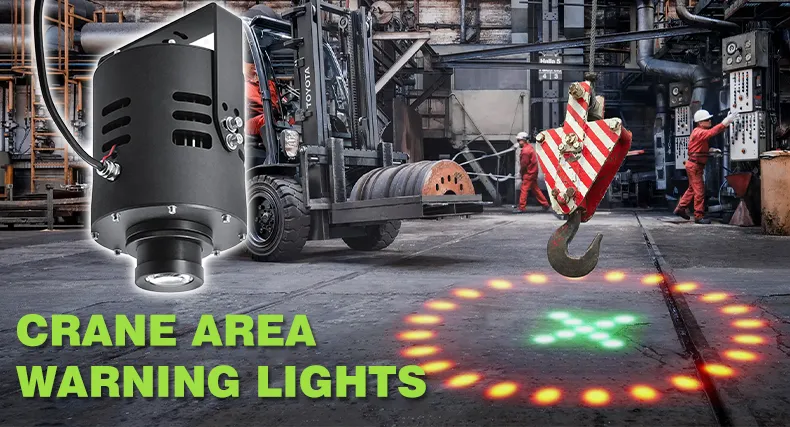
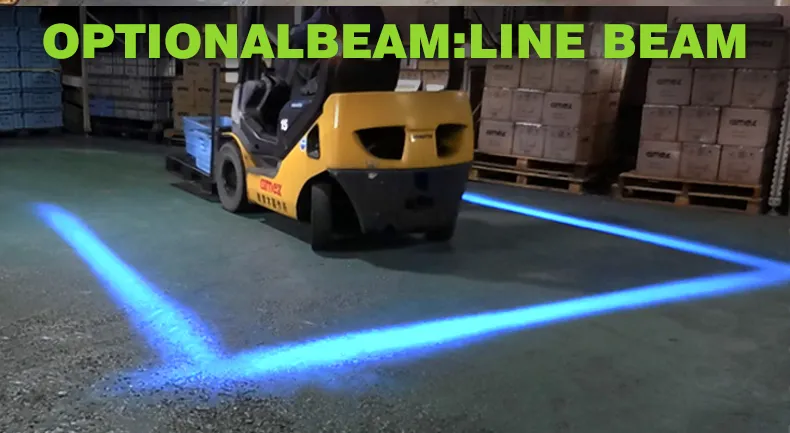
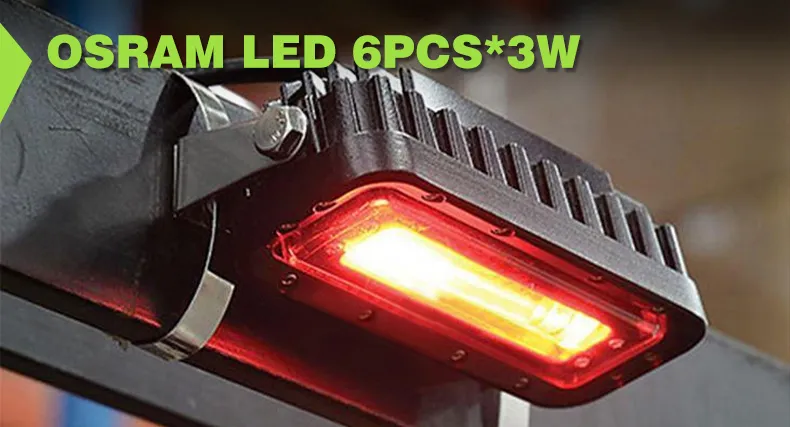
Where the sweep radius of the mast or the counterweight is the hazard, a red zone light paints a boundary on the floor around the moving truck. Laser line projectors go further: they draw a crisp, high-contrast line that stays visible in bright ambient light and at distance, which is where LED spots wash out. Per-truck cost climbs to the mid hundreds. This tier is what a warehouse needs when the aisles are narrow, the racking is high, or the trucks frequently reverse through pedestrian crossings.
Tier 3 — AI pedestrian detection
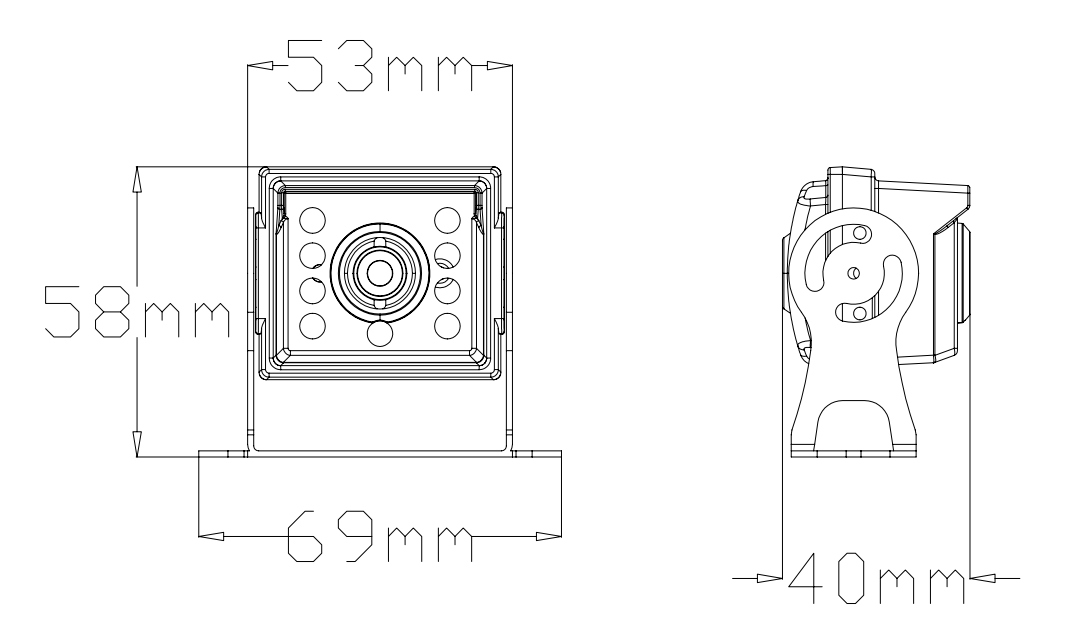
The XRLL XRL1341 system uses three AI cameras for 360-degree coverage, identifies a person at 6 to 7 metres and fires an audio-visual alarm to both the operator and the pedestrian before contact. It is IP67 sealed for the truck environment and aligns with OSHA 1910.178 documentation requirements. Per-truck cost is in the low thousands, roughly five to ten times tier one, but the accident-reduction profile is categorically different: tiers one and two give the pedestrian a warning, tier three gives both parties an intervention window even when the pedestrian is not looking.
| Tier | Per-Truck Cost (USD) | Fleet of 25 (USD) | Install Time per Truck | What It Solves |
|---|---|---|---|---|
| Tier 1 — Blue spot | 100 to 300 | 2,500 to 7,500 | Half a day | Aisle-end and doorway advance warning |
| Tier 2 — Red zone / laser line | 300 to 800 | 7,500 to 20,000 | Half to full day | Sweep envelope visibility, narrow aisles |
| Tier 3 — AI detection (XRL1341) | 1,500 to 3,000 | 37,500 to 75,000 | One to two days | Intervention window when pedestrian is not looking |
The per-truck numbers above are hardware-only. Add roughly 15 percent for wiring harnesses, mounting brackets and voltage converters on older trucks, and another 10 percent if you are running the install across multiple shifts. Most fleets land at a total installed cost 25 to 30 percent above the sticker price.
Building the Business Case: A Five-Year Model
The model has three inputs you already own and two you have to estimate. Own: current fleet size, current near-miss and recordable incident counts, current workers’ compensation premium. Estimate: reduction in incident frequency per tier, and how much of your insurance premium is experience-rated versus flat.
Worked example — a 25-truck regional distribution centre, three shifts, 18 recordable and near-miss forklift-pedestrian events per year, of which two are recordable. Workers’ compensation premium runs at USD 180,000 per year with an EMR of 1.15. The operations director is evaluating a tier two retrofit across the whole fleet at a total installed cost of USD 22,000.
| Year | Cumulative Cost (USD) | Cumulative Savings (USD) | Net Position |
|---|---|---|---|
| Year 0 (install) | 22,000 | 0 | -22,000 |
| Year 1 | 24,200 (maintenance) | 41,000 | +16,800 |
| Year 2 | 26,400 | 96,000 | +69,600 |
| Year 3 | 28,600 | 161,000 | +132,400 |
| Year 4 | 30,800 | 228,000 | +197,200 |
| Year 5 | 33,000 | 297,000 | +264,000 |
Where do the savings come from? Year one assumes a 40 percent reduction in near-miss frequency (from 18 events to 11), which cuts overtime reassignment, retraining hours and small first-aid cases. Year two adds the insurance effect: the EMR drops from 1.15 to 0.95 at renewal, and the premium falls by roughly USD 30,000 per year from that point onward. Year three onward assumes the recordable incident rate halves, avoiding one OSHA-recordable event every two years, which is priced at USD 60,000 in direct and indirect cost.
Sensitivity: what if the numbers are half as good?
Cut the near-miss reduction to 20 percent and the recordable-incident avoidance to one every four years, and payback still lands inside 24 months. The model is more sensitive to insurance loading than it is to hardware cost — a fleet that already runs a clean EMR below 1.0 will see a longer payback than a fleet with an EMR above 1.2, even on identical hardware.
What tier three adds
On the same 25-truck fleet, upgrading to tier three costs about USD 60,000 installed instead of USD 22,000. The payback stretches to roughly 30 months on the base case, but the tail-risk profile changes shape: AI detection addresses the incidents that tier one and tier two cannot, namely the pedestrian who is not looking, is wearing headphones, or is walking in a blind spot behind the mast. For a site with a documented fatality or serious-injury history, that tail-risk reduction is what tips the decision, and most operators in that position do not need the model to convince them.
Matching Retrofit Tier to Warehouse Profile
Not every warehouse needs tier three, and a subset of warehouses should not stop at tier one. Use the profile below to shortlist which tier fits your operation before you ask suppliers for quotations.
| Warehouse Profile | Recommended Tier | Why |
|---|---|---|
| Bulk storage, wide aisles, low pedestrian traffic | Tier 1 | Aisle-end warning covers the rare crossing event |
| Narrow-aisle racking, mixed manual and truck traffic | Tier 2 | Sweep envelope is the dominant hazard |
| Three-shift e-commerce hub, high pick density | Tier 2 + Tier 3 on high-risk trucks | Fatigue and shift change concentrate incidents |
| Cold storage, washdown, or outdoor yard | Tier 2 with IP68 upgrade | Environment kills cheap housings before LEDs dim |
| Site with prior recordable or fatality | Tier 3 fleet-wide | Tail-risk reduction is the primary objective |
| Customer-facing fulfilment with ESG audits | Tier 2 + telemetry | Audit trail is as valuable as the accident reduction |
Compliance, Insurance and the Paper Trail
A retrofit that is not documented does not count for the insurer, the regulator or the customer audit. Three sets of paperwork turn the hardware into evidence.
Product certification. CE and ROHS declarations for the EU and UK markets, E-mark (E9) for any fixture mounted on a vehicle that touches public roads, DOT for the United States, IEC 60825 classification if laser projection is part of the package, EN 62471 photobiological assessment for anything within arm’s reach of operators. ISO 9001 covering the manufacturing site — not the trading intermediary — is what an insurer’s underwriter will ask for.
Installation records. Per-truck voltage, mount location, torque values, harness routing and commissioning date. When an incident does happen, the first question an investigator asks is whether the safety light was installed correctly and functioning at the time. A signed installation record answers it before the interview starts.
Operational telemetry. Systems like the XRL1341 log detection events, near-miss timestamps and operator response. That data feeds the insurance renewal conversation with evidence rather than assertion, and gives the safety team a way to identify which aisles, which shifts and which operators are generating the risk.
Returns That Do Not Show Up in the P&L
Four benefits resist easy pricing but belong in the narrative that accompanies the model when you take it to the board.
Near-miss reporting goes up before it goes down. In the first three months after a tier two or tier three retrofit, most sites see a jump in reported near-misses. That is not a failure — it is the visibility working. Pedestrians and operators notice events they used to walk past. The near-miss log becomes a leading indicator instead of a lagging one, which is exactly what a mature safety culture needs.
Operator retention improves. Turnover among forklift operators in a tight labour market is expensive to replace, and exit interviews consistently rank “did not feel safe” in the top three reasons for leaving a warehouse job. A visible, working safety system is a retention signal that costs nothing beyond the retrofit itself.
Customer audits pass faster. Retail and pharma customers increasingly include warehouse safety in their supplier scorecard. Documented tier two or tier three coverage moves the score, and the score moves the tender outcome.
OEM and ODM flexibility. If your fleet is heterogeneous — mixed voltage, mixed mast configuration, mixed duty cycle — a manufacturer that can customize housing mold, beam pattern, projection pattern and logo means you standardize on one part number instead of maintaining three. That reduces spare-parts inventory and simplifies the training curriculum.
How to Structure the Procurement
Buying a retrofit is not the same as buying a consumable. Follow a three-stage process and the project stays on budget and on schedule.
- Pilot on three to five trucks. Pick the highest-risk aisle or the shift with the worst near-miss record. Run for 60 to 90 days. Log detection events, operator feedback, any hardware issues. The pilot gives you real numbers to plug into the sensitivity section of the model.
- Scale to the full fleet. Standardize the part number across the fleet wherever possible. Install during planned maintenance windows to avoid downtime. Train every operator on what the new lights mean and what to do when they see them.
- Document and revisit quarterly. Add the retrofit to the safety management system. Report near-miss and recordable trends to the leadership team every quarter. Revisit the tier decision annually; sites that start on tier one often graduate to tier two within 18 months as the data accumulates.
On the supplier side, ask three questions before you sign. Are you the manufacturer or the trader — and if you are the manufacturer, where is the plant, how big is it, and how many units do you produce per day? What is your quality control sequence — how many inspection stages, and can you show the test reports? What certifications do you hold for the exact model I am buying, not for a similar-looking sibling? A supplier who answers all three with specifics — plant address, machine count, daily output, named LED chip suppliers, patent portfolio — is telling you they built the product. A supplier who deflects is buying it from someone who did.
The XRLL warehouse and logistics solution covers the three tiers described above with per-truck hardware, installation guidance and the certification pack that goes with each SKU.
Building a Business Case for a Forklift Safety Retrofit?
Send your fleet size, current near-miss and recordable counts, insurance premium and site layout to XRLL. The sales team will respond within 24 hours with a tier recommendation, a five-year payback model built on your numbers, specification sheets, certification files and evaluation samples. Every unit ships from the company’s own Foshan plant — 17,000 m² facility, 17 machines, four assembly lines, daily output above 10,000 units — with CE, ROHS, E-mark, DOT, IEC 60825 and ISO 9001 documentation. OEM or ODM customization covers logo, beam pattern, housing mold and projection pattern.
Email: service02@xrlledlight.com · Phone / WhatsApp: +86-15818025687
Frequently Asked Questions
What is the typical payback period for a forklift pedestrian safety lighting retrofit?
On a 25-truck fleet with a moderate incident history, tier two retrofits typically pay back in 12 to 18 months and tier three in 24 to 30 months. The two variables that move the number most are your experience modification rate (EMR) at renewal and the frequency of near-miss events — the hardware cost is a smaller lever than most buyers expect.
Do safety lighting retrofits actually reduce insurance premiums?
Yes, indirectly. Insurers do not discount for hardware alone, but they do reprice your experience modification rate at renewal. A documented retrofit that cuts recordable incidents typically drops the EMR by 0.15 to 0.25 points within two years, which translates into a 15 to 30 percent premium reduction on a mid-sized warehouse policy. Bring the installation records and near-miss telemetry to the renewal meeting; assertions without evidence do not move the number.
Should I retrofit the whole fleet at once or start with a pilot?
Start with a pilot on three to five trucks in the highest-risk aisle or shift. Run it for 60 to 90 days, log detection events and operator feedback, then use the pilot data to tune the fleet-wide rollout. A pilot costs about 15 percent of a full-fleet retrofit and de-risks the rest of the budget. It also gives you real numbers for the sensitivity section of the business case, which is what the CFO actually wants to see.
Which certifications should I ask the supplier for?
CE and ROHS for the EU and UK, DOT for the United States, E-mark (E9) if the fixture is mounted on a vehicle that operates on public roads, IEC 60825 if any laser projection is part of the package, and EN 62471 photobiological assessment for anything within arm’s reach of operators. ISO 9001 should cover the manufacturing site itself, not just the trading company. Ask for the test reports behind the marks, not the marks alone, and confirm they apply to the exact model you are buying.
Is AI pedestrian detection worth the extra cost over blue spot and red zone lights?
It depends on your tail-risk profile. Blue spot and red zone lights give the pedestrian a warning; AI detection like the XRLL XRL1341 gives both the operator and the pedestrian an intervention window even when the pedestrian is not looking, is wearing headphones, or is in a blind spot behind the mast. For a site with a documented serious-injury history, three-shift operation or high pick density, the tier three cost is usually justified. For a low-density bulk storage site with a clean record, tier two is the right stopping point.
How do I tell a manufacturer from a trader when sourcing forklift safety lights?
Ask three specific questions. Where is the manufacturing plant, how large is it and how many units does it produce per day? What is the quality control sequence — how many inspection stages, and can you show the test reports? What is your patent portfolio and who supplies your LED chips? A real manufacturer answers with a plant address, machine count, daily output figure, named chip suppliers such as OSRAM or Cree, and a list of utility-model or design patents. A trader deflects or answers in generalities.


