How to Find a Reliable LED Work Light Manufacturer in China
Search the phrase led work light manufacturer and the results split into two very different kinds of seller: factories with die-cast presses and SMT lines, and trading companies with a brochure and a sourcing office. The difference rarely shows in the website — it shows only when a buyer knows which evidence to request and which questions make a reseller improvise. For distributors standardizing a lighting catalog, for equipment OEMs embedding lights into machines, and for fleet buyers tired of replacement cycles, the supplier decision sets a quality floor that no purchase order can later raise. This guide lays out the vetting method: how to tell the two seller types apart in a week of correspondence, which certificates to verify and how, what production evidence predicts unit ten-thousand matching unit one, and how a disciplined sample-and-pilot sequence protects the full-scale order.
Key Takeaways
- Manufacturer status is an evidence question, not a profile claim: ownership of tooling, placement machines and test stations — visible on a live video walkthrough of the exact line your order runs on — separates a factory from a reseller faster than any document exchange.
- Certificates attach to models and applicants: verify that the E-mark, DOT, CE or RoHS report numbers name the factory (or an authorized model family) rather than assuming a reseller’s listing inherits the original maker’s approvals.
- Quality is predictable only where it is tested: ask for the supplier’s full inspection chain — incoming chip authentication through pre-shipment gate — and which stations run per unit versus per batch, with the records behind them.
- Engineering depth decides what your second and third orders can become: beam design, voltage protocols, housing molds and projection patterns all require in-house optics, electronics and tooling capability, not a sourcing desk.
- A reliable China led work light manufacturer invites the awkward checks — video audit, named component brands, golden-sample retention — because process discipline is what they are selling in the first place.
Manufacturer or Middleman: The First Five Exchanges
The trade-versus-factory question answers itself in normal correspondence if you know what to listen for. Ask a technical question about beam design — where the hotspot falls at ten meters, whether the cutoff can be shifted for a specific mounting height — and a manufacturer’s sales engineer answers with optics language and constraints, while a middleman answers with “I will check with the engineer” and returns with the brochure restated. Ask which LED packages the fixture uses and press for the part series; genuine assemblers name OSRAM or Cree platforms the way XRLL documents across its range, because they buy those reels under account. Ask to see the line your order runs on, on a scheduled video call, not a marketing video — a factory can put a phone on any station within the hour; a reseller discovers its own partner’s working hours.
Documents corroborate the conversation. A manufacturer’s business license shows a scope that includes manufacturing and a location in an industrial cluster; its certificates list it as the applicant or manufacturer; its mold drawings, reflow profiles and test records carry its own document numbers. When the names on the test reports belong to a different company than the entity invoicing you, you have found the supply chain’s real owner — which is not automatically disqualifying, but changes what your contract should say about substitutions, tooling and warranty backstop.
The Seven Vetting Checks, and What Each One Exposes
| Check | What to request | What it exposes |
|---|---|---|
| Live video factory audit | Scheduled call touring SMT, assembly, burn-in, sealing and QC stations — named stations, not a lobby walk | Whether anyone makes the product or merely moves it |
| Certificate verification | Report numbers and full PDFs for CE, E-mark, DOT, RoHS, IEC tests; check applicant names and model scope | Borrowed or expired approvals; variants outside certified scope |
| Component disclosure | LED package brand and series, driver topology, capacitor class, connector standard — in the quotation | Whether the price buys branded silicon or an untraceable substitute |
| QC program walk | The full inspection chain from incoming chip test to pre-shipment gate, with per-unit versus per-batch frequency | Sampling theater versus process control |
| Tooling and design capability | Who owns the housing molds; examples of beam patterns, voltage protocols or projection graphics developed in-house; patent list | Whether your custom idea is a project or a resale request elsewhere |
| Capacity and schedule evidence | Line count, shift pattern, current booking window, component stocking practice | Promised dates built on queues the supplier does not control |
| Reference behavior | How they handle your smallest awkward ask — a written warranty statement, a named reference account, a spec change on a sample | Partner discipline, or whatever the order desk can survive |
Reading a Chinese Lighting Cluster the Right Way
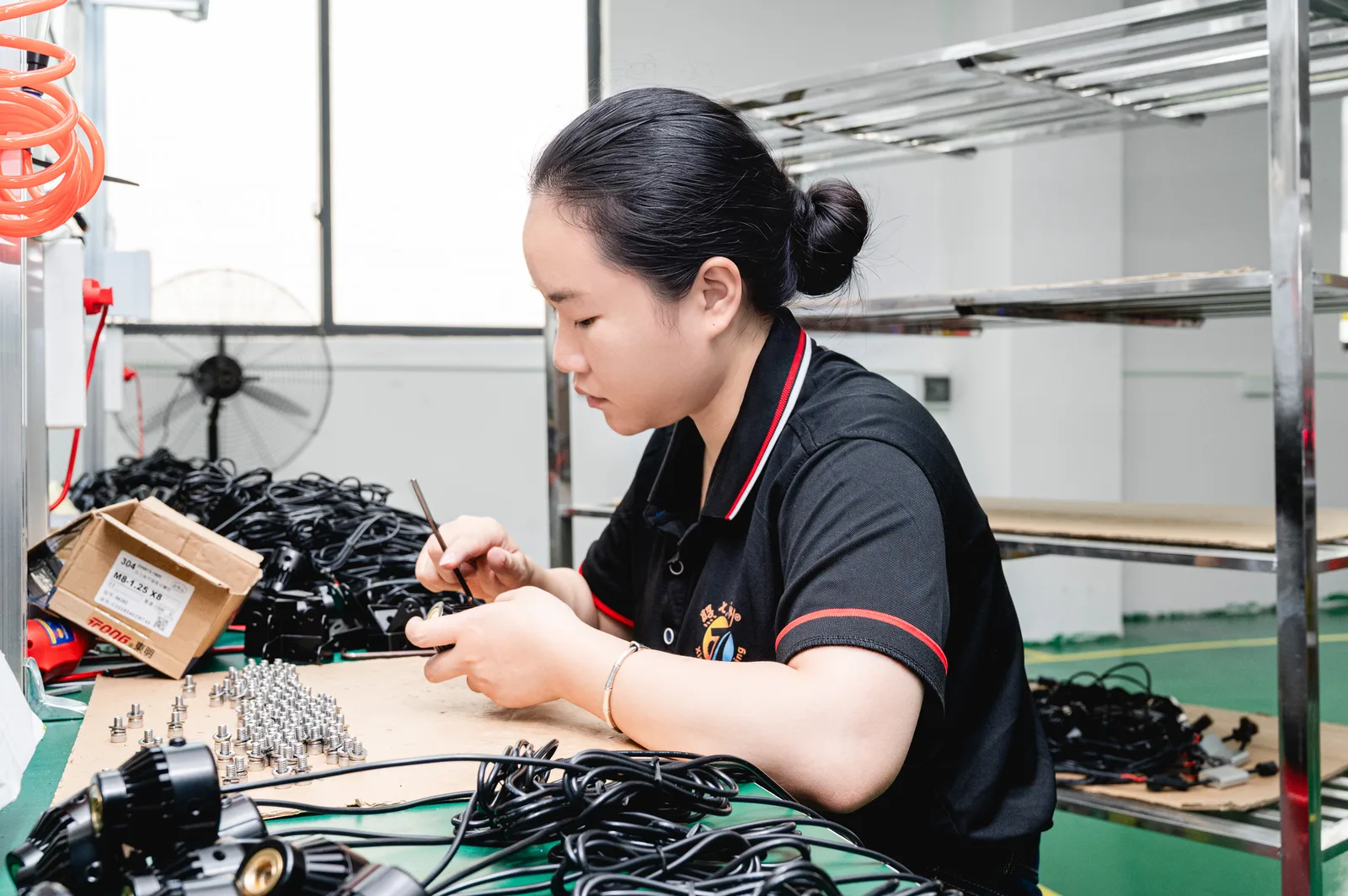
“Manufacturer in China” is not one market. The country’s vehicle- and industrial-lighting production concentrates in a small number of clusters, each with its own depth of suppliers — and the Pearl River Delta around Guangzhou and Foshan is where the component chain for heavy-duty fixtures (die casting, extrusion, drivers, LEDs, hardware) sits tightest. A fixture factory inside that chain can iterate a mold in days and replenish components within the week; one outside it pays freight and patience into every correction. XRLL, for example, was founded in Foshan in 2011 inside that supply ecosystem, and its vertical integration — in-house housing tooling on 17 production machines across 17,000 m² and four assembly lines — is the kind of capability the cluster’s depth makes possible.
Cluster position also makes the audit cheap. Within a day’s travel of any major lighting cluster, third-party inspectors and even your own staff can verify a facility exists at the scale claimed — the number of lines running, whether burn-in racks are warm, whether the QC stations in the brochure have operators at them. Ask any supplier where they sit on a map and whether an inspector can walk in this week; answers here predict audit honesty later.
What Engineering Depth Buys Your Second Order
Vetting checks screen for trust. Engineering capability determines what the relationship becomes after trust is established — and for OEM buyers this is the actual reason to contract a manufacturer rather than a catalog. Three tests separate the tiers. Ask for a different beam pattern on an existing housing: a real optics team discusses reflector versus TIR lens tradeoffs and timeline; a reseller asks you to take the catalog beam. Ask for a voltage protocol or connector your market requires: an electronics team can specify, validate and document the variant; a trading desk relays the request. Ask how they protect a design you co-develop: a manufacturer with 30-plus utility and design patents on file — and a practice of filing protection for customer programs — can answer with process; everyone else answers with assurance. The same logic applies to safety-forward categories like projected warning zones and AI pedestrian detection, where the supplier either designs systems or resells somebody else’s system.
Samples, Pilots, and the Discipline That Protects the Bulk Order
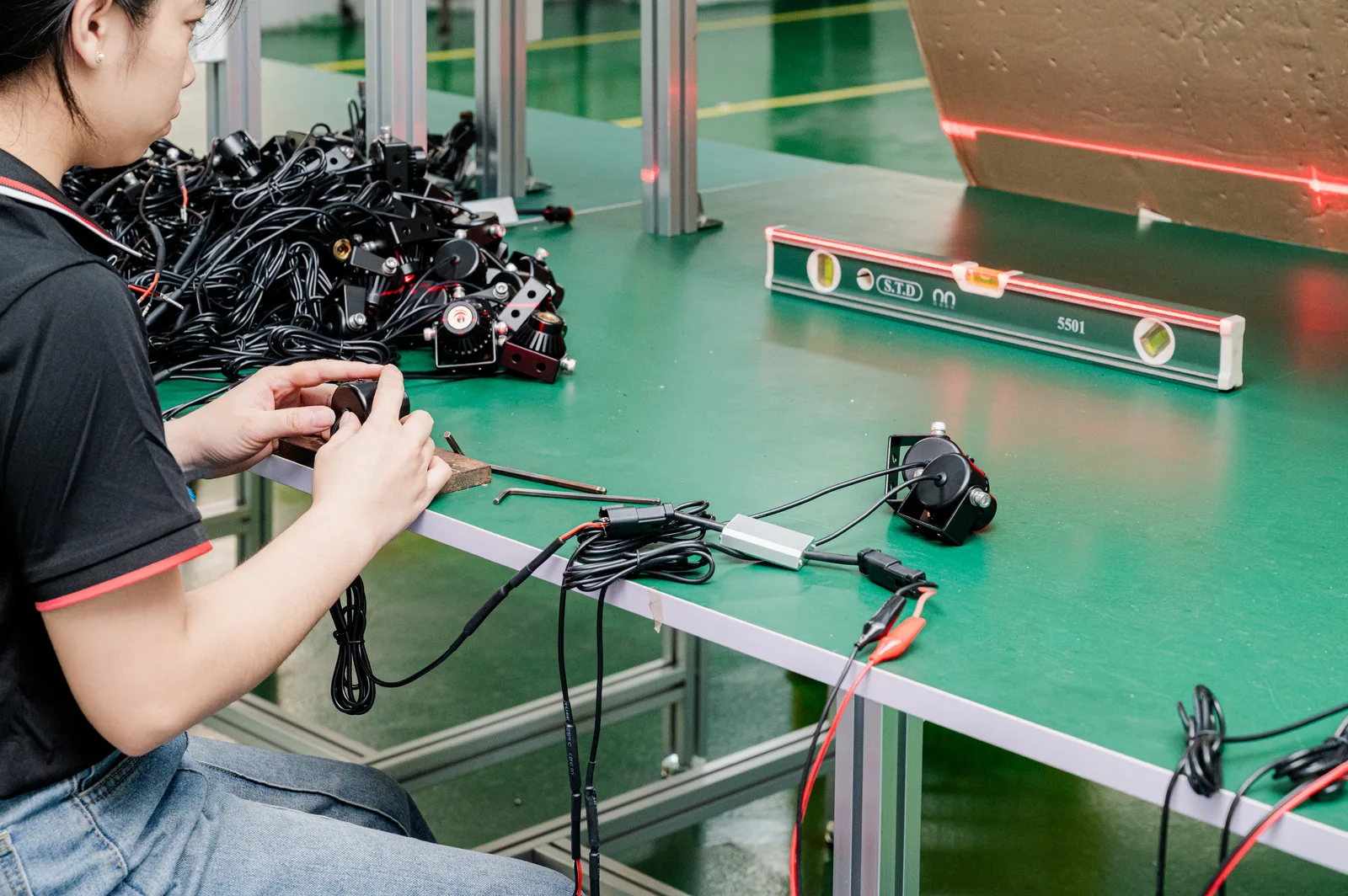
Every vetting signal above remains a promise until your own hands verify it. The sequence that works: evaluate first samples against the written specification — measured flux and beam rather than claimed, connector and harness fit, sealing and hardware under your mounting reality. Then require pre-production samples built on the actual line with production components, retained and signed as the golden reference for the order. Put pilot quantities through one full duty cycle in your application before committing the series. A manufacturer confident in its process treats this sequence as normal business — XRLL’s own program runs sample validation and testing before series production as standard. A supplier who resists sample discipline is telling you the sample and the shipment will not be the same product.
One quiet detail predicts reorders better than any single test: ask how the factory handles substitution — if a driver component or connector goes on allocation, does the engineering team validate a replacement and notify you, or does purchasing quietly swap it? Get the answer in the purchase agreement as a change-notification clause with your approval right. It costs one paragraph and is the difference between a supply relationship and a recurring surprise.

Writing the Shortlist Into a Decision
Run three or four candidates through the same seven checks and the field sorts itself quickly — usually down to two, rarely three, before the first sample round. Score the evidence, not the politeness: certificates verified by number, stations seen live on video, components named in writing, sample gates answered without friction. Then compare the survivors the way the buyers behind the fleet sourcing guide frame it — total cost of ownership across the replacement cycle, not the first invoice. And if the program is yours to build — your brand, your beam, your housing — start from how customization actually works, on the XRLL OEM/ODM program page, with the current engineered range documented on the LED work light product line.
Audit Us the Way You Will Audit Everyone
Send your vetting checklist to the XRLL desk — schedule the video line walkthrough, request certificate numbers for your destination markets, name the components and configuration your application needs, and set the sample gate. You will get a documented answer in 24 hours from a Foshan manufacturer running four assembly lines, nine QC stages and in-house tooling since 2011, serving buyers in 80+ countries, with OEM and ODM programs developed under the same discipline this guide recommends.
Email: service02@xrlledlight.com · Phone/WhatsApp: +86-15818025687 · Programs: xrllamp.com/oem-odm
Frequently Asked Questions
How do I verify a led work light manufacturer actually owns a factory?
Ask for evidence only a producer can generate on short notice: a live video call through the SMT, assembly, burn-in and QC stations at a time you choose; certificates listing the company as applicant rather than holder of copies; and document numbers of internal artifacts — mold drawings, reflow profiles, test records — that a reseller cannot produce. One scheduled video walkthrough disproves more factory claims than any certificate exchange, which is why genuine manufacturers agree to it immediately.
Which certifications should a work light manufacturer hold?
It depends on your market and mount, not on a badge collection. European vehicle mounting points toward E-mark type approval; U.S. on-road use involves DOT compliance; CE covers EU electrical and EMC directives; RoHS restricts hazardous substances; IEC-based laser safety applies to projected warning products; ISO9001 certifies the quality system rather than the product. What matters is scope: certificates attach to specific models and applicants, so verify report numbers against your exact configuration and destination markets rather than accepting a logo grid.
Is buying direct from a Chinese factory safer than using a trading company?
Direct is safer for specification and cost visibility, but only if the factory’s own commercial and documentation layers are export-experienced — contract terms, certification paperwork, change-notification discipline and claims handling are where thin factories struggle and good trading houses genuinely earn their margin. The practical middle path many importers use: contract with the factory directly on technical terms and component locks, while treating any intermediary’s value as documentation and logistics service to be priced separately, not a markup on the product’s identity.
What red flags predict a bad supplier relationship?
Four predict almost every downstream failure: refusal to do a live video audit; certificates whose applicant names differ from the invoicing entity without explanation; quotations that name no LED package or driver components; and sample resistance — the first sample perfect, the pre-production sample “same as before,” no golden-sample retention. Each one maps directly to a later surprise: substituted components, customs questions on documentation, spec drift between reorders. Treat reluctance at the vetting stage as the supplier’s own forecast.
How many manufacturers should I vet before ordering?
Three to four through the full process is the working norm. Fewer leaves you without a comparison baseline — quotes are only meaningful against identically specified competitors — and more dilutes the sample effort that actually decides the choice. Run all candidates through the same written specification, the same seven checks and the same sample gate; the shortlist that survives documentation honestly, not the one that discounts loudest, is the one that holds through the fifth reorder.


