IP67 vs IP68: Which Waterproof Rating Do Industrial Work Lights Need?
Two nearly identical work lights sit in a tender: one datasheet ends at “IP67”, the other at “IP68”, and the second costs eleven percent more. The buyer’s question is narrow but expensive — is that delta real protection or printed spec-sheet theater? Settling the IP67 vs IP68 question correctly means understanding what each rating’s laboratory test actually involves, what it does not cover, and which of your machines’ real-world abuse each rating was ever designed to survive. This article gives procurement managers a decision framework tied to washdown practice, storage conditions, and sealing design rather than to digits alone.
Key Takeaways
- Both ratings come from the same standard — IEC 60529 — and share full dust protection (the first digit, 6). They differ only in the water digit: IP67 is tested to 1 m immersion for 30 minutes; IP68’s test parameters are set and stated by the manufacturer.
- “IP68” without numbers is an unfinished sentence. Require the stated depth and duration — 2 m/24 h and 0.3 m/1 h are both literally IP68, and they protect very different investments.
- Immersion testing does not prove resistance to pressure washing. Jet resistance is a separate family of tests (the X5/X6/K ratings); the seal that survives a sink may fail a jet lance aimed at a warm housing.
- Seals age through thermal cycling, UV, and chemicals — the rating that matters is what the gasket does after two seasons, which is a materials and quality-control question, not a datasheet question.
- Rule of thumb: rain and occasional splash justify IP66/67; routine washdown, standing water, or fording risk justify IP68 with published test parameters and a potted driver behind the seal line.
Reading the Code: What the Two Digits of an IP Rating Mean
اللجنة الانتخابية المستقلة 60529 defines Ingress Protection marks as “IP” plus two digits. The first digit rates solid-object and dust protection on a scale to 6; أ 6 means no dust entry at all under test. The second digit rates water entry, from 1 (dripping) through 8 (continuous immersion). Where a manufacturer tests only one axis, an “X” fills the other — “IPX7” is immersion-tested but dust-untested, and deserves a follow-up question in any tender.
Crucially, every digit corresponds to one specific laboratory procedure: apparatus, duration, and conditions spelled out in the standard. The rating is not a general “toughness” score. It says the unit survived exactly one scripted event, and understanding that script is what makes the ip67 vs ip68 conversation useful instead of superstitious.
What the IP67 Test Actually Proves
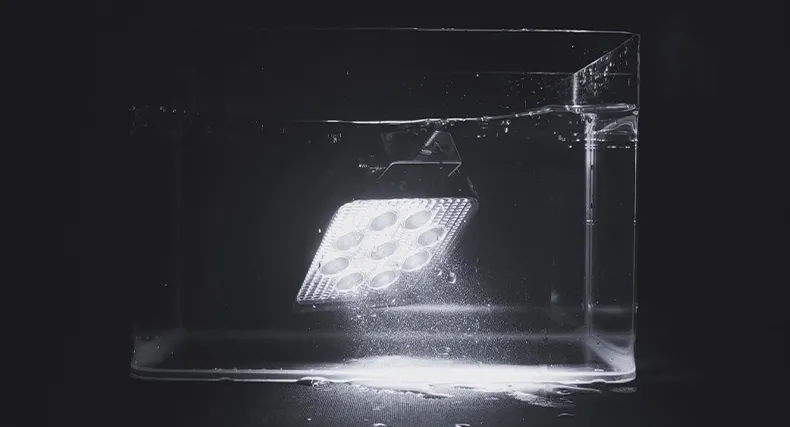
A device passes IP67 by sitting under 1 metre of water for 30 minutes, then showing no harmful ingress. The tank is calm, the water is room-temperature, the enclosure is at ambient temperature when it goes in, and — this detail gets missed constantly — the unit passes or fails based on visual inspection for water inside, not long-term corrosion.
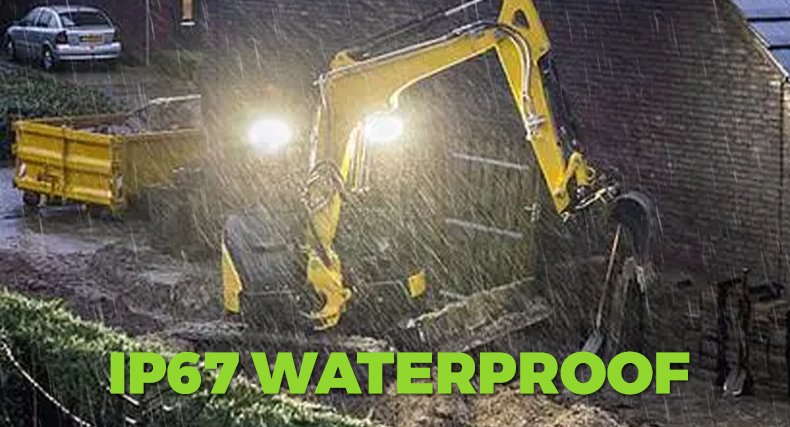
Translated to fleet reality, IP67 covers the genuinely common incidents: a machine parked through a storm week, a lamp dropped in a drain while washing the deck, fording a shallow crossing on a job site. For a tractor lamp that lives on a ROPS under a roof and sees rain, it is a meaningful, verifiable level of protection at the lowest cost that includes any immersion margin at all.
What IP67 does not prove: hot steam-driven suction as a housing cools, chemical attack on gaskets from detergent or slurry lime, or any pressure above hydrostatic head at 1 m. The physics of the failure is worth knowing: when a warmed housing cools after a washdown, it pulls a slight vacuum through whatever path the seal offers — and water sitting on the lens seam gets drawn in regardless of the immersion rating.
What IP68 Adds — and Why the Numbers Matter More Than the Digit
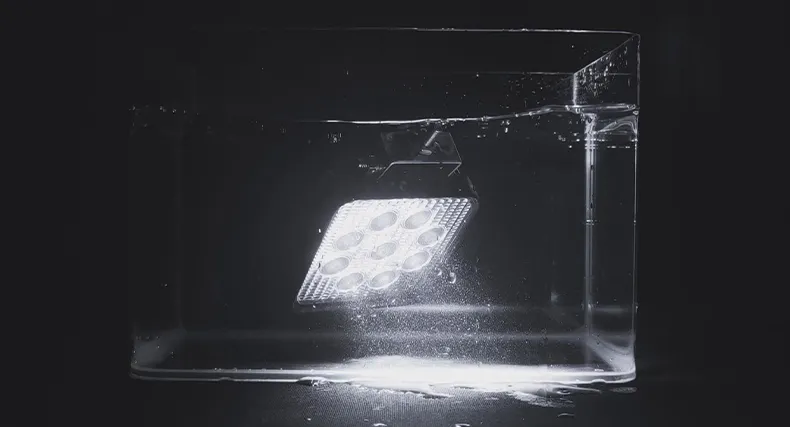
IP68 is defined by the standard as protection beyond 1 m, “at the option of the manufacturer,” subject to agreement with the user. That clause is the whole story: the digit alone proves nothing about depth or duration. A housing that passes 0.5 m for an hour and one that survives 3 m for a week both carry “IP68” on the box.
Two further realities separate honest IP68 designs from sticker-level claims:
- The seal architecture differs. Serious IP68 work lights use a compressed silicone or rubber gasket in a machined channel, ultrasonically welded or sealed cable entries, and often resin-potted drivers so that even an ingress event leaves electronics dry. A re-used IP67 gasket with a thicker compression pad is a parts-bin upgrade, not a design.
- The production test differs. A factory that seals to IP68 must verify every unit — typically a pressure-decay or immersion check on the assembly line — because seal performance is a tolerance game. At XRLL, sealing is a dedicated station in the nine-stage inspection chain: every sealed luminaire passes an IP68-class sealing test before it moves toward packing, which is why the company can state the rating as a production fact rather than a design aspiration.
IP67 vs IP68: Side-by-Side for Industrial Buyers
| Dimension | IP67 | IP68 |
|---|---|---|
| Standard test (اللجنة الانتخابية المستقلة 60529) | 1 m still water, 30 min, fixed conditions | Manufacturer-declared; must exceed 1 m and be stated in writing |
| Dust protection | Complete (digit 6) | Complete (digit 6) |
| Covers in service | Rain, splash, temporary submersion accidents | Prolonged submersion to stated depth, standing water, washdown splash with proper seal design |
| Does not cover | Jet-wash pressure, hot-water/chemical attack, suction on cool-down | Anything beyond its declared parameters; jets unless separately rated (X6/IPX9K territory) |
| Typical fit | Roof-mounted tractor and truck lamps, indoor yard equipment, covered storage fleets | Excavators and loaders washed daily, quarry and mining washing plants, snow and slurry duty, low-mounted units in standing water |
| Price signal | Baseline heavy-duty construction | Legitimately higher: better gaskets, potted electronics, 100% production seal testing |
| Buyer’s verification ask | Test report number and issuing lab | Declared depth/duration in writing + description of the inline sealing test |
The Ratings Nobody Compares: Jets, Steam, Dust Reality
Three adjacent marks settle most arguments the two digits hide:
IPX5/IPX6 (and 6K) — jets. Water projected from nozzles at defined pressure and distance. This is the family that models a pressure washer, and machines washed on a pad need it as much as immersion margin. Some suppliers quote IP69K for high-temperature, high-pressure underbody washing — relevant for food distribution and winter road fleets, rarely needed on earthmoving equipment.
IK — impact. A sealed lamp with a cracked polycarbonate lens is an expensive paperweight. Gravel-fall zones (quarries, demolition) deserve metal bezels or hardened lenses plus a stated IK value.
The dust digit in practice. Digit 6 is tested with talc at ambient temperature for up to eight hours. Quarry silica dust at 45 °C inside a housing that cycles hot-cold daily is a harder environment than the test; specify gaskets rated for the temperature range and check that the breather/drain provision exists on the housing you are actually buying.
Choosing by Duty Cycle: A One-Paragraph Answer per Environment
زراعة, above-roof mounting, seasonal use: IP67 is honestly adequate — weather plus the occasional power-wash of the implement end, with the lamp aimed away from the jet.
Construction and plant fleets with weekly washdown: IP67 at minimum, IP68 preferred; the failure you are buying against is detergent-hot ingress and cool-down suction at the cable gland, not deep water.
التعدين, quarry, aggregate washing: IP68 with published parameters, potted driver, sealed connector, metal bezel. Water is constant, abrasive, and chemically loaded; downtime is the dominant cost, and a lamp change-out in a pit takes hours the machine could have dug.
Municipal and winter-service vehicles: salt spray plus underbody washing puts the electrical side under the harshest cycle in any fleet — specify IP68 on everything below the beltline.
Within one supplier, ratings usually split across housing families, so match the SKU line to the duty rather than forcing one digit everywhere — the LED work light range page is where a manufacturer’s sealed designs and their tested ratings should be documented per model.
Five Questions That Cut Through Datasheet Claims
- “Which lab issued the IP test report, and what is the report number?” Real tests have paper trails; check the certificate against the issuing body’s register.
- “What depth and duration does your IP68 claim mean, in writing?” The answer — or the reluctance — tells you everything.
- “Is the driver potted, and what seals the cable entry?” Gland quality and potting decide more field failures than the lens gasket.
- “Do you seal-test production units, each one or by batch?” A manufacturer with an in-house sealing station will answer in one sentence. At XRLL this is station four of the nine-stage chain, run on sealed designs before downstream aging and vibration tests.
- “What happens to the seal across the temperature range?” Ask for the operating range and aging story; thermal cycling is where nominally identical gaskets diverge after eighteen months.
Get the Sealing Story Before the Price
Send your duty-cycle description — washdown practice, mounting position, climate — to the XRLL sales desk and receive a rating recommendation with the supporting test documentation, including the IP68 sealing-test protocol run on every sealed design, within 24 ساعات.
بريد إلكتروني: Service02@xrlledlight.com · Phone/WhatsApp: +86-15818025687
FAQ
Is IP68 always better than IP67 for work lights?
Not automatically. IP68 certifies manufacturer-declared immersion beyond 1 m, but a sloppy IP68 gasket design can age worse than a well-built IP67 with quality silicone and a sealed gland. Rate the environment first: if machines are never washed or submerged, IP66/67 weather protection is fully sufficient, and the IP68 premium is better spent on potting, lens hardness, or connectors.
Can I pressure-wash an IP68-rated lamp?
Immersion rating alone does not certify jet resistance — that is what X5/X6 (or 6K/69K) marks cover. An IP68 unit with a good gasket tolerates brief incidental spray, but directed hot jets at close range exceed any immersion test’s physics. Keep the lance off lens seams, cable entries, and breathers regardless of digits, and prefer suppliers who publish both water-ingress families on the datasheet.
What does “potted driver” have to do with the IP rating?
Potting fills the driver electronics in resin, so moisture that crosses the seal line — through an aging gasket or a wet connector — cannot bridge conductors. It converts a single-point sealing design into a two-layer defense and also improves thermal transfer and vibration endurance. On wet-duty fleets, potting quality predicts electronics survival better than the difference between the digits 7 and 8.
How do I verify a supplier’s IP claim during procurement?
Ask for the test report number and laboratory name, and check it with the issuing body; for IP68, require the declared depth and duration in writing. Then move from paper to process: how the factory seal-tests production units, what gasket material and temperature class it uses, and whether electronics are potted. A manufacturer that runs sealing as a station in its inspection line — as XRLL does across nine quality gates — answers these in one email; a reseller forwards the datasheet again.


