Warehouse LED Lighting Fixtures: Selection Criteria for Logistics Hubs
A distribution manager walks the floor at 6 a.m. and counts the dark spots before the shift starts: three high-bays out over the receiving dock, a flickering linear strip above the pack benches, an aisle in Zone C where the racking casts a shadow no ceiling fixture reaches. Every one of those gaps ends up on the same desk, and every one of them is a lighting decision. Warehouse LED lighting fixtures are not a commodity purchase. The right specification keeps pick rates stable, cuts the maintenance calendar from monthly to annual, and gives the safety team documented evidence that the operating environment meets the duty of care they signed up for. The wrong one shows up in a forklift near miss, an insurance audit, or a replacement order eighteen months after installation.
This guide is written for facility managers, logistics hub operators and EHS buyers who specify lighting for a building, not for a single task. It covers how a warehouse differs from any other indoor environment, the six zones that need different fixtures, the specifications that actually decide performance, the certifications that separate a documented product from a marketing claim, and the questions to ask a supplier before you sign a purchase order for five hundred units.
Key Takeaways
- Zone the building before you choose the fixture. High-bay, aisle, dock, cold storage, AGV corridor and charging room each need a different combination of lumen output, beam angle, ingress protection and mounting height.
- Efficacy beats raw wattage. Look at lumens per watt at the driver, not at the LED chip. A 150 lm/W fixture running ten hours a day pays for a premium over a 110 lm/W alternative inside two years.
- Ingress and impact ratings are non-negotiable. IP65 is the floor for indoor dusty halls, IP66 or IP67 for dock doors and washdown, and IK08 or higher anywhere a forklift mast can reach.
- Certification is a paper trail, not a logo. Ask for CE, ROHS, DLC listing, EN 62471 photobiological report and, where lasers are involved, IEC 60825 classification. A supplier who hesitates is telling you something.
- Mobile and mounted safety lighting is part of the plan. Forklift-mounted blue spots, red zone projections and AI detection systems belong in the same specification document as your ceiling fixtures.
Why Warehouse LED Lighting Fixtures Are a Different Purchase
An office buys lighting for comfort. A retail store buys it for merchandising. A warehouse buys it for throughput and safety, under conditions that would destroy a commercial-grade fixture in months. Four constraints make the specification harder than most buyers expect.
Mounting heights between 8 and 15 metres
High-bay storage typically sits between 8 and 15 metres to the ceiling, and modern automated facilities push past 20 metres. Every metre of height costs light on the floor. A fixture that produces excellent numbers at 6 metres may deliver less than half of them at 12 metres, and the only way to know is to ask for the photometric report and the candela distribution curve, not the marketing lumen figure.
Twenty-four hour operation with thermal cycling
Distribution hubs running three shifts keep fixtures energised for eighteen to twenty-two hours a day. Cheap drivers fail first, not the LED chips. Ask for the driver brand, the L80 lifetime at 25 °C ambient, and the operating temperature range. A quality fixture will hold 80 percent of its initial lumens past 50,000 hours; a poor one will be at 70 percent by 25,000.
Mechanical impact and vibration
Forklifts, order pickers and pallet jacks move through the same volume as the fixtures above them. Racking absorbs and returns vibration. IK08 impact resistance (5 joules, equivalent to a 1.7 kg mass dropped from 300 mm) is the practical minimum in any aisle where a truck can reach the housing.
Dust, humidity, cold and washdown
Ambient conditions vary inside one building. Dry goods storage might be 20 °C and dusty. Cold storage runs at −25 °C with condensation on every surface. Fresh food zones get high-pressure washdown twice a week. Each of those environments demands a different IP rating and a different housing material, and a single SKU rarely fits all of them.
The Six Zones Every Logistics Hub Lights Differently
A useful specification document treats the warehouse as six zones, not as one volume. Each zone gets its own fixture schedule, its own photometric target and its own maintenance interval.
Zone 1 — High-bay storage racks
Target 200 to 300 lux on the floor between racks, with vertical illuminance of at least 100 lux on the rack face so labels and barcodes read from the aisle. Round or square UFO high-bays in the 150 W to 200 W class, with a narrow beam (60° or 90°) mounted 10 to 15 metres up, are the workhorse. Choose a colour temperature between 4000 K and 5000 K and a CRI of 80 or better; anything warmer dulls barcode contrast, anything cooler reads as clinical and fatigues pickers on night shift.
Zone 2 — Aisles and picking lanes
Aisles need uniformity more than raw output. A ratio of minimum to average illuminance above 0.6 keeps shadow zones from forming between fixtures, which is where pick errors and near misses concentrate. Linear LED strips mounted parallel to the rack runs, or high-bays with a wide 120° lens, both work. In manual picking zones, a CRI of 90 or higher helps distinguish similar packaging colours.
Zone 3 — Dock doors and yard aprons
Dock doors are where indoor meets outdoor, and where weather, dust and vehicle exhaust all land on the fixture. IP66 minimum, IK09 preferred, and a housing rated for −30 °C to 50 °C. Yard aprons need wider distribution and higher output: 300 W to 500 W floodlights on 12 to 20 metre poles, aimed to keep light off neighbouring property lines and inside the truck manoeuvring envelope.
Zone 4 — Cold storage and washdown
Cold rooms at −25 °C need a fixture whose driver is rated for the same temperature as the LED module. Condensation is the enemy: IP66 is the practical floor, IP67 for washdown zones. Stainless steel or polycarbonate housings survive cleaning chemistry that will corrode painted aluminium inside a year.
Zone 5 — AGV and robot corridors
Automated guided vehicles read floor markings, LiDAR returns and overhead cues. Flicker from a poorly designed LED driver can confuse vision systems; choose fixtures with a flicker index below 0.1 and a frequency above 1 kHz. Avoid strobe effects entirely in AGV corridors, and keep amber warning beacons out of the same sightline as navigation sensors.
Zone 6 — Charging rooms and battery bays
Lead-acid battery charging releases hydrogen. Many jurisdictions require ventilation-first design and, where a hazard classification applies, fixtures rated for the corresponding zone. Even in unclassified rooms, sealed housings and corrosion-resistant materials extend service life dramatically.
Specifications That Actually Decide Performance
Every supplier quotes lumens. Very few hand over the full specification set that predicts how the fixture will behave in year three. Ask for all eight columns below in writing.
| Specification | What Good Looks Like | Why It Matters |
|---|---|---|
| Efficacy (lm/W) | 140 to 180 lm/W at the driver | Drives energy cost; the biggest lever on total cost of ownership |
| Lumen maintenance | L80 ≥ 50,000 hours at 25 °C | Predicts when output falls below the design target |
| Beam angle | 60°, 90° or 120° matched to mounting height | Controls uniformity and glare; wrong angle wastes lumens on the rack tops |
| Colour temperature | 4000 K to 5000 K for storage, 3000 K to 4000 K for offices | Balances barcode contrast with visual comfort on long shifts |
| CRI | 80 minimum, 90 in picking and QA zones | Colour accuracy affects pick error rates on similar packaging |
| Ingress protection | IP65 indoor, IP66 dock and cold, IP67 washdown | Seals out dust and water; the failure mode is corrosion, not burnout |
| Impact resistance | IK08 minimum, IK10 in forklift traffic | Protects against mast contact, thrown shrink wrap and falling debris |
| Driver and warranty | Named-brand driver, 5-year warranty minimum | Driver failure is the most common warranty claim |
Two specifications get less attention than they deserve. The first is flicker: a low-frequency driver produces a stroboscopic effect that fatigues operators and can trigger photosensitive reactions. Look for a flicker index below 0.1 and a modulation frequency above 1 kHz, particularly in AGV zones and anywhere a rotating machine shares the space. The second is dimming compatibility. Motion-sensor dimming in low-traffic aisles cuts energy use by 30 to 50 percent, but only if the driver supports 0-10 V, DALI or a wireless protocol your building management system can actually talk to.
Comparing the Four Fixture Families
Almost every warehouse LED lighting fixtures specification ends up combining four families. Understanding their roles keeps you from over-buying one and under-buying another.
| Family | Best For | Typical Wattage | Mounting Height | Watch Out For |
|---|---|---|---|---|
| UFO high-bay | Storage racks, aisles, bulk floor | 100 W to 240 W | 8 m to 15 m | Narrow beam creates dark pools between fixtures if spacing is off |
| Linear high-bay | Aisles, pack benches, QA stations | 80 W to 200 W | 4 m to 10 m | Longer housings catch more vibration; check mounting hardware |
| Floodlight | Dock aprons, yards, exterior | 200 W to 1000 W | Pole or wall, 8 m to 25 m | Light trespass complaints; specify a shielded optic |
| Task and mobile | Forklifts, order pickers, maintenance | 18 W to 90 W per unit | Vehicle-mounted | Voltage mismatch (12/24/48/80 V) and IP rating for the truck environment |
Beam patterns are a design decision, not an accessory
Whether you choose a flood, spot or combo beam depends on the task, not on the fixture catalogue. A spot beam concentrates light for long-throw applications such as yard floodlighting or aisle-end warning; a flood beam spreads light evenly across a wide area such as a pack bench or dock face; a combo beam puts a bright centre inside a wider halo, which is what most warehouse tasks actually need. Suppliers who cannot show you the candela distribution curves for each optic are selling you a lamp, not a lighting design.
Certifications and the Paper Trail Behind Them
A certification mark printed on a housing proves nothing on its own. What matters is the test report behind it, and whether the report covers the exact model you are buying rather than a similar-looking sibling. Every serious specification asks for the following documents at quotation stage.
- CE and ROHS declarations for the European Union and any market that mirrors the directives, including the UK under UKCA.
- DLC listing for commercial rebates in the United States and Canada. DLC Standard v5.1 or Premium is the current benchmark; Premium unlocks higher utility rebates.
- UL 1598 or UL 8750 for wet and damp locations in North America.
- EN 62471 photobiological safety assessment for the LED module, particularly in fixtures within arm’s reach of operators.
- IEC 60825 laser classification if any laser-based projection is part of the package.
- ISO 9001 covering the manufacturing site, not just the trading company.
- E-mark (E9 or another member state code) for any fixture mounted on a vehicle that operates on public roads, and DOT for the United States.
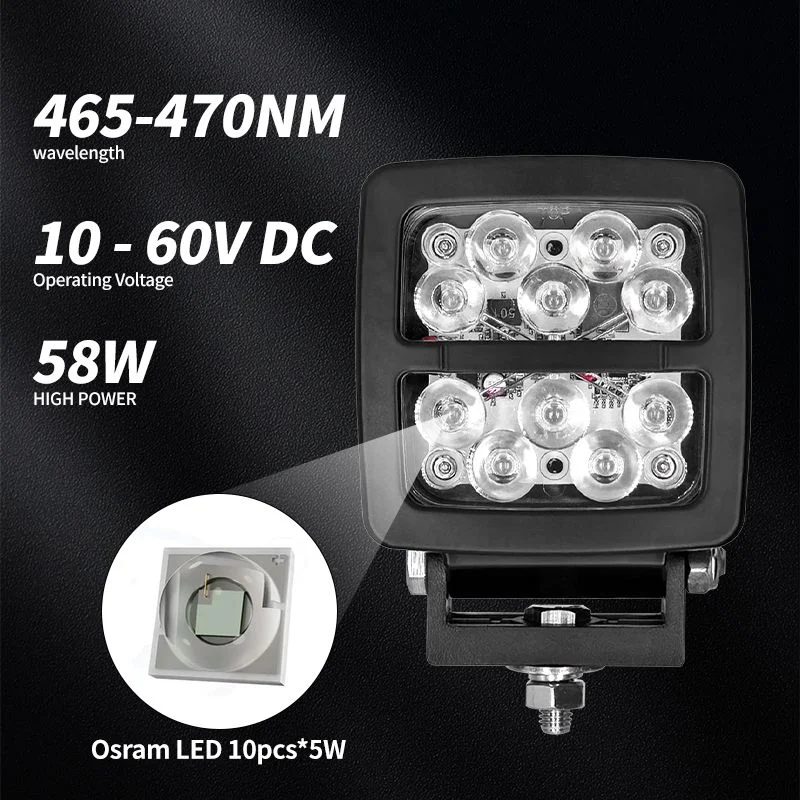
For fixtures that end up on a forklift rather than the ceiling, add IP67 or IP68 sealing verification and vibration test results to the list. A warehouse truck absorbs continuous shock; a fixture rated only for stationary indoor use will fail at the solder joints long before the LEDs dim.
The Forklift Layer Most Lighting Plans Miss
Ceiling fixtures light the room. They do not warn a pedestrian that a truck is rounding a blind corner, or mark the sweep radius of a swinging mast. That job belongs to the vehicle, and it belongs in the same specification document.
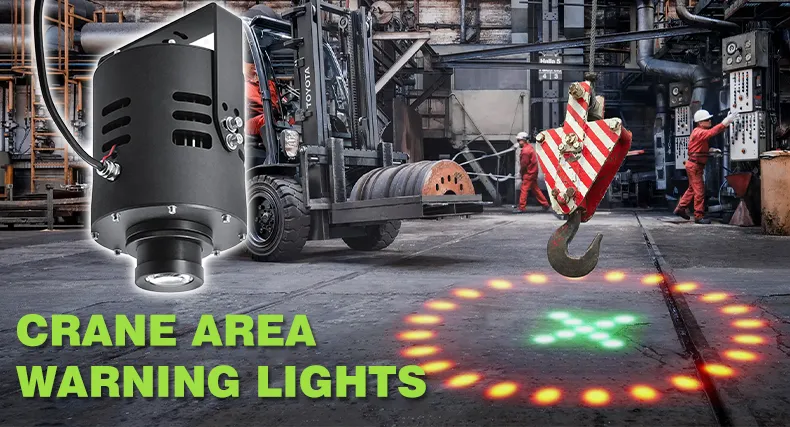
Three families of forklift-mounted lighting have become standard in modern logistics hubs. Blue spot lights project a saturated dot a few metres ahead of or behind the truck, giving pedestrians advance warning at aisle ends and doorways. Red zone lights paint a boundary around the moving vehicle, showing how much space the mast and counterweight will sweep. Laser line projectors draw a crisp boundary that stays visible at distance and under bright ambient light, which is where LED spots wash out. Where behaviour is harder to coach, an AI pedestrian detection system such as the XRLL XRL1341 uses three cameras for 360-degree coverage, identifies a person at 6 to 7 metres and fires an audio-visual alarm before contact.
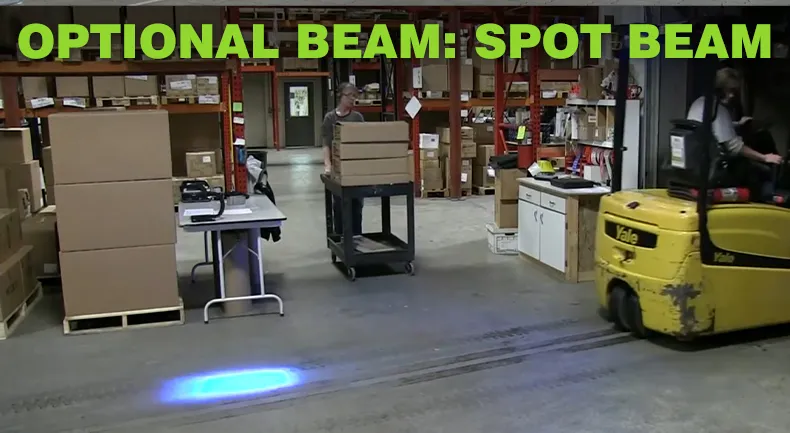
These units are specified differently from ceiling fixtures. They run off the truck battery, so voltage compatibility (12 V, 24 V, 48 V or 80 V) has to be confirmed. They live in the same dust, cold and washdown environment as the ceiling hardware, so IP67 minimum and IP68 for cold storage. They take vibration directly from the mast, so a vibration-tested housing and potting compound matter more than the lumen figure.
The XRLL warehouse and logistics solution pulls the ceiling layer and the vehicle layer into one plan, and the LED forklift light range shows how blue spot, red zone and AI detection options sit side by side for the mobile layer.
Manufacturer or Trader: How to Tell the Difference
Most suppliers on a sourcing platform will tell you they are a factory. Very few can prove it in a way that survives an audit. Three checks settle the question quickly.
Ask for the manufacturing site, not the sales office. A genuine factory will name the city, the plant size, the number of production lines and the daily output. XRLL has manufactured in Foshan since 2011, in a 17,000 m² plant with 17 machines, four assembly lines and daily output above 10,000 units. That kind of specific answer is harder to invent than a stock photo of a workshop.
Ask for the quality control sequence. Nine inspection stages is what XRLL runs per unit: incoming LED chip verification against OSRAM and Cree references, PCB and driver inspection, soldering and assembly checks, IP68 sealing tests, photometric and beam-pattern verification on an integrating sphere, high and low temperature ageing, vibration and shock tests, voltage and electrical safety tests, and a pre-shipment final check. A trader who cannot describe the QC sequence is buying from someone who can.
Ask for the patent portfolio. More than 30 utility-model and design patents, concentrated in laser projection, AI detection and matrix display technology, is what an engineering-driven factory looks like on paper. Patents matter because they show the company developed the product rather than rebranding someone else’s.
Two more signals worth checking. Chip provenance: quality fixtures name their LED supplier, typically OSRAM or Cree for demanding applications, and unbranded chips correlate strongly with early lumen depreciation. Customer footprint: over 5,000 B2B customers in more than 80 countries, with the United States, United Kingdom, Germany, Spain, Italy, Australia and Japan as core markets, tells you the company already handles export documentation.
A Practical Specification Workflow
The order of operations matters more than most buyers expect. Follow these six steps and the fixture schedule writes itself.
- Map the six zones on your floor plan. Mark mounting heights, ambient conditions and any special hazards (cold, washdown, hydrogen, AGV corridors).
- Set photometric targets per zone. Horizontal illuminance on the floor, vertical illuminance on rack faces, and a minimum-to-average uniformity ratio above 0.6.
- Request a lighting layout from at least two suppliers. Compare fixture counts, wattage totals and predicted uniformity, not just unit prices.
- Layer in the mobile lighting plan. Blue spots at aisle ends, red zones on high-mast trucks, laser lines in brightly lit halls, AI detection where pedestrian traffic is unpredictable.
- Collect the paper trail. CE, ROHS, DLC, UL, EN 62471, IEC 60825 where applicable, ISO 9001 for the site, and photometric files for every SKU on the schedule.
- Pilot before you scale. Order enough units for one zone, run them for 90 days, and verify the numbers against the design before committing to the full building.
Planning a Warehouse Lighting Retrofit?
Send zone drawings, mounting heights, ambient conditions and system voltages to XRLL and the sales team will respond within 24 hours with a fixture schedule, photometric layout, specification sheets and evaluation samples. Every unit ships from the company’s own Foshan plant with CE, ROHS, E-mark, DOT and ISO 9001 documentation, and OEM or ODM customization covers logo, beam pattern, housing mold and projection pattern.
Email: service02@xrlledlight.com · Phone / WhatsApp: +86-15818025687
Frequently Asked Questions
How many lumens do I need per square metre in a warehouse?
Storage and bulk floor areas typically target 200 to 300 lux on the floor, aisles and picking lanes 300 to 500 lux, and QA or pack benches 500 to 750 lux. Convert to lumens by multiplying the target lux by the floor area and dividing by the utilisation factor from the photometric layout, which usually falls between 0.5 and 0.7 for high-bay installations.
What colour temperature is best for a warehouse?
4000 K to 5000 K reads as neutral to cool white and delivers the barcode contrast pickers need. Below 3500 K the light looks warm and dulls label differentiation; above 5700 K it looks clinical and fatigues operators on long shifts. Match the colour temperature to the task, not to a fashion.
How long should warehouse LED lighting fixtures last?
A quality fixture holds at least 80 percent of its initial lumens past 50,000 hours at 25 °C ambient, which is roughly ten years at eighteen hours a day. The driver usually fails first, so a five-year warranty covering the whole unit, not just the LED module, is the practical minimum.
What IP rating do I need for a dock door fixture?
IP66 is the practical floor for a dock door: it seals against heavy rain and dust blown in by truck traffic. Move to IP67 for cold storage where condensation forms on every surface, or for washdown zones in fresh food operations.
Do warehouse LED lighting fixtures need to be dimmable?
Dimmable fixtures with motion sensors cut energy use by 30 to 50 percent in low-traffic aisles. Confirm the driver supports 0-10 V, DALI or a wireless protocol your building management system can talk to before you order; retrofitting dimming later means replacing drivers.
Should forklift safety lights be in the same purchase as ceiling fixtures?
Yes. The two layers solve different problems and are specified against different standards, but they belong in one lighting plan so the ceiling illuminance, aisle uniformity and truck-mounted warning coverage are designed together rather than bolted on afterwards. See the warehouse and logistics solution for how XRLL combines them.


