Emergency Vehicle Lights: SAE J845 Class 1 vs Class 2 vs Class 3
A procurement officer for a county fleet opens three quotes for warning beacons, and all three spec sheets say the same thing: “SAE J845 Class 2.” None of them explain what the class means, what it costs to step up or down, or why the fire department next door specifies a different class for its engines. The label is not decoration — it is the single most useful line on an emergency vehicle light datasheet, because it compresses photometric performance, intended operating speed and legal suitability into one grade. This guide unpacks that grade: what SAE J845 measures, how Class 1, Class 2 and Class 3 differ in practice, and how to map the classes onto the vehicles you actually buy for.
The comparison matters most to two groups. Public-sector buyers — municipal, county and utility fleets — who must match classes to state purchasing codes. And industrial fleet buyers, because the same three-class logic now shapes how forklifts, yard trucks and service vehicles are equipped for visibility, even when the standard itself was written for the road.
Key Takeaways
- J845 grades brightness, not quality. SAE J845 classifies warning lamps by photometric output — candela measured at defined test points. Class 1 is the brightest grade, Class 3 the lowest, with roughly a factor of two between steps at the primary measurement point.
- Each class targets a speed envelope. Class 1 exists for vehicles that demand attention at highway speed and in daylight — police, fire, ambulance. Class 2 suits service and utility work near traffic. Class 3 is for low-speed, off-road and site-internal duty.
- Class and color are separate decisions. J845 says nothing about red, blue or amber. Color authority comes from state and national regulations; the standard only grades how bright the lamp is.
- Underspecifying is a compliance risk; overspecifying is a cost. A Class 2 lamp on a police cruiser fails the visibility intent of state codes; a Class 1 lamp on a warehouse forklift wastes money and annoys the yard.
- Demand the test file per model. A class claim without a photometric test report is marketing. Suppliers who ship certification files with the quote — CE, E-mark (E9), DOT-referenced compliance, ISO 9001 factory audits — are the ones whose grade claims survive scrutiny.
What SAE J845 Actually Measures
SAE J845 is a performance standard published by SAE International (formerly the Society of Automotive Engineers) covering warning lamps for authorized emergency, maintenance and service vehicles. Its job is narrow and precise: define how much light a warning lamp must deliver, and in which directions, so that a buyer can compare products on a like-for-like basis.
The unit of measurement is the candela — the SI unit of luminous intensity. Test laboratories mount the lamp on a goniometer, fire it through its flash cycle, and record peak intensity at a grid of vertical and horizontal angles. The standard then sets minimum candela values per class at those test points. In round numbers familiar to fleet engineers, the primary-point minimums sit on the order of 500 cd for Class 1, half that for Class 2, and lower again for Class 3 — always confirm the exact values against the current revision of the standard, because the tables are periodically updated.
Three consequences follow from this measurement approach, and each one affects procurement:
Brightness is judged where it matters. A lamp can look dazzling face-on at one meter and still fail, because the standard cares about intensity at the angles from which approaching drivers actually see it — dead ahead, 10 degrees left, 45 degrees off-axis, and so on. A well-engineered optic spreads usable intensity across the grid instead of concentrating it in one flattering direction.
The flash cycle is part of the test. Modern warning lamps are flashing devices; the laboratory captures the peak during the flash. This links J845 to its companion standard SAE J595, which governs flash rate and pattern for flashing warning lamps. When a datasheet cites both, you know intensity and flash behavior were both held to a written yardstick.
The class is verified, not self-declared — in principle. The standard defines the test; reputable manufacturers run it at accredited laboratories and keep the reports. Your job as a buyer is to ask for them. More on that in the specification section below.
Class 1: The Highway-Grade Signal
Class 1 is the top of the J845 scale. Its minimum candela values are the highest of the three grades, engineered for one working condition: being seen early, at speed, in uncontrollable ambient light.
The vehicles that justify it are the ones the public expects to yield to — police cruisers, fire apparatus, ambulances, and authorized escort or incident-response vehicles. Two physics realities drive the requirement. First, closing speed: at a 130 km/h combined closing speed on a two-lane road, every extra second of detection distance is roughly 35 meters of stopping room. Second, daylight: full summer sun on a windshield can wash out a lower-grade lamp entirely, while a Class 1 output still registers in the driver’s peripheral vision.
Cost follows performance. Class 1 lamps demand higher-output sources, tighter optic tolerances and more aggressive thermal management to sustain peak intensity through long incidents. Municipal buyers pay for that — and for the discipline of reserving the grade for vehicles whose mission requires it. A public works department does not need Class 1 on a parking enforcement vehicle, and equipping one that way invites both glare complaints and budget questions.
Class 2: The Work-Zone Workhorse
Class 2 sits at the middle of the scale — roughly half the primary-point intensity of Class 1. It is the default grade for the vehicles that work near traffic rather than through it: tow trucks, utility service trucks, road maintenance equipment, refuse collectors, airport ground support, and municipal service vehicles of every description.
The operating logic is detection distance at moderate closing speeds. A worker in a cone taper needs approaching drivers to register the amber flash from 200 to 400 meters out, slow down, and move over. Class 2 delivers that envelope without the intensity — and expense — of the police grade. In most North American jurisdictions, state and provincial codes for service and utility vehicles reference this class explicitly, which is why “SAE J845 Class 2” appears on so many government purchase orders for amber beacons.
For industrial buyers, Class 2 is also the grade most often borrowed for site vehicles that share ground with public traffic at gates, weighbridges and yard approaches. It is bright enough for outdoor daylight visibility while staying tolerable to coworkers at close range — a balance Class 1 does not attempt.
Class 3: The Site-Internal Grade
Class 3 defines the lowest J845 intensity tier, aimed at vehicles that never share space with highway traffic: forklifts and reach trucks inside warehouses, terminal tractors, slow-moving mine and quarry equipment, agricultural machinery within farm boundaries, and groundskeeping vehicles on closed campuses.
Here the design priority shifts from raw detection distance to sustained tolerance. A lamp that must warn a pedestrian 20 meters away in a lit aisle does not need highway-grade candela — it needs a signal that is unmistakable at close range, day after day, without blinding the person picking orders in the next rack. Class 3 outputs live comfortably in that envelope.
This is the class where most industrial warning equipment naturally operates, and it is worth saying plainly: the majority of purpose-built industrial warning lights — blue spot projectors, red zone markers, LED strobes for forklifts and crane warning units — are engineered for exactly these low-speed, high-proximity conditions rather than for the public road. The J845 framework is a useful mental ruler for them even when a given product family is formally certified under industrial or automotive part standards instead, because the underlying question — how much light, aimed where, seen from how far — never changes.
Class by Class: The Comparison Table
| Dimension | Class 1 | Class 2 | Class 3 |
|---|---|---|---|
| Photometric intent (J845 primary test point) | Highest minimum candela — on the order of 500 cd | Roughly half the Class 1 minimum — on the order of 250 cd | Lowest tier — on the order of 100 cd |
| Designed detection envelope | Highway closing speeds, full daylight, hundreds of meters | Work zones and roadside duty, moderate distances | Site-internal speeds, tens of meters, controlled lighting |
| Typical vehicles | Police, fire apparatus, ambulances, escort vehicles | Tow trucks, utility and service trucks, road maintenance, refuse fleets | Forklifts, yard tractors, quarry and farm machinery, campus vehicles |
| Typical colors by usage custom | Red / blue where law reserves them for emergency services | Amber for work and service duty | Amber, blue or red per site convention |
| Cost and engineering burden | Highest — output optics plus sustained thermal management | Moderate — the volume grade, widest product choice | Lowest — close-range optics, compact housings |
| Procurement risk if mismatched | Overspend and glare complaints on low-speed vehicles | Noncompliance with state utility-vehicle codes if used where Class 1 is required | Insufficient warning if pushed into roadside work zones |
What the Class Does Not Tell You
Grading intensity is necessary but not sufficient. Four more variables decide whether a lamp survives and performs on your fleet, and none of them appear in the class number.
Color legality
J845 is color-blind. Whether your vehicles may show red, blue or amber is decided by state statutes in the US, provincial codes in Canada, and the applicable vehicle regulations elsewhere. The long-standing convention — red and blue reserved for sworn emergency services, amber open to work and service vehicles — is encoded in those legal instruments, not in the SAE document. Spec the class for visibility and the color for legality, in that order, and confirm both against your jurisdiction before award.
Flash behavior
How the intensity is delivered — steady burn, single flash, double flash, rotating emulation, synchronized patterns across multiple lamps — is governed by companion standards such as SAE J595 and by local practice. Pattern choice changes perceived urgency and how the lamp reads against daylight and background clutter. Fleets that synchronize rear lamps to flash together generally report stronger yielding behavior from following drivers than the same lamps firing in unstructured alternation.
Environmental survival
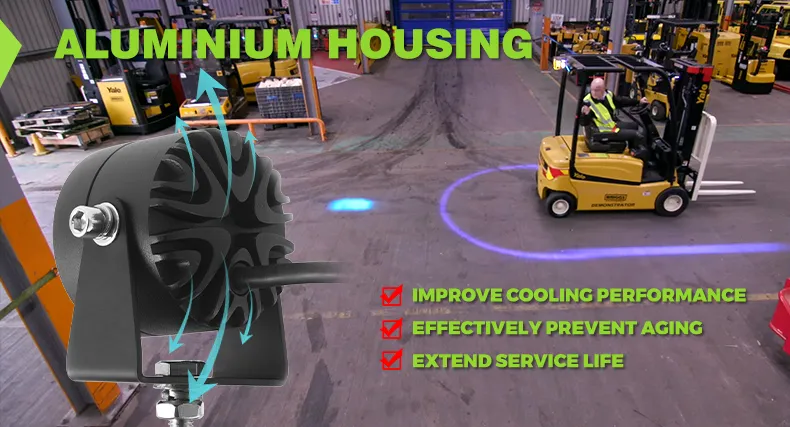
Photometric compliance is measured on a laboratory bench. Your lamps live on vibration, wash-down, salt spray and thermal cycling. The specification lines that predict survival are ingress protection (IP68-rated sealing for pressure washing and outdoor exposure), housing material, operating temperature range, and input voltage tolerance across the vehicle’s electrical states — cranking dips and charging peaks included. A Class 2 lamp that loses its seal in the first winter delivers zero candela in the second.
Certification chain
The class claim sits inside a wider compliance story. For road-going equipment in Europe, E-mark approval (issued under the E9 designation) is the entry ticket; for the North American market, buyers reference DOT compliance; CE and ROHS documentation covers the European market’s electrical and material requirements; an ISO 9001-certified factory quality system underpins batch-to-batch consistency. When a supplier can present this chain — laboratory photometrics for the class claim plus the market certifications for the markets you operate in — the paperwork stops being overhead and becomes a purchasing instrument.
How Industrial Fleets Should Use the Framework
Suppose you equip a distribution site: counterbalance forklifts inside the racking, yard tractors between the dock and the trailer parking, one service truck that leaves the gate for public roads. One visibility strategy will not fit all three, and the J845 classes give you a clean language for the split.
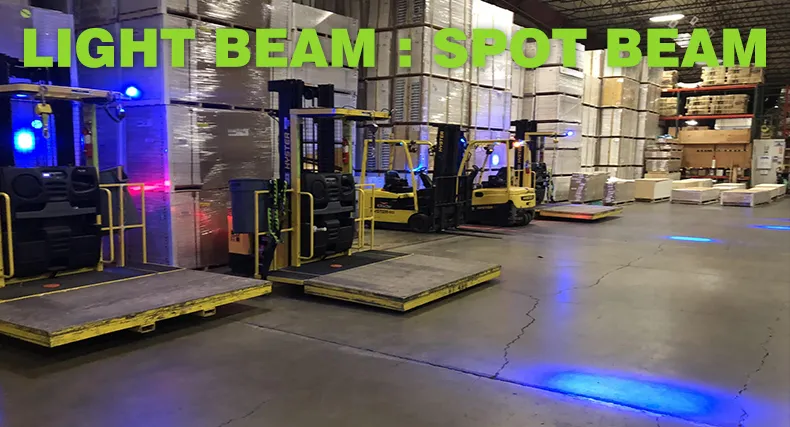
Inside the racking, the enemy is the blind corner at 8 km/h, and the proven answer is projection rather than flash: a blue spot or blue arrow thrown onto the floor ahead of the machine warns pedestrians before they can see the machine itself, and a red zone drawn beside the truck marks the footprint pedestrians must keep clear of. These are close-range signals in the Class 3 intensity world — engineered for recognition at walking distance, not for roadside daylight.
On the yard, ambient light is uncontrolled and vehicle speeds rise. This is where a genuine flashing beacon earns its mount — bright enough for outdoor daylight, flashing hard enough to pull attention at the trailer-park intersections. Equipment built to the Class 2 intensity envelope is the natural fit for vehicles that mix site duty with short public-road movements at gates and approaches.
On the public road, the service truck belongs to the regulated world: amber beaconing at the grade your jurisdiction references, plus the market certifications — E-mark or DOT as geography dictates — that let the vehicle pass inspection without argument. The lamp that satisfies the code on paper should also satisfy the physics: verified candela at the test angles, a housing that sheds pressure washing, and a supplier who answers specification questions with documents instead of adjectives.
That supplier discipline is exactly where an established warning-light manufacturer earns its place on the vendor list. A factory that runs its own photometric and environmental test sequence — verifying LED chips on arrival, checking drivers and PCBs, pressure-testing seals, measuring light output, aging units thermally, vibrating them, and inspecting again before shipment — produces grade claims you can forward to your safety authority without translation. XRLL, a Foshan-based manufacturer of industrial and vehicle warning lighting founded in 2011, builds its warning-light line on that nine-gate test discipline, with market certifications including CE, E-mark (E9), DOT-referenced compliance and ISO 9001, and supplies fleet customers across more than 80 countries from a 17,000 square-meter plant turning out over 10,000 lighting units a day.
The Specification Checklist
Before converting any quote into a purchase order for warning lamps, run the datasheet through this sequence:
- Class and jurisdiction. Write the required J845 class into the RFQ alongside the legal color for the vehicle’s role in your jurisdiction. Reject quotes that answer neither.
- Photometric test report. Request the laboratory report per model — candela at the defined test points — not a brochure claim. File it with the purchase record for audit.
- Market certifications. E-mark (E9) for European road duty, DOT-referenced compliance for North America, CE and ROHS documentation as the baseline, ISO 9001 for the factory behind them.
- Input voltage envelope. Match the lamp’s operating range to the vehicle’s electrical reality — 12/24 V compatibility covers most mixed fleets, but confirm cranking-dip tolerance on combustion vehicles.
- Sealing and housing. IP68 for wash-down and outdoor duty; die-cast aluminum housings over plastic where vibration and stone chips are part of the working day.
- Flash pattern options. Selectable patterns let one model serve indoor equipment softly and yard equipment assertively, which trims your spares inventory.
- Sample verification. Bench-test samples for start-up behavior, pattern accuracy and build quality before releasing the fleet order — a serious supplier ships evaluation units and answers questions inside a working day.
Specifying Warning Lights for a Mixed Fleet?
Send your vehicle list, operating speeds and jurisdiction to the XRLL team. Within 24 hours you will receive a per-vehicle-class recommendation — projection lights for indoor machines, beacons for the yard, road-legal units for the service fleet — with the certification file for each model and evaluation samples for your own bench test. OEM/ODM production is available for fleets that need logo branding, custom projection patterns or purpose-built housings.
Browse the full warning light range — strobe beacons, laser line projectors, blue spot and red zone systems, crane warning lights — then talk to the factory directly.
E-mail: service02@xrlledlight.com · Phone / WhatsApp: +86-15818025687
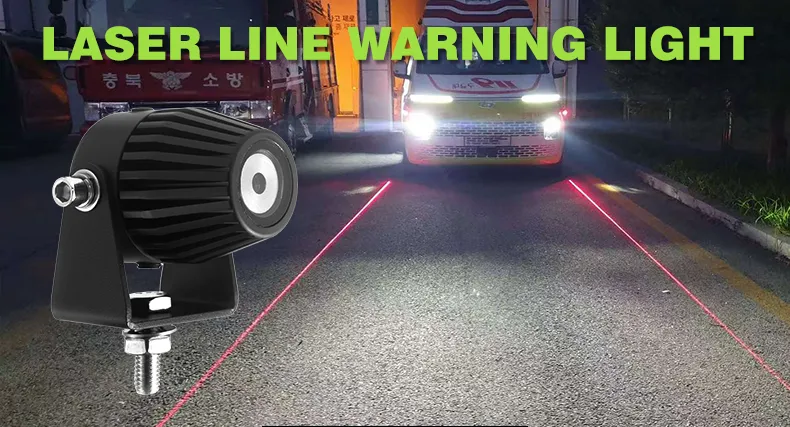
One more practical note for European readers: the same selection logic applies under the region’s own framework, where emergency and work lamps fall under ECE-style approval rather than the SAE document, and where the ambulance sector increasingly pairs beaconing with floor-projected laser lines to mark the vehicle’s working radius at incident scenes — a projection application the industrial world adopted first.
Frequently Asked Questions
Is SAE J845 a legal requirement or an industry standard?
SAE J845 is a voluntary industry standard, not a law. It becomes legally relevant because state and provincial vehicle codes, and many public purchasing specifications, reference it when defining acceptable warning lamps. When your jurisdiction cites a class, you are buying to the law through the standard.
Can I install a Class 2 lamp on a police or fire vehicle to save budget?
No — that substitution defeats the purpose of the grade. Class 2 intensity was engineered for moderate-distance visibility near traffic, not for highway closing speeds and demanding daylight conditions. Most codes that govern emergency vehicles expect the highest grade, and an underspecified lamp weakens both the safety case and the agency’s liability position.
Which class applies to forklifts and warehouse vehicles?
Site-internal machines operate in the Class 3 intensity world — close-range signaling at low speeds in controlled lighting. In practice, most industrial warning lights for this duty are specified by function rather than by road-standard class: blue spot projectors for blind corners, red zone lights for pedestrian standoff distance, and compact strobes for crossings. Verify the product family’s own certifications (CE, ROHS, ISO 9001 factory) instead of expecting a J845 grade.
Does the class determine whether I can use red or blue lights?
Non. SAE J845 grades brightness only; color authority comes from state and national vehicle law. In most North American jurisdictions red and blue are reserved for sworn emergency services, while amber is the working color for service, utility and maintenance vehicles. Confirm color rules with your jurisdiction before ordering, and pair them with the class that matches your operating speed.
How do I verify a supplier’s class claim before ordering?
Ask for the photometric test report for the exact model and Revision level, showing candela at the defined test points, and check that the laboratory is identified and dated. Then check the surrounding certification chain — E-mark (E9), DOT-referenced compliance, CE, ROHS and an ISO 9001 quality system — and bench-test samples for build quality. A supplier who answers with documents rather than adjectives is one whose claims will hold up at inspection.


