Blue Forklift Safety Lights: How They Prevent Pedestrian Accidents
The shift supervisor reviews the near-miss log on a Monday morning and finds the same entry three times in six weeks: pedestrian stepping out of a doorway into the path of a reversing forklift, operator braking hard, no contact, both parties shaken. The aisle is straight, the ceiling lights are bright, the truck horn works. Nothing failed. And yet the pattern keeps repeating.
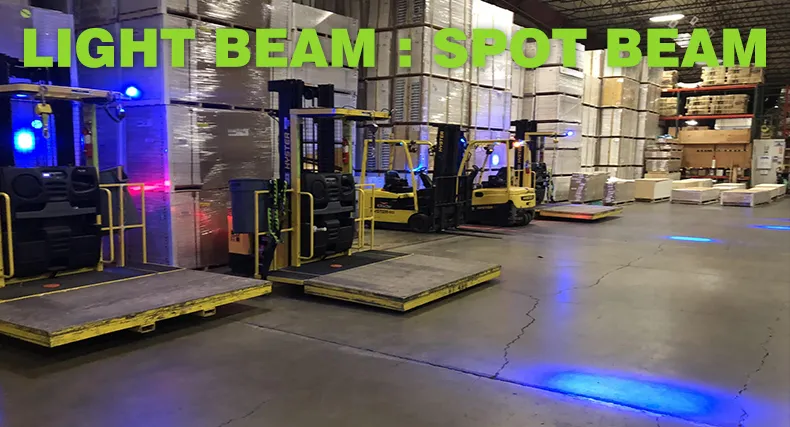
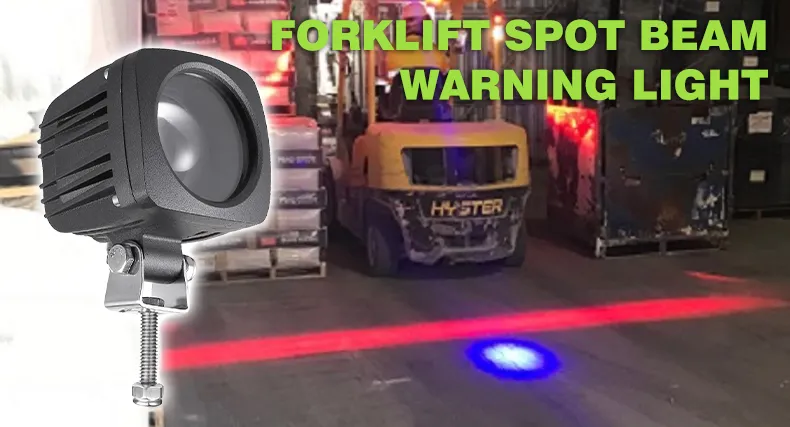
This is the accident class a blue forklift safety light is engineered to close. Not a horn, not a beacon, not a mirror — a focused blue LED projecting a saturated dot on the floor two to five metres ahead of the truck, giving the pedestrian a visual cue that arrives before the vehicle does. The technology is old enough to be proven and new enough that most warehouses still specify it incorrectly. This guide explains how the light works, what accident pattern it prevents, where to mount it, what it cannot do, and how to write a specification that survives an audit.
Key Takeaways
- Blue wins on contrast. Warehouses are a yellow-and-orange palette — cardboard, racking, pallet wood, amber beacons, safety vests. A saturated blue dot is the highest-contrast floor cue available in that environment.
- The warning window is two to three seconds. At a typical forklift speed of 8 km/h, a projection four metres ahead of the truck gives a pedestrian enough time to stop, step back or make eye contact with the operator.
- Mount position determines the accident class covered. Front mount closes aisle-end crossings, rear mount closes reversing encounters, dual mount covers both.
- A blue light is a warning, not a detection system. It cannot see around a corner, cannot alert a pedestrian wearing headphones, and washes out in direct sunlight. Layer it with AI detection or laser lines where those gaps matter.
- Specify the whole unit, not just the LED. IP67 sealing, vibration-tested housing, named chip provenance and the EN 62471 photobiological report are what separate a documented product from a marketing claim.
How a Blue Forklift Safety Light Actually Works
The product looks simple — a small LED housing with a lens, mounted low on the truck chassis, aimed at the floor. Three engineering decisions inside that housing are what make the projection visible in a working warehouse rather than a laboratory.
1. Saturated blue LED at 465 to 475 nm
The wavelength is chosen for contrast, not for aesthetics. A typical warehouse floor reads as grey concrete, tan cardboard, orange racking, yellow safety paint and the amber of a forklift beacon. Blue at 465 to 475 nm sits at the opposite end of the visible palette and produces the highest chromatic contrast against every one of those surfaces. A white spot would blend into the ceiling-light spill; a red spot would blend into the safety paint and the amber beacon; a green spot would blend into the exit signage.
2. Focused optic, not a flood lens
The projection is a dot, roughly 100 to 200 mm in diameter at four metres, not a wash of light. A focused optic concentrates the LED output into a narrow beam that holds its shape on the floor and stays visible under bright ambient light. A flood lens spreads the same lumens over a much larger area and produces a pale smear that a pedestrian walking with a pick list will not notice.
3. Sealed, vibration-tested housing
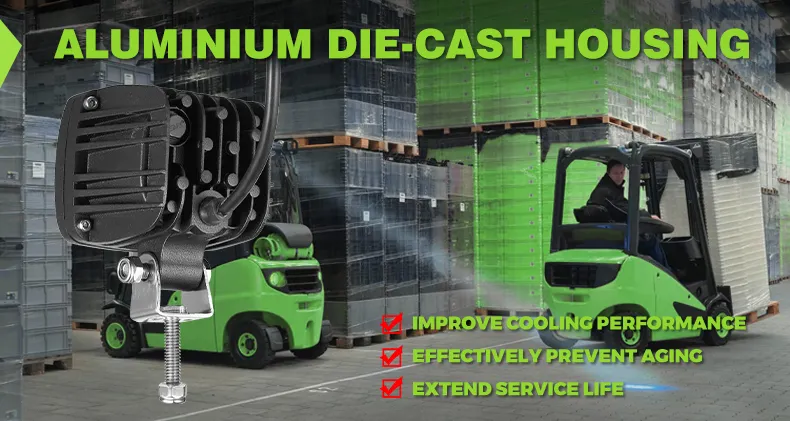
The unit lives on the chassis of a truck that runs three shifts, absorbs mast vibration continuously, and gets exposed to dust, condensation and the occasional impact from shrink wrap or a pallet corner. IP67 sealing is the practical floor; a machined aluminium housing with a potted driver board is what survives the duty cycle. A consumer-grade plastic housing will fail at the solder joints long before the LED dims.
The Accident Pattern Blue Lights Are Designed to Prevent
Forklift-pedestrian incidents cluster into four patterns, and each has a different failure mode. Blue lights close three of the four cleanly and partially close the fourth.
Pattern 1 — Aisle-end crossings
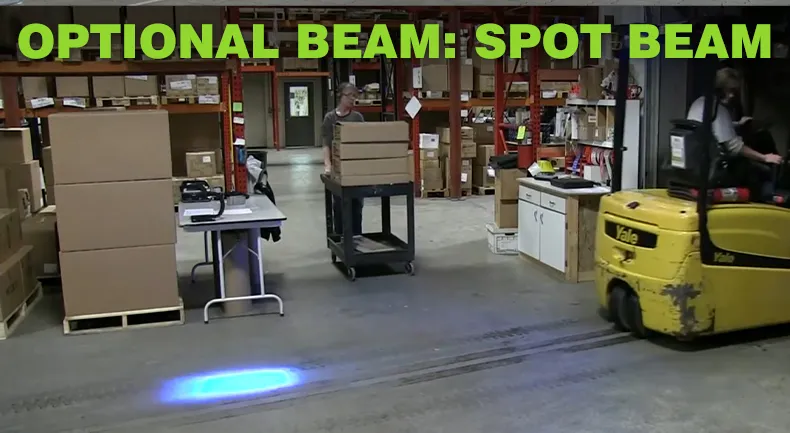
A pedestrian walks down a perpendicular aisle and steps into the main aisle just as a truck approaches the intersection. The pedestrian is looking at a pick list, a handheld scanner or the rack labels; the operator is looking forward at the load. Neither sees the other until contact is close. A front-mounted blue light projects the dot four to six metres ahead of the truck, into the perpendicular aisle, where it lands in the pedestrian’s peripheral vision as they approach the crossing. The colour contrast and the movement of the dot as the truck advances are what trigger the stop response.
Pattern 2 — Doorway and blind-corner encounters
A truck emerges from a loading dock doorway, a cold-storage vestibule or a corner where racking blocks the sightline. The pedestrian on the other side has no warning until the truck is already in the shared space. A blue light mounted low on the chassis projects ahead of the truck’s leading edge and appears on the floor of the doorway or the corner before the truck itself does. This is the single highest-value deployment scenario, and it is why most warehouses start with a front mount.
Pattern 3 — Reversing movement in shared traffic
A truck backs out of a rack position or reverses down an aisle toward a pedestrian crossing behind it. The operator is looking over their shoulder or at a rear-view camera, and the pedestrian behind the truck is often out of the mirror’s field of view. A rear-mounted blue light projects behind the truck and gives the pedestrian a warning that arrives before the counterweight does. Reverse movement accounts for a large share of forklift-pedestrian incidents across industry data, and rear-mount coverage is the specific engineering control for it.
Pattern 4 — Blind-spot and non-attentive pedestrian
A pedestrian steps directly into the truck’s path from behind a rack upright, or walks with headphones on, or is looking at a mobile device. No visual warning can reach a pedestrian who is not looking. This is the pattern a blue light cannot close, and it is where an AI pedestrian detection system such as the XRLL XRL1341 becomes the right layer — three cameras for 360-degree coverage, detection at 6 to 7 metres, audio-visual alarm to both parties. Blue lights reduce the frequency of patterns 1 to 3; AI detection addresses pattern 4.
Mounting Position, Beam Angle and Projection Distance
Getting the hardware right is half the specification. Getting the mounting right is the other half. A premium blue light mounted in the wrong place performs worse than a mid-range unit mounted correctly.
| Mount Position | Beam Angle | Projection Distance | Accident Class Covered |
|---|---|---|---|
| Front, low on chassis | Narrow (10 to 15 degrees) | 4 to 6 metres ahead | Aisle-end crossings, doorway emergence |
| Rear, low on chassis | Narrow (10 to 15 degrees) | 3 to 5 metres behind | Reversing encounters, backing out of racks |
| Dual front and rear | Narrow both directions | 4 to 6 m front, 3 to 5 m rear | Full forward and reverse coverage |
| Mast-side, mid height | Medium (20 to 30 degrees) | 2 to 4 metres to the side | Lateral pedestrian traffic in wide aisles |
Front versus rear versus dual mount
Front mount is the default and the highest-value single deployment. If budget only allows one light per truck, mount it front-low and aim it four to six metres ahead. Rear mount is the second priority for fleets that reverse frequently — reach trucks working in narrow aisles, order pickers, and any operation where the truck spends more time backing than driving forward. Dual mount is the standard for a mature safety programme and roughly doubles the hardware cost but closes both accident classes with a single installation window.
Beam angle and projection distance are linked
A narrow beam (10 to 15 degrees) produces a tight dot at distance; a wider beam produces a larger but paler projection. For a forklift travelling at 8 to 12 km/h in a warehouse environment, the tight dot at four to six metres is the right trade-off. Anything wider washes out under ceiling lighting; anything narrower becomes a pinpoint that a pedestrian may miss entirely.
Where Blue Lights Fit in the Wider Warning-Light Family
A blue forklift safety light is one of five sub-types in the warning-light family. The other four — amber beacon, strobe, red zone marker and laser line projector — solve different problems. Blue lights are the right choice for the aisle-end and doorway crossing scenario; zone markers are the right choice for the sweep-envelope scenario; amber beacons are the right choice for long-range presence; laser lines are the right choice for bright ambient light where LED spots wash out. Most mature retrofits layer two or three of these sub-types rather than betting on one.
Compliance and the Regulatory Frame
A blue light is not a regulated product in the way a road-vehicle beacon is, but it does sit inside several regulatory frameworks that a warehouse safety manager has to satisfy.
OSHA 1910.178 is the operative standard for powered industrial trucks in the United States. It puts the duty on the employer to keep trucks separated from pedestrians and to document the engineering controls used. A blue light retrofit with installation records, per-truck commissioning dates and a training module for operators and pedestrians satisfies the documentation requirement.
EN ISO 3691 plays the equivalent role in the EU. It classifies forklifts and their safety equipment and requires that any aftermarket warning device does not interfere with the truck’s original safety functions.
ANSI/ITSDF B56.1 is the North American design standard for low-lift and high-lift trucks. It does not mandate blue lights but references them as an accepted engineering control for pedestrian separation.
Product-level certification. The unit itself should carry CE and ROHS for the EU and UK markets, an EN 62471 photobiological safety assessment (blue LEDs at close range are within the actinic UV and blue-light hazard evaluation scope), and an IP67 test report from an accredited lab. ISO 9001 covering the manufacturing site is what an insurer or a customer’s ESG auditor will ask for.
Limitations: What a Blue Light Cannot Do
Four limitations belong in any honest specification. Writing them down protects the buyer, the installer and the operator.
A blue light cannot see around a corner. It projects where the truck is pointing. If a pedestrian steps out from behind a rack upright at close range, the light has already passed them. This is the blind-spot class, and it is where AI detection closes the gap.
A blue light cannot alert a pedestrian wearing headphones. The cue is purely visual. In a warehouse where pickers routinely wear earbuds, the visual channel is degraded. Pair the light with an audible truck horn or an AI system that fires an audio alarm on both the truck and the pedestrian side.
A blue light washes out in direct sunlight. Outdoor yards, loading aprons and open-air storage lose the projection contrast under full sun. In those environments, a laser line projector is the right choice — it stays visible at distance and under bright ambient light where an LED spot fades.
A blue light does not replace training. The technology works only if operators understand what the projection means and pedestrians are taught to respond to it. A retrofit without a training module produces a floor covered in blue dots that nobody looks at. Budget for a two-hour operator briefing and a fifteen-minute pedestrian induction every quarter.
Layering with AI pedestrian detection
The XRLL XRL1341 uses three AI cameras for 360-degree coverage, identifies a person at 6 to 7 metres and fires an audio-visual alarm to both the operator and the pedestrian before contact. It is IP67 sealed for the truck environment and aligns with OSHA 1910.178 documentation requirements. On a site with a documented serious-injury history, three-shift operation or high pick density, the combination of blue lights plus AI detection addresses all four accident patterns rather than three.
Specification Checklist for a Blue Forklift Safety Light
Write the following eight lines into the purchase specification before you shortlist suppliers. A supplier who cannot answer all eight in writing is not the right supplier.
- LED wavelength: 465 to 475 nm saturated blue, with the chromaticity coordinates on the data sheet.
- Optic: focused beam, 10 to 15 degrees, producing a 100 to 200 mm dot at four metres.
- Ingress protection: IP67 minimum, IP68 for cold storage or washdown environments. Test report from an accredited lab.
- Voltage compatibility: 12 / 24 / 48 / 80 V DC across the same product family, with the driver brand named.
- Housing: machined aluminium with a potted driver board, vibration-tested to the truck duty cycle.
- LED chip provenance: named supplier — OSRAM, Cree or Lumileds — not “imported LED.”
- Certification pack: CE, ROHS, EN 62471 photobiological assessment, ISO 9001 covering the manufacturing site.
- Warranty and spares: multi-year warranty covering the whole unit, not just the LED module, with spare housings and drivers available on the same part number.
Supplier Selection: Manufacturer or Trader
Three questions settle the difference in one email exchange. Ask for the manufacturing site — city, plant size, machine count, daily output. Ask for the quality control sequence — how many inspection stages, and can you see the test reports for the exact model you are buying. Ask for the patent portfolio and customization capability — can the supplier modify beam pattern, housing mold or projection pattern to fit a heterogeneous fleet.
XRLL has manufactured LED vehicle and industrial lighting in Foshan, Guangdong since 2011, in a 17,000 m² plant with 17 machines, four assembly lines and daily output above 10,000 units. Nine inspection stages per unit — incoming LED chip verification against OSRAM and Cree references, PCB and driver inspection, soldering and assembly checks, IP68 sealing tests, photometric and beam-pattern verification on an integrating sphere, high and low temperature ageing, vibration and shock tests, voltage and electrical safety tests, and a pre-shipment final check. More than 30 utility-model and design patents concentrated in laser projection, AI detection and matrix display technology. Serving over 5,000 B2B customers in more than 80 countries, with the United States, United Kingdom, Germany, Spain, Italy, Australia and Japan as core markets.
The XRLL LED forklift light range includes blue spot lights, red zone markers, laser line projectors and the XRL1341 AI pedestrian detection system on a single voltage-agnostic product platform.
Evaluating Blue Forklift Safety Lights for Your Fleet?
Send your fleet size, aisle layout, ambient conditions and near-miss log to XRLL. The sales team will respond within 24 hours with a mounting recommendation, per-truck specification, certification files and evaluation samples. Every unit ships from the company’s own Foshan plant with CE, ROHS, E-mark, DOT, EN 62471, IEC 60825 and ISO 9001 documentation. OEM or ODM customization covers logo, beam pattern, housing mold and projection pattern.
E-mail: service02@xrlledlight.com · Phone / WhatsApp: +86-15818025687
Frequently Asked Questions
Why blue rather than red or white for a forklift safety light?
Contrast. A typical warehouse floor reads as grey concrete, tan cardboard, orange racking, yellow safety paint and amber beacons. Blue at 465 to 475 nm sits at the opposite end of the visible palette and produces the highest chromatic contrast against every one of those surfaces. White blends into ceiling-light spill; red blends into safety paint and the amber beacon; green blends into exit signage. Blue is the only colour that reliably stands out in the warehouse environment.
How far ahead of the forklift should the blue light project?
Four to six metres ahead for a front-mounted unit on a truck travelling at 8 to 12 km/h. That distance gives a pedestrian two to three seconds of warning — enough time to stop, step back or make eye contact with the operator. Shorter than three metres and the warning arrives too late; longer than seven metres and the dot loses intensity under ceiling lighting.
Do blue forklift lights need to be certified?
The unit itself needs CE and ROHS for the EU and UK markets, an EN 62471 photobiological safety assessment (blue LEDs fall within the blue-light hazard evaluation scope), and an IP67 test report from an accredited lab. ISO 9001 should cover the manufacturing site. A blue light mounted on a forklift that never touches a public road does not need E-mark or DOT — those apply to road-vehicle beacons.
Can I install a blue light myself or does it need a qualified technician?
A qualified technician. The install involves tapping into the truck battery at the correct voltage, routing a harness that survives mast vibration, and aiming the projection to the right distance and angle. A mis-aimed light produces a dot that lands on the rack face instead of the floor, or one that projects too close to the truck to give a warning window. Budget half a day per truck for a proper install and record the commissioning date, voltage and mount position for each unit.
Do blue forklift lights work outdoors?
Not well under direct sunlight. The projection loses contrast against a sunlit yard or loading apron, and the pedestrian cue degrades. For outdoor environments, specify a laser line projector instead — it stays visible at distance and under bright ambient light where an LED spot washes out. Blue lights are an indoor technology; the outdoor equivalent is a laser line or a high-intensity strobe.
What is the difference between a blue light and an AI pedestrian detection system?
A blue light is a passive warning — it projects a dot on the floor and relies on the pedestrian seeing it. An AI detection system such as the XRLL XRL1341 is an active intervention: three cameras scan 360 degrees around the truck, identify a person at 6 to 7 metres, and fire an audio-visual alarm to both the operator and the pedestrian before contact. Blue lights close the aisle-end and doorway accident classes; AI detection closes the blind-spot and non-attentive-pedestrian class that blue lights cannot reach.


