
Portable LED Work Lights: Rechargeable vs Corded for Job Sites
A night pour on a slab that has not been wired for power, a loading yard where the nearest outlet is 80 metres of trailing lead away, a rental fleet whose most-complained-about asset is the site light that dies at hour three of a twelve-hour shift — these are the real jobs behind a led work light portable purchase. The category splits into two power philosophies: battery packs that buy freedom and ration hours, and cords that buy unlimited runtime and cost you every metre of cable management. Site managers and equipment-rental buyers win by matching the philosophy to the shift pattern, not by choosing the brighter datasheet. This comparison lays out the runtime maths, the failure modes, and the specification lines that decide which portable lamp earns its place on your trucks.
Key Takeaways
- Runtime is the product. A rechargeable unit’s value is its usable lux at hour eight of a shift, not its peak lumens at hour zero — most batteries throttle output as charge falls and cold bites.
- Corded site lights trade battery anxiety for cable logistics: runs, trip hazards, generator fuel, and the 110/230 V question on international job sites.
- Battery cost is a three-year story: cycle life, replacement availability, and how the unit is stored between shifts decide whether cordless is cheaper per site-hour than a tower and a drum of lead.
- The hybrid pattern wins most tenders: one corded tower lighting the bulk of the site plus two or three cordless task units at the faces of work where people actually stand.
- Rental fleets should specify serviceability above brightness: swappable batteries, generic chargers, and a failure mode that is not “the whole lamp is the battery.”
The Dividing Line: Where the Power Comes From at Hour Nine
Peak output is marketing; sustained output is procurement. A rechargeable portable rated 6,000 lumens new may deliver 70–80% of that late in a charge, and cold weather hits lithium capacity before it hits the LEDs. Meanwhile the corded tower on a generator throws the same light at 2 a.m. as at 6 p.m., limited only by fuel and the crew’s patience with noise. The first specification question is therefore temporal, not optical: what is the longest single lighting duty, and is mains or a genset reachable at that position?
Answer that before comparing any two models, because it partitions the market cleanly. Tasks under a shift’s worth of hours within walkable distance of storage — CCTV checkpoints, truck loading bays, inspection and maintenance corners, indoor fit-out — fall naturally to cordless. Area lighting for excavation at night, formwork pours, or a whole laydown yard falls to corded towers, usually 200–2,000 W metal-halide replacements in LED.
Rechargeable Portable Lights: What to Insist On
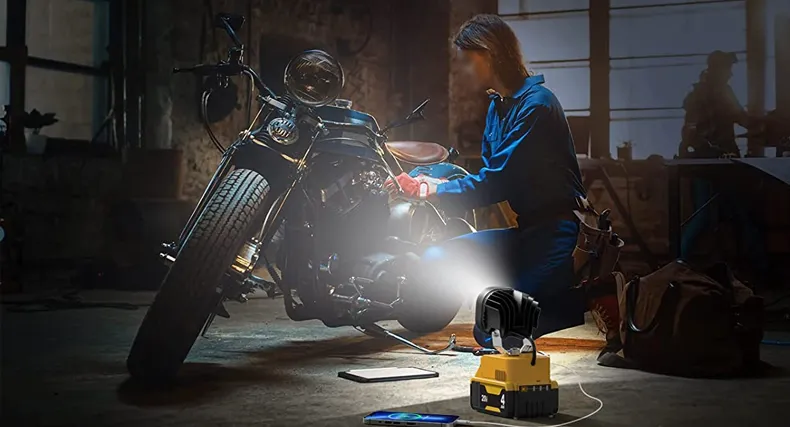
Battery architecture
Two designs wear differently. Integrated packs (the lamp and battery are one sealed object) are compact and weatherproof but become e-waste when the cells fade — typically after three to five hundred full cycles. Modular designs with a removable pack turn battery life into a consumable line item the way power tools solved it. For anyone buying more than a handful of units, ask the supplier for the cycle-life curve and the replacement pack price before the lamp price.
Runtime and dimming discipline
A 2-step or continuous dimmer stretches a pack further than its capacity spec — crews run 40% light on a perimeter watch and need full output only during active phases. Demand runtime stated per lumen step (e.g., hours at full versus hours at eco), not one optimistic number at a mid setting.
Cold performance
Winter outdoor duty is where portable lights develop opinions. Lithium charge acceptance drops near freezing, and a pack drained in a warm store shed and carried out at −5 °C will give up a visible share of its rated hours. Units meant for northern job sites state an operating range that includes discharge below zero; if the datasheet is silent, assume it is not weatherproofed in that dimension.
Shipping and compliance reality
Lithium-ion lamps are regulated freight. For import buyers, UN 38.3 test documentation (the standard transport safety qualification for lithium cells and batteries) is a baseline paperwork item alongside the lamp’s own electrical certifications, and packing instructions decide whether a container ships as full battery, equipment-with-battery, or low-state-of-charge. A factory that exports to 80+ countries assembles this paperwork as routine; an assembler trading domestic stock will discover your problem at customs.
Corded Portable Lights: The Unglamorous Dependability Case
Corded site lighting — tripods, mast towers, and heavy-base flood heads plugged into mains or a genset — has no runtime ceiling, no battery depreciation, and electronics simple enough that any maintenance electrician keeps them alive. Its costs are spatial and administrative: cable runs and protective matting over walkways, RCD/GFCI-protected circuits on wet sites, generator fuel and noise hours, and the theft profile of copper.
The practical planning numbers crews argue about: a 100 m run of correct-gauge cable is a real voltage-drop story (thin cable at distance dims lamps and stresses drivers), trip-rated bases matter more than lumens on wind-exposed hoarding lines, and a tower that folds into a hand-truck profile saves more labor per move than a 15% brighter one that does not.
One understated advantage of the corded camp is diagnostic simplicity. When a tower underperforms, the failure is visible — a burnt connector, a tripped RCD, a kinked core — and any electrician on site closes it the same shift. When a cordless unit underperforms, the cause is usually invisible chemistry: a pack that has lost a third of its cycles, a BMS that has cut discharge in the cold, or a charger that quietly stopped balancing cells weeks ago. Fleets that run both power types need both failure-response habits on the job-sheet, and fleets that run only cordless need a spot-check routine for pack health, not just lamp cleanliness.
Rechargeable vs Corded: Side-by-Side for Site Buyers
| Decision Dimension | Rechargeable Portable | Corded Portable / Tower |
|---|---|---|
| Single-shift coverage | Best at 6–10 h with an eco step; verify per-model runtime tables | Unlimited while fuel or mains lasts |
| Setup time per move | Seconds — carry, place, switch on | Minutes to tens of minutes: unroll, protect, test circuit |
| Peak output ceiling | Mid-thousands of lumens before runtime collapses | Tens of thousands — area lighting territory |
| Ownership cost driver | Battery cycle life and replacement packs | Cable inventory, generator fuel, theft of copper |
| Cold/wet sensitivity | Capacity drops in freeze; seal quality decides rain survival | Drivers and connectors hate water; RCD discipline mandatory |
| Rental-fleet fit | High demand, high abuse — needs swappable packs and charge-state turnaround policy | Steady workhorse revenue; returns include missing cable, not dead cells |
| Failure mode | Whole unit dark at shift end if charging discipline slips | Partial: one head or one cable out, rest of the run stays lit |
The Hybrid Layout Most Sites Actually Want
Ask crews which light they miss first and the answer is rarely the tower — it is the lamp at the face of work. The cost-effective pattern is one corded tower (or a shared genset circuit) covering general area, plus two or three cordless task units placed at the working face, in vehicles, and at gate points. The tower solves lux over area; the battery units solve lux at the hands. Specifying all-cordless inflates cost per delivered lux-hour; specifying all-corded charges the site in labor for every reposition.
For rental catalogues the same logic sets the fleet mix: towers for contract customers with long static hours, cordless compacts for the high-move, short-hire segment — and a charging/inspection routine between rentals that treats packs as consumables with a service life, exactly like batteries in any power-tool line.
Cost the layout in site-hours rather than unit prices. A cordless compact that saves thirty minutes of cable work per reposition pays for its battery replacement reserve within a season on a multi-move site; the same unit, left on a bench all week because nobody owns the charging routine, is a loss twice over — capital sitting idle and a night shift stopped for want of light. The buyers who get the arithmetic right put charging lockers and spare packs on the mobilisation list with the same seriousness as fuel for the genset.
Specification Lines That Settle the Purchase
- Runtime per lumen step, stated in hours at full and eco, at a rated temperature — the number datasheets hide most often.
- Ingress protection matched to storage reality. A site lamp lives in rain between uses; IP-based sealing is the minimum, and potted electronics behind the seal line separate pro units from consumer stock. Sealed designs on a real factory floor carry a per-unit sealing test in production — the station ahead of aging and vibration checks in XRLL’s nine-stage quality chain.
- Impact and stability: a stated IK class on the housing, a base that survives a knocked tripod, guards over the lens.
- Charging ecosystem: common charger across the fleet, wall-bracket or in-cab options, charge indication a gloved hand can read.
- Electrical hygiene for corded units: 9–32 V tolerance is irrelevant here, but correct-gauge cable spec, IP-rated connectors, and RCD-compatible supplies are not.
- Paperwork for importers: certifications for the market (CE for the EU, E-mark/DOT where vehicle-mounted, UN 38.3 for lithium freight) with report numbers, not logos.
Browse how a manufacturer documents its cordless and vehicle-mounted lines together on the LED work light range — per-model ratings and test evidence, not a single umbrella claim, is the documentation standard worth demanding in a tender.
Spec the Shift, Not the Lamp
Send your shift pattern, site conditions, and target layout to the XRLL sales desk — a Foshan factory producing 10,000+ units a day across four lines — and receive a runtime-matched recommendation with charging and compliance documentation inside 24 heures. OEM branding and custom configurations run on in-house tooling with pre-production samples.
E-mail: service02@xrlledlight.com · Phone/WhatsApp: +86-15818025687
FAQ
How long do rechargeable job-site work lights actually run?
Plan on roughly 6–10 usable hours at a mid output step for compact pro units, less at full brightness and less again in freezing weather; large-format cordless towers can stretch a full shift only on eco steps. Treat any runtime claim without a lumen-level table as unfinished. If the duty exceeds the table, the correct answer is a corded unit or a spare pack, not optimism.
Are battery work lights worth it for a rental fleet?
Yes for the high-move short-hire segment, with two design requirements: a removable battery treated as a tracked consumable with a replacement part number, and a between-rental charging and inspection routine. Avoid integrated-pack lamps whose first battery failure retires the whole unit — in rental hands that is not an edge case, it is the schedule.
Can I leave a portable LED work light out in the rain?
Only within its tested rating. IP6x-class sealing with a potted driver and sealed connector tolerates rain and a wet concrete floor; the charging port and any handle seam are the usual weak points, so check where the rated seal line sits and whether the charger socket is separately capped. Cabled units add a live-connection risk in water and belong under RCD-protected circuits as surely as their IP rating belongs on the spec sheet.
What paperwork should an importer demand for lithium-battery site lights?
UN 38.3 test summaries and the packing instruction used for the shipment, the electrical safety and EMC certifications for the destination market (CE and related directives in the EU, applicable US/Canada listings where claimed), RoHS conformity, and the lamp’s own IP test report. Collect report numbers per SKU — a freight classification argument at your customs broker is settled with documents, not assurances.


