Red Zone Forklift Lights: Boundary Marking for Pedestrian Safety
A pedestrian steps backward from a rack end without looking, and the reversing forklift behind them stops half a metre short. The operator had seen the movement; the pedestrian never saw the truck. In the incident review, someone asks the question that eventually leads every serious warehouse to the same product: why did the walking person believe the space behind them was empty? Floor paint was worn, the mirror was angled for the adjacent aisle, and nothing on the floor said “machine operates here.” A red forklift safety light exists to say exactly that — projecting a visible red boundary around the truck itself, so the warning travels with the vehicle instead of fading with the paint.
This article explains what a red zone light projects and where it belongs in a pedestrian safety program, how it differs from blue spots and laser line projectors, what to consider when planning mounting and projection distance, and which build specifications separate a durable unit from a disposable one.
Key Takeaways
- The warning moves with the truck. Painted zones stay put while trucks vary their position, load and swing. A red zone light projects the hazard boundary around the vehicle itself, so the line is always under the truck that creates the risk.
- Red is the boundary colour; blue is the approach colour. Blue spots announce “a truck is coming” at blind corners; red lines say “keep out of this area” beside and behind the vehicle. Most fleets that try one end up specifying both.
- Projection distance is a facility decision. Aisle width, truck speed, load overhang and turning radius all influence where the line belongs. Set it during a supervised pilot, then standardise it in the site’s traffic management plan.
- A light is an engineering control, not a compliance certificate. Under OSHA 1910.178, visible warning devices support — they do not replace — the powered-industrial-truck program, operator training and site traffic rules a facility must already run.
- Build quality decides year-two survival. OSRAM and Cree chips, IP68 sealing and nine in-house inspection gates are what keep the line bright after a season of washdown, vibration and dock spray.
What a Red Zone Forklift Light Actually Does
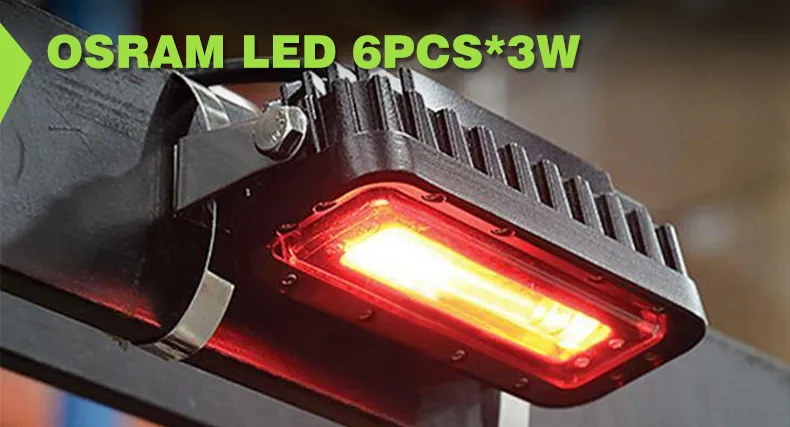
The hardware is compact: an LED lamp sealed against dust and water, mounted low on the truck body, fitted with an optic that throws a sharply defined red pattern onto the floor. Depending on the model and the optic, the projection is a line, an arc or a halo running along the sides, the rear or the full perimeter of the vehicle. The pattern lands one deliberate step outside the truck’s physical footprint, and everything inside that red line reads, at a glance, as “machine space — do not enter.”
Three properties make the projection work in a busy aisle. First, contrast: saturated red against grey concrete, tan cardboard and yellow floor markings is unmistakable, even in peripheral vision, which is where most pedestrian awareness actually operates. Second, ownership: because the boundary is projected by the truck, it appears wherever the truck goes — every temporary stop, every off-grid manoeuvre a planner never anticipated, every aisle where the paint has been scraped away by a season of pallet dragging. Third, self-explanation: unlike a spot that must be interpreted, a line around a vehicle is understood without training. Visitors, agency staff and drivers from other sites read it correctly the first time they see it.
That last point matters more than it sounds. Distribution centers run a permanent rotation of temporary workers, and every safety device that requires induction to understand quietly excludes exactly the population most at risk.
Red Zone, Blue Spot and Laser Line: Which Cue Does Which Job
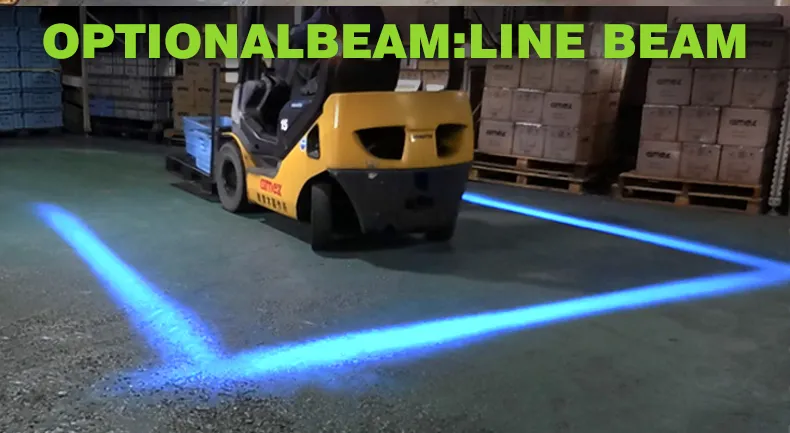
Red zone lights are one member of a family of projection lights, and choosing between them — or combining them — is the core of a good specification. The table below summarises the division of labour.
| Light | Projection | Message to the Pedestrian | Best-Fit Location |
|---|---|---|---|
| Blue spot light | Blue dot or arrow on the floor ahead of / behind the truck | “A truck is approaching this point” | Blind corners, doorways, aisle ends |
| Red zone light | Red line, arc or halo along the vehicle’s sides / rear | “Stay outside this boundary around the truck” | Shared aisles, picking faces, loading docks |
| Laser line projector | Crisp projected line at a chosen floor position | “This is the edge of the zone” | Fixed walkway edges, dock ledges, AGV lanes |
| AI pedestrian detection (XRL1341) | No projection — audible and visual alarms on detection | Active warning when a person enters the monitored zone | High-traffic fleets, blind zones, AGV integration |
The rows are complements, not competitors. A common progression on a retrofit: blue spots first at blind intersections, red zones next on trucks that work mixed pedestrian aisles, laser lines where walkways need a fixed edge, and camera-based detection where the facility wants the truck itself to react to a person. XRLL manufactures the full stack — blue, red and laser projection lights plus the XRL1341 AI system — on one industrial platform, which keeps sourcing and spares simple.
Planning the Boundary: Mounting, Projection Distance and Aim
Projection distance is the specification question every buyer asks first, and the honest answer is that it belongs to the facility, not the lamp. The line must clear the truck’s swing and load overhang, sit inside the aisle’s usable width, and fall where a walking person will actually see it before stepping in. Common installations project the boundary in the band of roughly half a metre to one metre from the body, with tighter lines in narrow aisles and wider halos in open dock areas — but the number that survives is the one validated in your aisles, at your truck speeds, with your loads. Treat the lamp’s adjustability as the feature: a housing that lets the crew set and lock the angle during commissioning turns distance from a gamble into a setting.
Mounting follows the same logic. Low on the chassis puts the line close to the wheels and resists mast interference; side and rear coverage targets the reversing encounters that dominate close-range incident statistics; full-perimeter halo projections suit mixed-traffic zones where people approach from any direction. Whatever the position, the unit needs a housing that survives the location — impact from pallet corners, washdown spray and the vibration of a truck that runs two shifts a day. Aim each unit with the truck on level ground and the mast lowered, then mark the locked hardware so a knock on the shop floor is visible at the next inspection.
Where Red Zone Lights Fit in a Safety Program
A red forklift safety light is an engineering control layered on top of a traffic management program — not a substitute for one. In the United States, powered industrial truck operations fall under OSHA 1910.178, which places duties on the facility around operator training, truck maintenance and workplace operating conditions. Visible boundary projection supports that framework in concrete ways: it gives operators and pedestrians a shared, continuously visible definition of the danger zone, reinforces the separation rules taught in training, and demonstrates to an inspector or an insurer that hazard warning is engineered into the equipment rather than delegated to paint and memory.
Facilities auditing their own exposure usually sequence controls by reliability: elimination and separation first (physical walkways, barriers, one-way aisles), visible warning devices second, administrative rules and training third. Red zone lights sit squarely in the second layer — always on whenever the truck runs, requiring no decision from a tired operator at hour nine of a shift. They also pair naturally with detection: the boundary tells people where the risk is; a camera system such as the XRL1341, which XRLL designs to align with OSHA 1910.178, tells the operator when someone crosses into it.
Specifications That Separate Durable Red Zone Lights
Two red zone lights can look identical online and age completely differently on a dock. The difference lives below the housing, and it is checkable before purchase:
- Chip provenance. Standard production at XRLL uses German OSRAM and American Cree LED chips, verified at incoming inspection. The chip is the light source — no specification recovers brightness lost to an anonymous substitute.
- Sealing rating. IP68 (dust-tight, rated for continuous immersion) is the working standard for trucks that face washdown, dock spray and winter slush. Ask what test stands behind the rating.
- Optic quality. The boundary must read as a line, not a smear. Focused optics hold the pattern’s edge at working projection distances; cheap lenses blur exactly the geometry that makes the warning legible.
- Production test depth. XRLL runs nine in-house inspection gates — incoming chip inspection, PCB and driver checks, welding and assembly inspection, IP-sealing tests, photometric and beam-pattern output testing, high and low temperature aging, vibration and shock testing, electrical safety testing, and a final pre-shipment inspection. Ask any supplier which of those steps their units pass.
- Documentation. ISO 9001 certification, CE, ROHS, E-mark and DOT documentation where applicable, plus EN 62471 photobiological reports for the light source — the audit pack a procurement department files once and re-uses every tender.
Behind the checklist sits capacity, which matters the day the pilot becomes a fleet-wide order. XRLL builds its lamps in a 17,000-square-metre factory in Foshan on four assembly lines, with daily output above 10,000 units, and returns quotations within 24 heures. For buyers standardising across sites, OEM and ODM customization covers projection pattern, beam pattern, housing mold and logo.
Rolling Out Zone Marking Across a Distribution Center
- Map the encounter points. Pull twelve months of near-miss reports and mark every cluster on the floor plan. Rack ends, dock doors and cross-aisles usually explain most of the pins.
- Pilot one truck, two weeks. Fit a red zone light — and a blue spot where the map shows blind approaches — on the truck with the busiest mixed-traffic route. Record where the line sits, and leave the position alone until the trial ends.
- Measure, then standardise. Ask operators and pedestrians what the line changed, verify it clears swing and overhang in the tightest aisle, then lock the distance and mounting into the site’s traffic management plan.
- Fleet-fit by exposure, not by age. Trucks on pedestrian-heavy routes get boundary lights first; yard trucks behind barriers last. Spread the installation across scheduled maintenance windows so the fleet never pauses.
- Close the loop in training and review. Add the boundary rule to inductions, photograph the standard installation for the maintenance system, and re-check aim at the next service interval. When budget allows, layer AI detection on the routes the data still flags.
For teams consolidating the hardware side of that program, the XRLL LED forklift light range lists the red zone family alongside the blue spot, laser projection and AI detection options, so one supplier conversation covers the whole visibility layer.
Planning Red Zone Marking for Your Fleet?
Send XRLL your aisle widths, truck types and encounter points. The sales team responds within 24 hours with model recommendations, projection-distance guidance for your layout, certification files and evaluation samples for a two-week pilot. OEM and ODM customization covers projection pattern, housing and logo for fleet-wide standardization.
E-mail: service02@xrlledlight.com · Phone / WhatsApp: +86-15818025687
Frequently Asked Questions
How far from the forklift should a red zone light project its line?
The line must clear the truck’s swing and load overhang while staying inside the aisle’s usable width, which makes it a facility decision rather than a fixed standard. Common installations land in the band of roughly half a metre to one metre from the body — tighter in narrow aisles, wider in open dock areas. Validate the distance during a supervised pilot in your own aisles, then lock it into the traffic management plan.
Do I need a red zone light, a blue light, or both?
They answer different questions. A blue spot announces that a truck is approaching a blind corner or doorway, which helps pedestrians before they can see the vehicle. A red forklift safety light marks the no-go boundary around the truck itself, which helps people who are already beside or behind it. Fleets that work mixed pedestrian traffic typically run blue at the front and rear for approach warning, and red along the sides and rear for boundary marking.
Can projected boundary lines replace painted floor markings?
No — they solve different problems. Paint defines fixed zones such as walkways and staging areas; a projected boundary follows the truck through every temporary position, off-grid manoeuvre and scraped aisle the paint no longer covers. Sites that rely on paint alone discover the gap the first time a truck stops outside the marked path. The durable setup is paint for fixed geography, projection for the moving hazard.
Are red zone lights visible in daylight or outdoor yards?
Projection lights are designed primarily for indoor ambient light, and direct sunlight washes any projected pattern toward invisibility — the same physics that makes a phone screen hard to read outdoors. In covered yards and overcast conditions the line remains legible. For open-air operation, test the specific lamp in your worst-case lighting before rollout, and treat the projection as one layer of the outdoor warning stack rather than the only one.
What should I check before ordering red zone lights for a whole fleet?
Four items cover most of the risk: the LED chip provenance (OSRAM and Cree are the standard in XRLL production), the test evidence behind the IP68 sealing claim, the beam-pattern and photometric test records, and the certification file — ISO 9001, CE, ROHS, E-mark or DOT as your market requires, plus an EN 62471 photobiological report. Request evaluation samples and confirm rated input details for your truck voltage groups in writing before the bulk order.


