Beacon Lights for Industrial and Fleet Use: Sourcing Guide 2026
A facilities director inheriting a mixed fleet — reach trucks in the warehouse, telehandlers on the yard, an overhead crane over the loading bay, and a small family of AGVs that arrived with the automation upgrade — needs warning lighting that works across all of them. Four departments, four suppliers, four different connectors later, the spares shelf is chaos. A beacon light sounds like the simplest purchase in the safety catalog, and it becomes the most complicated the moment the fleet stops being uniform.
This sourcing guide is written for fleet safety equipment buyers and industrial facility managers in exactly that position. It covers what beacon and warning lights do on industrial equipment, the product families you will choose among — from rotating beacons and strobe lights to laser line projectors and crane area lights — the specifications that actually decide field performance, application-by-application recommendations, and a sourcing checklist for buying directly from a manufacturer.
Key Takeaways
- Match the light to the message. Rotating beacons signal steady presence, strobe lights grab attention in bursts, laser line projectors mark zones on the floor, and crane area lights paint the swing radius — most facilities need two or three types, not one.
- Amber is the industrial default; red and blue are regulated. Keep amber for utility and material-handling equipment; red and blue are reserved for emergency and enforcement vehicles in most jurisdictions, and road-legal use requires E-mark or DOT compliance.
- Rate for the environment, not the brochure. Washdown and outdoor duty needs IP67/IP68-sealed units; sheltered warehouse duty is fine at IP65. Check the temperature range against your coldest site, not your headquarters.
- Wide-voltage input simplifies mixed fleets. Platforms accepting 10–110V DC let one part number cover 12V utility vehicles, 24–48V forklifts and 80V equipment — fewer SKUs, faster spares resolution.
- Buy from the factory, not the catalog. Certification files with matching model numbers, batch test records, and OEM options (logo, 빔 패턴, mounting) separate a manufacturing partner from a box-shifter.
What Beacon Lights Do in Industrial and Fleet Settings
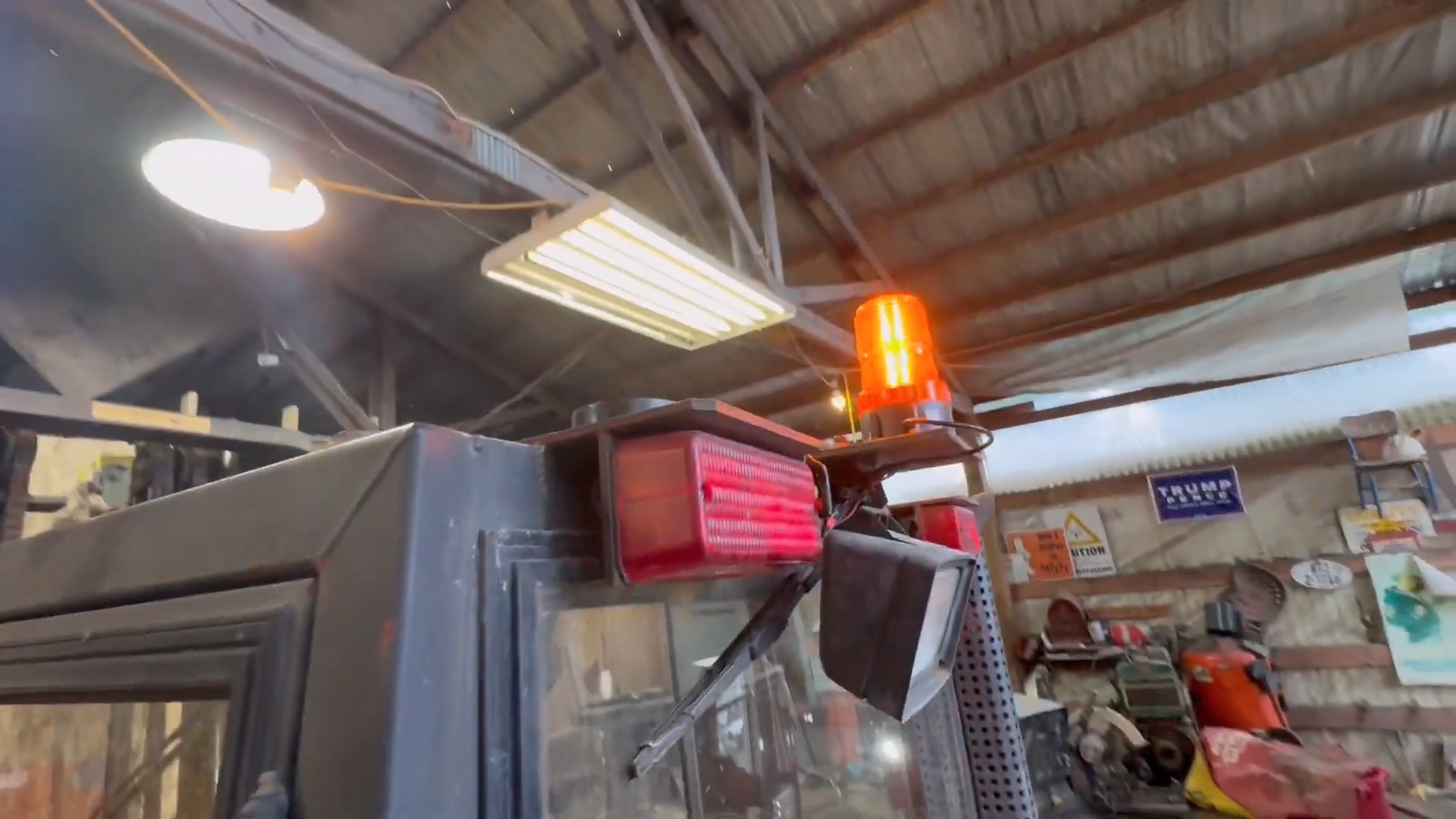
Every warning light answers one question for everyone near a machine: where is it, and what is it about to do? Beacon lights handle the “where is it” half. A dome mounted on the cab roof or cage gives a 360-degree signature visible over racking, pallets and site traffic — the machine announces itself before it appears. That matters most in mixed environments where pedestrians, trucks and fixed plant share space: the warehouse aisle where a reach truck exits a blind corner, the yard where a telehandler crosses a pedestrian route, the plant floor where an AGV follows its programmed path with no operator to lean on a horn.
The “what is it about to do” half belongs to a second family of projection lights — blue and red zone lights that paint a moving margin around a forklift, laser line projectors that draw a virtual wall, and crane lights that mark the load path on the ground. Serious safety programs pair the two: a presence beacon plus a zone projection. Buyers who understand this pairing stop treating “warning light” as one SKU and start specifying a small system, which is also the mindset that survives a fleet audit.
The Product Families, and Where Each Fits
Industrial warning lighting has settled into five families. They are complementary, and the sourcing mistake to avoid is forcing one family to do another’s job.
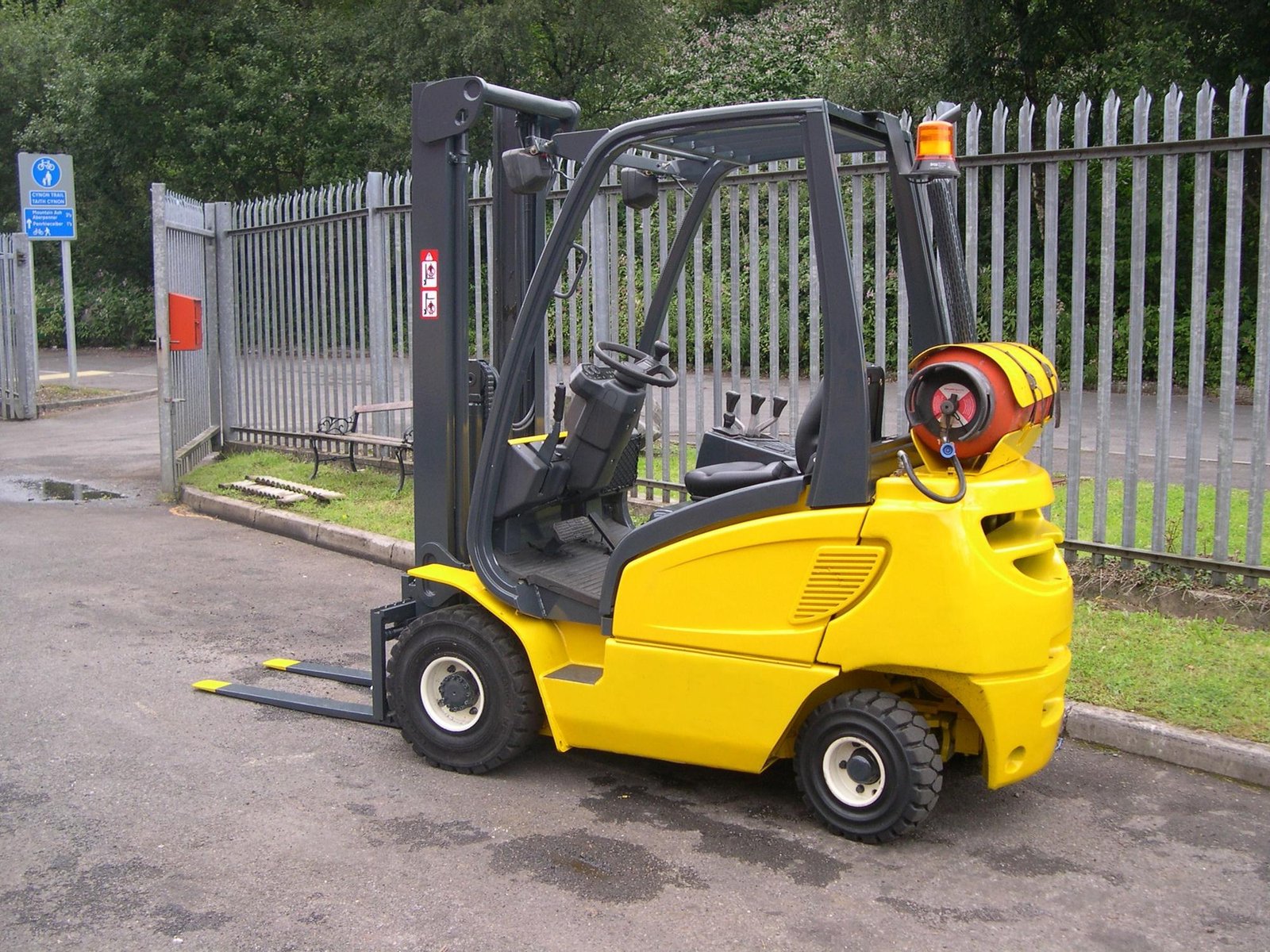
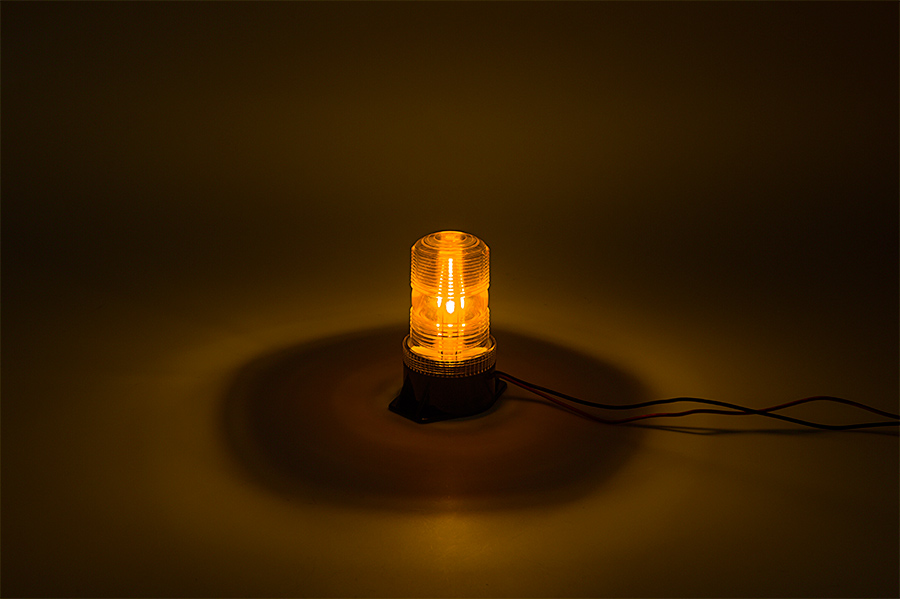
Rotating and LED-emulated beacons. The classic amber dome. Early versions spun a mirror or reflector around a bulb; current LED arrays emulate the sweep electronically, which removes the motor — the traditional first component to fail. Rotating beacons read as “vehicle present, working in the area.” They are the default on municipal, agricultural and slow-moving industrial equipment, and they remain the least ambiguous signal at long distance.
Strobe and flashing beacons. Fixed LEDs firing high-intensity pulses — no moving parts at all. The sharp flash cuts through daylight and draws the eye faster than a continuous sweep, which makes strobes the choice for attention-critical moments: reversing, intersection crossings on site roads, tow vehicles. Compact industrial strobe platforms run from 3W units with arrow or spot optics to 12W multi-chip units in die-cast aluminium housings rated for −40°C to +80°C service.
Laser line projectors. A class of their own: a laser diode with line optics projects a bright red or green line onto the floor ahead of or beside the machine — a virtual no-entry zone for pedestrians. Compliance for laser products is governed by IEC 60825, and buyers should ask for the laser safety file specifically; it is a different document from the CE file and a frequent gap in low-cost offerings.
Crane and area warning lights. High-power units that project colored zones onto the ground — red and blue arcs under an overhead crane’s hook path, or a spotlight warning where the load will travel. A 75W crane safety area light, for example, exists precisely because a tower crane’s danger zone is measured in tens of meters, beyond what a cab dome can communicate.
Traffic advisor and directional bars. Sequential arrow displays that tell traffic which way to merge around a work zone. Common on utility fleets and snow-removal equipment; less common inside warehouses. Fleet buyers serving municipal or road-works contracts should treat them as part of the beacon family and check road-use compliance (E-mark in Europe, DOT in the US) before quoting.
Selection Criteria That Decide Field Performance
Light color and local rules
Amber is the universal “caution — work in progress” color and the safe default for industrial equipment worldwide. Red and blue carry legal weight: they are restricted to emergency and enforcement vehicles in most jurisdictions, and fitting them to a works truck can be illegal on public roads. Green appears on some sites for safety officers and incident commanders. Before standardizing on a color across a fleet, confirm the rule in every country the equipment will operate in — a beacon that is compliant in Texas may need different documentation in Hamburg.
Ingress protection and temperature
IP65 seals out dust and water jets — adequate for indoor warehouses and sheltered yards. IP67 survives temporary submersion; IP68 is the washdown-and-weather grade for outdoor fleets, cold stores and food-processing environments where hoses run daily. Temperature range matters as much: a unit rated −30°C to +65°C covers refrigerated logistics, and industrial platforms specified to −40°C serve outdoor winter operations. Match the rating to your harshest site, because failure rates concentrate exactly where the rating was borderline.
Voltage and electrical protection
Mixed fleets mix voltages. A warning-light platform that accepts 10–110V DC input covers 12V utility vehicles, 24V and 48V forklifts, and 80V electric equipment with one part number — a genuine sourcing advantage in spares management. Reverse-polarity protection should be standard; truck batteries get jumped and misconnected, and a light that dies from a reversed connection is a warranty claim waiting to happen.
Mounting and mechanics
Magnetic bases suit rental equipment and temporary deployments; permanent brackets suit owned fleets. Check the hardware: stainless steel brackets and die-cast aluminium housings with hard glass covers shrug off dock impacts and pressure washing that deform plastic shells. For equipment exposed to constant vibration — telehandlers, yard trucks, cranes — solid-state LED construction with no moving parts has a structural reliability advantage that shows up in year-two failure data.
Flash patterns and synchronization
Multiple flash patterns (rotating emulation, double flash, quad flash, steady-on) let one unit serve different sites and rules. Where several warning lights operate in view of each other, synchronization prevents the visual chaos of unsynchronized flashing — worth confirming with the supplier before ordering dozens of units for one facility.
A Specification Snapshot: What a Serious Product Range Looks Like
The table below shows the specification depth a buyer should expect from any manufacturer’s warning-light range, using representative units from XRLL’s industrial line. Use it as a benchmark for comparing quotations — any supplier unable to fill in a column like this is selling a catalog, not an engineered product.
| Unit | Type | Power / Voltage | 건설 & Rating | Typical Use |
|---|---|---|---|---|
| XRL2010A | Flashing amber beacon | 5여 (5 × 1W LED), 10–110V DC | PC cover and base, amber; magnetic base optional; −30°C to +65°C; IP65; CE | Utility vehicles, rental fleets, temporary works |
| XRL2010B | LED beacon | 9여 (30 × 0.3W LED), 10–110V DC | PC cover and base, amber; −30°C to +65°C; IP65; CE | Fleet vehicles needing a stronger presence signal |
| XRL-1082B family | Compact strobe / warning light | 12여 (오스람 4 × 3W), 10–80V DC | Die-cast aluminium housing, hard glass cover, stainless bracket; −40°C to +80°C; IP67; >50,000h; EMC; CE | Forklifts, harsh-environment industrial vehicles (blue or red optics) |
| 1335i | Crane safety area light | 75여 | High-output projection optics | Overhead and mobile cranes — marking the swing/load zone |
| Laser line projector line | Virtual line / zone projection | Laser diode modules | IEC 60825 laser-safety compliance | Pedestrian no-entry lines ahead of forklifts, AGVs, machinery |
The full range, including construction machinery lights and AGV-oriented units, is on the XRLL warning light category page.
Application Recommendations by Environment
Warehouse and dock operations. Amber beacons on the cab for presence, plus blue or red zone lights for the moving margin around the truck. At blind corners, add a red-blue warning module or a projected line. IP65 is sufficient indoors unless washdown is routine.
AGV and AMR fleets. Automated vehicles have no operator, so the light is the only voice. Constant or slow-pulse beacons signal presence; synchronization across the AGV fleet avoids flash confusion in long aisles. Laser line projection is increasingly standard on AGV platforms to clear pedestrian paths proactively.
Overhead and mobile cranes. Cab dome for presence is not enough — specify area projection (red/blue) marking the hook path and swing radius on the ground. The 75W class exists for exactly this scale of hazard.
Construction machinery and telehandlers. Vibration and weather dominate the specification: die-cast housings, hard glass, IP67 minimum, −40°C rating for winter sites, stainless hardware. Add a traffic advisor bar where machines work adjacent to public roads.
Mining and quarry. Combine everything at the harshest settings — high-vibration-rated strobes, wide-temperature beacons, and zone projection sized for the equipment. Verify salt-fog and corrosion resistance in the test file, not the brochure.
Sourcing Directly from a Manufacturer
The price gap between a trading company and a factory is real, and so is the support gap three years in. Four checks separate them quickly. Certification files: ask for the CE, E-마크, 점, ROHS and ISO 9001 documents with the model number matching your quotation — and the IEC 60825 laser file for projection products. Test evidence: sealing, vibration, thermal aging and photometric tests run on production batches, with records available. Manufacturing depth: a real factory — ours runs 17,000 square meters, 17 machines and four assembly lines with daily capacity above 10,000 units — can host a walkthrough and put names on its workshops. OEM capability: custom logo, 빔 패턴, projection pattern and housing molds let a fleet or dealer standardize one specification instead of managing five suppliers’ SKUs; XRLL quotes custom projects within 24 hours of receiving specifications or a sample, with pre-production testing before mass production.
MOQ, lead time and payment terms are quoted per program once the application is understood — any supplier who promises universal terms before asking what you operate is guessing on your budget.
Specifying Warning Lights Across a Mixed Fleet?
Send your equipment list and site conditions. The XRLL team responds within 24 hours with model recommendations per vehicle class, the certification file for each unit, and evaluation samples for pilot installation — plus an OEM/ODM scope sheet if you want the fleet branded.
이메일: service02@xrlledlight.com · Phone / 왓츠앱: +86-15818025687
Frequently Asked Questions
What is the difference between a beacon light and a strobe light?
A rotating beacon sweeps a beam continuously and reads as “vehicle present and working.” A strobe fires high-intensity pulses from fixed LEDs — no moving parts — and reads as “pay attention now.” Many fleets use both: the beacon for general presence, the strobe for critical moments like reversing or crossing. LED-emulated beacons close most of the durability gap by removing the motor.
Which IP rating do I need for outdoor beacon lights?
IP65 handles rain and dust for general outdoor use. Choose IP67 where equipment may sit in standing water or face high-pressure cleaning, and IP68 for washdown-critical environments such as food processing and cold-chain facilities. Also check the temperature range against the coldest site — a unit rated −30°C to +65°C covers refrigerated logistics, while −40°C-rated platforms serve winter road operations.
Are red and blue beacon lights legal on industrial vehicles?
Amber is the standard legal choice for utility and material-handling equipment almost everywhere. Red and blue are restricted to emergency and enforcement vehicles in most jurisdictions, so they are generally limited to off-road industrial use — and rules differ by country and state. On-road use of any warning light requires the relevant compliance (E-mark in Europe, DOT in the US). Confirm locally before standardizing a color across a fleet.
Can one beacon model cover trucks with different voltages?
Yes — that is what wide-input design is for. A platform rated 10–110V DC runs on 12V utility vehicles, 24V and 48V forklifts, and 80V electric equipment with one part number, which simplifies spares and standardizes the safety look across the fleet. Confirm reverse-polarity protection is included; it is the difference between a survived mis-jump-start and a dead unit.
What should I ask a manufacturer before ordering beacons in bulk?
Four things: the certification files with your exact model numbers (including the IEC 60825 laser file for projection lights); the factory test gates applied to production batches — sealing, vibration, thermal aging, photometric — and access to records; a sample unit for pilot installation on your actual equipment; and written OEM/ODM terms if you need custom colors, patterns or branding. MOQ, lead time and payment terms should be quoted for your program in writing.


