LED Work Lights: Industrial Sourcing Guide for Fleet Buyers 2026
A purchasing manager specifying led work light units for a mixed fleet usually learns the hard way that two lamps with the same wattage label can cost a 40% difference in downtime. One survives a winter of freeze-thaw cycles on a tractor ROPS; the other fogs from inside after three months on an excavator and fails a pre-start check. This guide is written for fleet buyers, agricultural machinery OEMs, and mining procurement managers who need a repeatable way to specify industrial work lighting across machines, suppliers, and duty cycles — before the first sample order ships.
Key Takeaways
- Specify the duty cycle first, the lamp second. Mounting point, vibration class, water exposure, and electrical source narrow the field faster than lumens ever will.
- Lumens, 빔 패턴, and IP rating are three separate decisions — a bright flood in the wrong beam or a high-lumen pod with a cheap seal will still fail in the field.
- Ask suppliers for test evidence per SKU: chip brand and bin documentation, lumen reports, salt-spray and vibration records, and the exact certification report numbers behind CE/E-mark/DOT claims.
- A vertical-integration factory with in-house tooling, sealing tests, and 9-stage inspection changes both lead-time risk and aftermarket quality drift — this is where a manufacturer and a trader genuinely differ.
- For fleets above roughly 50 기계, standardise on two or three housing families across all vehicle types; part commonality beats per-vehicle optimisation on total cost.
What an Industrial LED Work Light Has to Survive
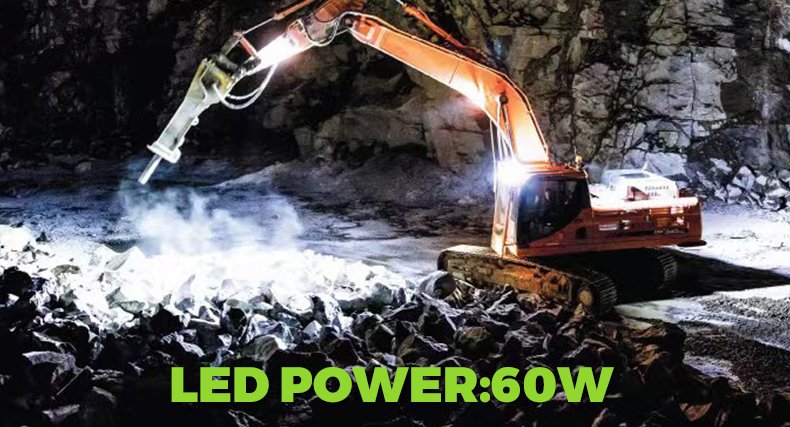
Cars, warehouses, and office desks do not define the operating envelope here. An industrial work light on a wheel loader in a quarry sees the simultaneous abuse that most equipment never experiences alone: continuous vibration through the mounting bracket, water jets during daily washdown, thermal cycling between a −10 °C morning start and an afternoon cabin-side ambient over 50 °C, hydraulic oil and amine dust on the lens, and impact from swinging loads or falling gravel. Each of those attacks a different failure mode — fatigue cracks at solder joints, seal degradation, lens crazing, driver overheating.
The procurement consequence: a specification that only states wattage and price is a specification for early replacement. Serious fleet tenders describe the environment in numbers (washdown pressure, temperature range, mounting orientation, hours per season) and let those numbers drive component choices. That framing also exposes supplier honesty quickly, because an assembler buying generic modules cannot document what is inside the housing.
The Six Specification Lines That Actually Decide the Purchase
1. Light output: demand lumens, not watts
Wattage is what the lamp consumes; lumens are what the task receives. Two 30 W pods can differ by over 40 % in delivered lumens depending on chip bin and driver efficiency. Require a lumen report per model, measured on an integrating sphere at rated voltage, and check the claimed efficiency band: heavy-duty fixtures using recognised chips from suppliers such as OSRAM or Cree should sit in a credible lm/W range rather than promising miracle numbers at a bargain price.
2. Beam pattern: flood, 점, or combination
Flood optics (wide, roughly 60° and broader horizontal spread) light a work zone — a digger bucket, a loading bay, a tractor implement at night. Spot optics throw a tight 10–15° beam down a haul road or across a paddock. Combination units do both acceptably. A common tender error is buying everything in flood “for general lighting” and then discovering the perimeter stays dark, or buying spots for a loading dock and blinding the operator with reflected glare. Specify per mounting point, with a photometric file or at minimum a beam photo per SKU.
3. Ingress protection: IP rating matched to the washdown, not the marketing page
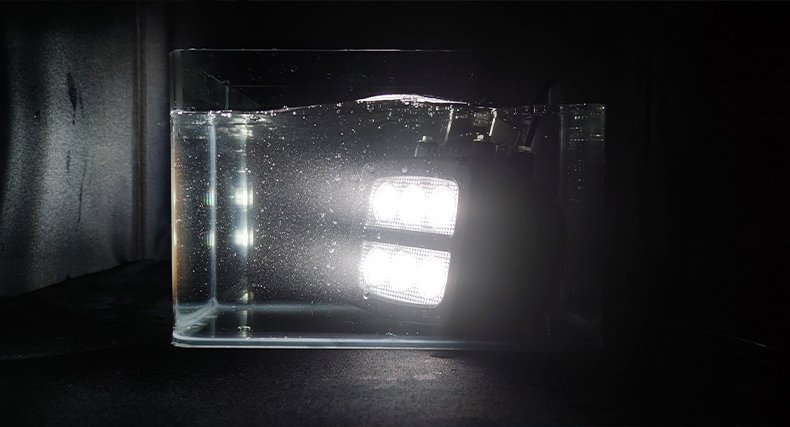
IP65 survives rain and splash. IP67 survives temporary immersion. IP68, which XRLL builds its sealing test stage around, is the rating to require on machines that get pressure-washed at the end of every shift, because a jet lance drives water far past what “rainproof” seals handle. The vent grommet, the cable gland, and the lens-to-housing seam fail long before the aluminium shell does — ask where the rated seal line sits, and whether the driver electronics are potted behind it.
4. Electrical envelope: 12/24 V with real transient tolerance

Plant fleets run 24 V, trucks and 4×4 service vehicles often 12 V, and hybrid and telehandler electrical buses generate load-dump and ignition-collapse spikes that kill unprotected drivers. Ask for the operating voltage range (a genuine heavy-duty unit covers roughly 9–32 V continuously), confirm reverse-polarity protection, and check how the lamp behaves during a jump-start surge. Connector standardisation matters as much: DT-style sealed connectors across the fleet cut field wiring failures dramatically compared with mixed blade connectors.
5. Thermal design and mount rating
LED lifetime is a temperature story. Require the junction or heat-sink specification, and check that the housing has mass to pull heat away from the board — thin cast cases with the driver thermally isolated from the heatsink are a known early-failure pattern. If the unit mounts on a high-ambient machine compartment, derating data beats peak output data.
6. Compliance claimed versus compliance documented
For units that see public roads — truck-mounted work lamps, service-vehicle lighting — E-mark (an E9 number for European approval) and DOT/FMVSS status decide legality, not preference. CE covers EMC and electrical safety directives for European sale. In the plant, EMC immunity matters on modern CAN-bus machines. The procurement question is always the same: “send the report numbers.” A manufacturer with its own lab will answer in a day; a reseller will take three weeks and return two pages.
Work Light Types: Where Each One Earns Its Keep
| Type | Typical Mount | Best For | Watch-outs |
|---|---|---|---|
| Compact pod / square work light | ROPS, roll-cage, bucket boom | Operator-critical task light: excavator bucket, loader scales, PTO work | Cheap pods concentrate heat at the bracket; check IK/vibration rating |
| Flood bar / light bar | Roof, canopy front edge, tractor head | Wide-area wash: yard work, night harvesting, site security | Glare to oncoming traffic when used road-side; combo optics fix most cases |
| Spot / penetration lamp | Upper rack, crane mast, haul-road side | Long-throw perimeter, road work at speed, open-pit ramps | Useless at close range; never substitute one flood bar for both jobs |
| Machine-integrated heavy-duty lamp | OEM bolt patterns on tractors, dozers, forklift masts | Factory-fit lighting programs where the lamp is part of the machine build | Requires a supplier with in-house tooling for housings and brackets |
| Specialised safety-projection units | Forklift overhead guard, AGV chassis | Blue-spot presence, red-zone and laser-line area marking around moving machines | Laser types must carry IEC 60825 classification documentation |
Supplier Evaluation: What Separates a Factory from a Reseller
Everything above is easy to write into a tender and easy to fake on a datasheet. The evaluation therefore shifts from specifications to evidence.
Ask for the build sheet
A genuine manufacturer can name its LED chip supplier and list the inspection stages the unit passes before it ships. At XRLL, that chain runs nine stations — incoming chip verification against the OSRAM and Cree specifications, PCB and driver inspection, solder and assembly checks, an IP68 sealing test on every sealed design, lumen and beam verification, thermal aging, vibration and shock, electrical safety, and a pre-shipment final inspection. If a supplier cannot describe their process at that granularity, assume the lamps are somebody else’s, and you will be dealing with that somebody else whenever quality shifts.
Check vertical integration where it matters
Housing dies, die-cast tooling, and potted drivers are the difference points for OEM/ODM programs. A factory with in-house mold and fixture tooling — XRLL runs 17 production machines across four assembly lines in a 17,000 m² plant in Foshan, at a capacity above 10,000 units a day — can hold a custom bracket or beam change to a tooling timeline instead of a trading company’s sourcing lottery. For brand owners running private-label catalogs, that same capability decides whether revisions in year two match samples approved in year one.
Verify certificates by number
Request the certificate or report numbers for CE (EMC and LVD), E-마크, 점, ISO 9001 for the quality system, and IEC 60825 for any laser projection model, then spot-check at least the critical ones against the issuing body. Thirty-plus granted utility and design patents in a supplier’s portfolio is a reasonable proxy for engineering depth — but documentation beats marketing in every audit.
Test the communication loop
Response speed on a pre-sales spec question predicts after-sales behavior more accurately than any brochure. A 24-hour quotation window on submitted drawings or samples is the working standard at a factory sales desk worth keeping.
Three Common Ways Fleet Work-Light Programs Go Wrong
Buying per vehicle instead of per duty. Six SKUs across a mixed fleet becomes a spare-parts problem within a season. Consolidate onto two or three housing families — a pod, a mid-size flood or combo bar, a long-throw spot — and let brackets adapt them to each machine.
Under-specifying the seal. The cheapest lamp in the tender usually fails at the cable entry, not the LED. If washdown happens, make IP68 with a potted driver and a sealed gland the floor, and let the lifecycle cost argument do the negotiating.
Ignoring the electrical story. Ground-loop corrosion, load-dump damage, and flicker on CAN-bus machines all trace back to installation and driver quality, not lamp brightness. Budget for proper wiring looms, fusing at the source, and connectors rated for the vibration class of the machine.
Specify With the Factory, Not Against It
Send your mounting drawings, duty-cycle numbers, or a sample photo to the XRLL engineering sales desk and receive application feedback plus a quotation within 24 시간. Chip documentation, test reports, and certificate numbers ship with every quotation; OEM and ODM programs run on in-house tooling with pre-production sample approval.
이메일: service02@xrlledlight.com · Phone/WhatsApp: +86-15818025687
FAQ
How many lumens does a work light need on construction equipment?
Size the light to the task distance, not the machine price. A bucket or hitch work zone within a few metres is well served by a compact pod in the 2,000–5,000 lumen band with flood optics; a yard or harvest-wide wash needs 10,000+ lumen combo bars; haul-road throw needs spots regardless of lumen total. Ask the supplier for spacing-to-illuminance guidance per mounting height — a lux map answers the question that lumens cannot.
Is IP67 enough, or should I require IP68 for fleet work lights?
If machines are pressure-washed, require IP68 with a potted driver — a jet lance drives water far beyond what IP67 immersion testing represents. For weather-only exposure with occasional rain, IP66/67 is adequate and cheaper. Whichever you pick, ask where the seal line sits and how the cable entry is rated; that joint, not the lens, is what fails first in service.
What certifications should imported work lights carry for the US and EU markets?
For Europe: CE (EMC and low-voltage directives) as the market entry requirement, plus E-mark numbers for any lamp with road-use claims. For the US and Canada: DOT/FMVSS status where on-road use applies, and SAE-style beam compliance for driving lamps per your legal counsel’s reading of the application. RoHS conformity and an ISO 9001 factory certificate round out the import file. Always collect report numbers, not logos.
Can an OEM program start from an existing lamp catalog, or does it need custom tooling?
Both routes exist on a spectrum. Logo, 빔 패턴, color temperature, voltage, and bracket changes ride on existing housings and move fastest. A private label that must look distinct — custom housing or lens graphics — needs mold work, which only makes sense with an in-house tooling shop and carries a tooling timeline and commitment. A serious factory will tell you plainly which tier your volumes belong in; get pre-production samples approved before any tooling release.
How do I compare two brands whose datasheets show identical specs?
Compare evidence, not numbers: the chip brand and bin documentation behind the lumen claim, the sealing and vibration test records behind the IP rating, the thermal path behind the life claim, and the certificate numbers behind compliance. Then run a season trial — mount one unit of each on your dirtiest, wettest machine and inspect at teardown intervals. Field failure data settles datasheet ties faster than any spec sheet.


