Strobe vs Beacon Lights: Which Warning Solution Fits Your Fleet?
A fleet safety manager finally gets budget approval for warning lights, opens the supplier catalog, and finds two line items that look interchangeable: strobe lights and beacon lights. The unit prices are similar, the voltage ranges overlap, and both promise visibility. Choosing wrong is not dangerous — both will light up — it is expensive: a light that crews stop noticing within a month, or a motor-driven beacon that starts failing its second winter while the LED units on neighboring trucks keep working. The right question is not which type is better, but which signal each one sends, and which signal your operation actually needs.
This guide is written for fleet safety managers and equipment buyers comparing the two technologies side by side. It covers how each light builds its visual signature, how that signature performs in daylight, dust and night shift conditions, where each type wins on maintenance and total cost, and the specification checks — voltage, mounting, sealing, certification — that settle the decision for a mixed fleet.
Key Takeaways
- They send different messages. A rotating beacon sweeps a continuous beam and reads as “this vehicle is present and working.” A strobe light fires sharp high-intensity pulses and reads as “stop and look now.” Match the message to the risk: presence marking gets a beacon, decision points get a strobe.
- Mechanism decides maintenance. A rotating beacon carries a motor and drive train that wear with every hour; a strobe is solid-state and has nothing mechanical to fail. LED flashing beacons now emulate the rotating look with no motor at all.
- Ambient light breaks the tie. In bright yards and outdoor docks, the strobe’s peak intensity cuts through daylight at distance. In dim warehouse aisles, a beacon’s steady sweep is easier to live with around the clock.
- Check the vehicle, not just the light. Input voltage range, mounting surface and sealing (IP68 for wash-down and outdoor duty) decide whether the light survives your fleet — whatever technology sits inside it.
- Ask for the certificate per model. E-마크 (E9) for road use in Europe, DOT-referenced compliance for North America, CE and ROHS as the baseline. A supplier who ships test files with the quote is a supplier who built the light properly.
Two Different Jobs Hiding Under One Catalog Name
Catalog language blurs the two technologies because “beacon” is used as an umbrella term for anything dome-shaped and amber. On a specification sheet, though, the distinction is mechanical and it matters:
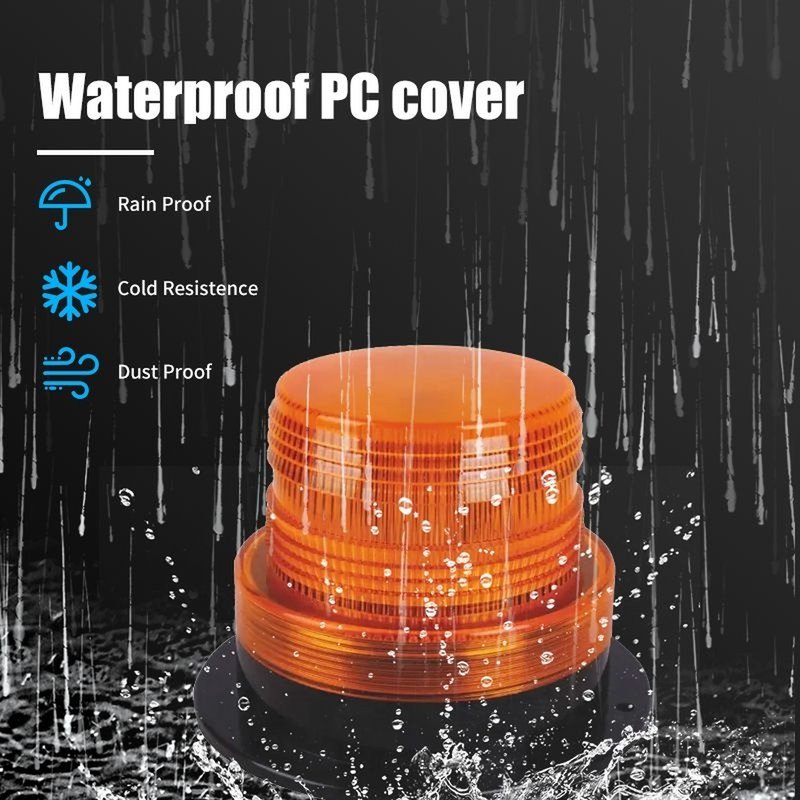
A rotating beacon works the way its name suggests. A motor spins a reflector or a lens around a stationary light source, sweeping the beam across 360 degrees once or twice per second. The result is a moving highlight that circles the vehicle — visible from every angle, but never at full brightness from any single one of them. It is a mature technology: simple, inexpensive, and familiar to every driver and pedestrian alive. Its weakness is the mechanism itself. Motors, brushes and drive components wear, and wear shows up as stutter, noise, then silence — usually starting in the second or third year of duty.
A strobe light produces the opposite signature. The light source — xenon tube in older designs, LED chips in current ones — stays fixed, and the intensity does the work: short, high-peak flashes separated by darkness. Nothing moves. A strobe light draws attention through contrast — the sudden change between flash and dark triggers peripheral vision more reliably than a steady source — which is why the same technology has been used for decades on emergency vehicles, airport runways and mining equipment. Its historical weaknesses were cost and globe life; modern LED electronics have closed both gaps, with flash patterns now set in software rather than hardware.
There is also a third category that confuses the comparison: LED flashing beacons — dome-shaped units like a traditional beacon, but built from LED arrays that emulate rotating or flashing patterns without a motor. We will treat them as their own option, because for many buyers they now make the cleanest case.
How Each Signature Performs Where You Actually Work
The physics of attention decides this comparison more than any spec number. Three field conditions separate the technologies:
Bright ambient light. A rotating beacon’s swept beam competes with daylight, and at distance the sweep can wash out entirely — the eye never receives enough intensity in one place to register it. A strobe light concentrates its energy into each pulse, so peak intensity stays high even against a bright sky. For outdoor yards, quarry perimeters and road-adjacent docks, that difference is the single strongest argument for the strobe.
Night shift and dim interiors. The calculation reverses. In a warehouse aisle lit at 200 lux, a full-power strobe firing every second becomes the visual equivalent of a camera flash — hard to ignore, and hard to work beside for eight hours. A beacon’s continuous sweep communicates presence without punishing everyone in the building. Fleets that run both outdoor yards and indoor aisles often specify beacons on the slow indoor equipment and strobes on yard trucks and anything crossing pedestrian zones at speed.
Angle of observation. A pedestrian walking toward a forklift sees its beacon sweep rotate toward them — bright, then dim, then bright again — a pattern the brain learns to read as “vehicle operating nearby.” A strobe’s flash hits every viewing angle with the same intensity, which makes it the safer choice for warning points that must work from any direction: rear corners, crossing intersections, reversing routes. This is also why the two combine well on one vehicle — the beacon for general presence, the strobe for the moments when geometry puts a worker in a blind spot.
Head-to-Head: The Comparison That Decides the Purchase
| Attribute | Rotating Beacon | Strobe Light | LED Flashing Beacon |
|---|---|---|---|
| Visual signature | Continuous 360° sweep; reads as presence | High-intensity pulses; reads as urgent attention | Selectable flash or rotating-emulation patterns |
| Moving parts | Motor, reflector drive — wears with hours | None — solid state | None — solid state |
| Maintenance profile | Motor wear from year two; listen for stutter | Driver electronics only; no scheduled service | Driver electronics only; no scheduled service |
| Daylight visibility at distance | Moderate — sweep washes out in bright sun | Strong — peak intensity per flash | Strong with high-flash patterns |
| Indoor comfort over long shifts | Good — steady, familiar signal | Can feel aggressive in dim aisles | Adjustable — pick a softer pattern |
| Typical fleet fit | Slow indoor equipment, presence marking, budget replacement | Yard trucks, 부두, road-going vehicles, blind-spot warning | Mixed fleets standardizing on one dome format |
Where a Strobe Light Is the Right Answer
Specify a strobe light when the warning has to win against its surroundings. The classic fits:
Vehicle-mounted warning on road-adjacent work. Municipal service fleets, snow-clearing contractors and utility crews work within sight of live traffic. Here the strobe’s daylight performance is not negotiable, and certification shifts to road requirements — E-mark (E9) documentation for Europe, DOT-referenced compliance for North America. A rotating beacon on a highway shoulder is a light; a strobe is a statement.
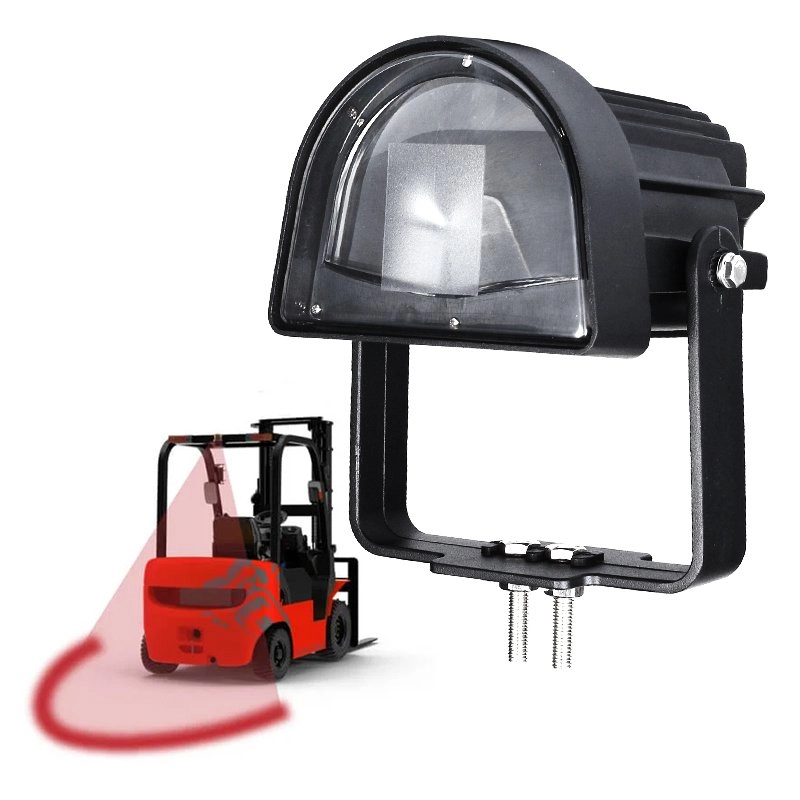
Reversing and crossing points. Any moment when a vehicle’s geometry hides the operator from a pedestrian — reverse travel out of racking, blind intersections between dock doors — deserves the signal that triggers from every angle. Fleets commonly pair a rear strobe with an audible alarm, so the visual and auditory warnings land together.
High-noise, high-ambient sites. 채광, quarrying and port operations combine sun, dust and 90-decibel environments. Workers are already orienting by sight, not sound, and the strobe’s pulse is the pattern most likely to break through peripheral vision before a task absorbs full attention.
Long-duty durability requirements. With no motor, an LED strobe built on quality drivers and OSRAM or Cree chips measures its service life in the electronics — and a well-sealed unit (IP68) keeps that rating through wash-down and winter. For fleets burning 3,000+ hours per year, removing the mechanical failure mode removes most of the warranty claims with it.
Where a Rotating Beacon Still Earns Its Spot
Retiring the rotating beacon entirely would be premature. It remains the sensible choice in four situations:
Continuous presence marking indoors. A reach truck circling narrow aisles for eight hours needs to be visible without dazzling every colleague on the floor. The sweep reads as “working here” without the strobe’s repeated startle.
Replacement consistency on legacy fleets. If forty trucks already carry a standard beacon model, switching the whole fleet to a new technology mid-life creates two spares inventories and two training behaviors. Replace like-for-like now, standardize on the next purchase cycle.
Budget-tier equipment. On low-hour machines — a seasonal trailer mover, a backup order picker — the cheapest certified beacon is a defensible spend. The motor will outlive the equipment’s duty hours at that usage rate.
Sites that standardize on the look. Some operations train specifically on the rotating signature: supervisors read a moving highlight as “equipment active” from across the floor. Familiarity has safety value of its own, and there is no requirement to abandon it.
The Middle Path: LED Flashing Beacons
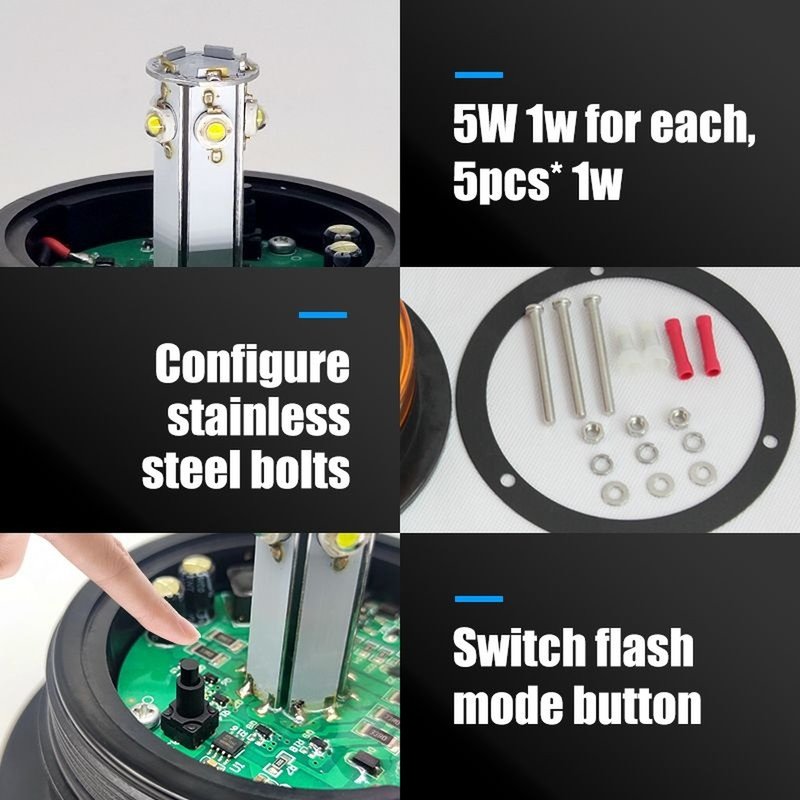
Most buyers comparing strobe vs beacon lights in 2026 end up looking at the technology that borrows from both. An LED flashing beacon keeps the familiar dome format and 360-degree coverage, but replaces the motor with an LED array and a driver board. In practice that means: rotating-emulation patterns for fleets that want the classic sweep look, straight flash patterns for buyers who want strobe-style attention, and multiple patterns selectable on install so one SKU can serve both indoor and outdoor vehicles.
The maintenance argument is the same as for the strobe — no moving parts, no scheduled service — and the power profile is gentler than xenon designs, which matters on electric forklifts where every watt eventually comes off the battery’s shift budget. Compact 5W-class amber units cover utility vehicles and the smaller forklift classes, while higher-output domes serve yard trucks and outdoor plant. When we build a warning-light kit for a mixed fleet, this is the category that most often ends up on the final bill of materials, precisely because it lets one supplier and one spare-part bin cover every vehicle class.
Specification Checks That Settle the Decision
Whichever technology wins the comparison on your site, five checks apply before the purchase order goes out:
1. Input voltage against your real fleet. Diesel trucks run 12V or 24V systems; electric forklifts and AGVs may sit at 36V, 48V or higher. A warning light whose datasheet input range does not span your vehicle classes either needs converters or gets mis-wired — the root of a good share of early field failures. Ask for the exact input range in writing for the model quoted.
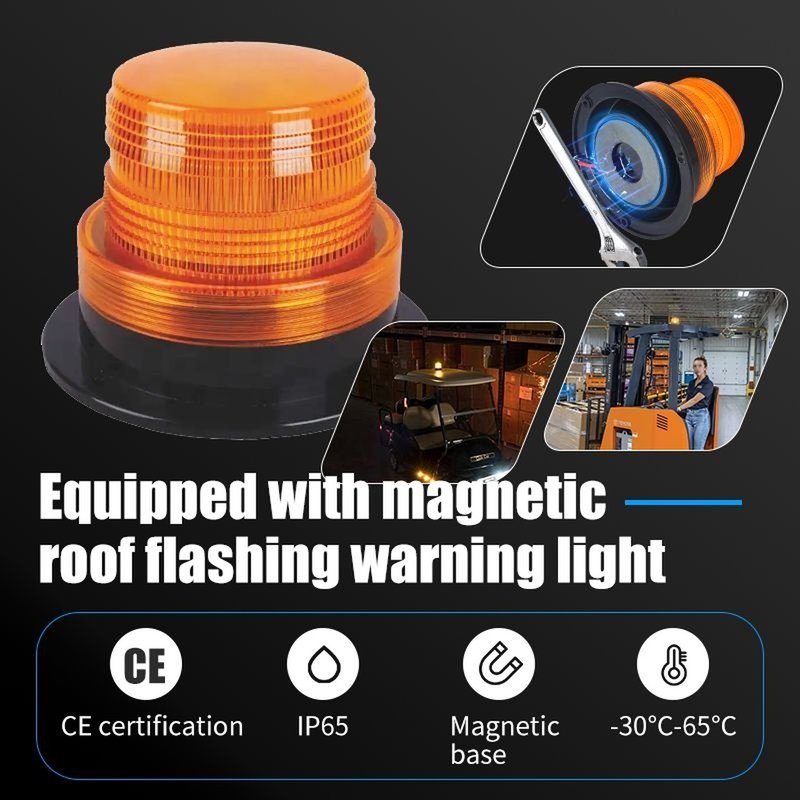
2. Mounting reality. Magnetic bases speed up pilot trials and shared equipment; permanent mounts survive vibration on trucks that leave the yard. Check that the mount hardware is stainless or otherwise rated for your wash-down regime, and that the dome material is UV-stabilized — amber polycarbonate that yellows in year one is a visibility problem, not just a cosmetic one.
3. Sealing and build. IP68 밀봉 하우징, die-cast aluminium or engineering-grade bases, and named LED chips (OSRAM and Cree are the industry’s reference points) separate lights that survive cold stores and outdoor yards from lights that fog and fade. These are the same failure modes that decide forklift light quality generally, and they apply to every technology in this comparison.
4. Certification for the market, per model. For road use in Europe, ask for the E-mark (E9) certificate covering the exact model — not “our range is certified.” For North America, request DOT-referenced compliance documentation. CE and ROHS form the baseline for industrial equipment anywhere. Laser-based zone projectors carry additional requirements under IEC 60825, which is worth knowing if your warning package later grows beyond dome lights.
5. Color conventions on your site. Amber signals “vehicle working, proceed with care” and is the default for most fleets. Blue has become the recognized color for forklift and AGV movement warning — spot projections and blue-zone marking. Red carries emergency and stop semantics and should be reserved deliberately. Whatever you choose, apply it consistently across the fleet: a warning vocabulary only works if every light follows the same grammar.
Matching the Technology to the Environment
| Operating Environment | Recommended Choice | 왜 |
|---|---|---|
| Warehouse aisles, long shifts | Rotating beacon or soft LED flash pattern | Presence signal without flash fatigue in dim ambient light |
| Outdoor yards and docks | Strobe light | Peak intensity stays visible against daylight at distance |
| Cold storage and wash-down zones | Either — specify IP68 sealing and rated cabling | Technology matters less than sealing and material quality |
| Road-adjacent municipal work | Strobe with E-mark / DOT documentation | Road certification plus daylight cutting power |
| Mixed electric fleet (forklifts + 트럭) | LED flashing beacons, wide-voltage input | One dome format, selectable patterns, no motor to service |
| Blind crossings and reversing routes | Strobe, paired with audible alarm | Omnidirectional attention trigger at decision points |
Total Cost of Ownership: Where the Real Price Difference Hides
Unit price comparisons between strobes and beacons miss the line item that actually costs fleets money: replacements and the labor to fit them. A motor-driven rotating beacon on a 3,000-hour-per-year yard truck will typically visit its motor and drive train somewhere in years two to four; each swap is a part, a technician and a truck off the floor. An LED strobe or flashing beacon built on quality drivers has no scheduled failure in that window — its risks are the shared ones (sealing, connectors, mounting), not the technology-specific ones.
That is why the quality question underneath the technology question matters more than the strobe-vs-beacon debate itself. A cheap LED unit with an unnamed driver and a hand-sealed lens will lose to a well-built rotating beacon over five years. A well-built LED unit — OSRAM or Cree chips, verified IP68 sealing on every production batch, vibration and thermal aging tests before shipment — will outlast any motor design on the fleet. When you evaluate suppliers, ask what happens inside their factory between incoming chips and final inspection; the nine-gate test sequence a serious manufacturer runs (chip verification, driver checks, sealing tests, photometric output, thermal aging, vibration, electrical safety, final inspection) is the best predictor of which light is still flashing in year five.
Choosing Between Strobes and Beacons for Your Fleet?
Send your vehicle list, voltage classes and site conditions to the XRLL team. Within 24 hours you will get a recommendation per vehicle class — rotating beacon, strobe light or LED flashing beacon — with the certification file for each model and evaluation samples for a pilot installation. OEM/ODM branding is available for fleets that want their own dome colors and logo.
See the full warning light range — strobe beacons, 회전 조명, laser projectors and crane warning systems — then talk to the factory directly.
이메일: service02@xrlledlight.com · Phone / 왓츠앱: +86-15818025687
Frequently Asked Questions
Will a strobe light or a rotating beacon last longer on industrial vehicles?
A strobe light lasts longer in high-hour duty because it has no moving parts — the motor and drive train in a rotating beacon are its first components to wear, typically showing up as stutter or noise in years two to four. Build quality still decides the outcome: a well-sealed LED unit with verified drivers will outlast both, while a poorly sealed one can fail regardless of technology.
Are LED flashing beacons a good middle ground between strobes and rotating beacons?
For most mixed fleets, yes. They keep the familiar dome shape and 360-degree coverage, run selectable patterns (rotating emulation or straight flash) from an LED array with no motor, and draw less power than xenon strobes. One model can therefore serve indoor forklifts on a soft pattern and yard trucks on a high-flash pattern, which simplifies spares and purchasing.
Which warning light fits an indoor electric forklift fleet best?
In dim warehouse ambient light, a rotating beacon or a soft LED flash pattern communicates presence without the startle effect of a full-power strobe firing all shift. Reserve strobes for the specific trouble spots — reversing routes, blind intersections — and pair them with audible alarms there. Confirm the input voltage covers your battery configuration before ordering.
Does the flash pattern I choose actually matter for safety?
It matters in two practical ways. First, pattern and flash rate change how far away the light registers — high-flash patterns stay noticeable against bright daylight, while single-flash patterns suit dim interiors. Second, varying patterns between vehicle types helps workers identify which machine is moving before they look up. Apply one convention fleet-wide so the pattern stays meaningful.
Is a strobe worth the higher cost for a small fleet?
Judge it by operating conditions, not fleet size. A two-truck operation working outdoor docks will get more safety value from one strobe than a twenty-truck indoor warehouse gets from twenty of them — daylight performance and blind-spot warning are where the technology earns its price. Indoors, a certified LED flashing beacon at a lower unit cost usually does the same job.


