LED Work Lights for Trucks: Auxiliary Task Lighting Guide 2026
A refrigerated van that cannot light its own cargo bay at 3 a.m., a tipper whose tailgate crew works by dome light, a bodybuilder re-wiring thirty chassis a month and tired of lamps that fail at the connector — these are the jobs a led work light for truck purchases actually has to survive. Auxiliary task lighting is where truck illumination decisions get made or broken: it is specified late, budgeted small, and judged every single shift by drivers and loading crews. It is also the category most often confused with driving lights and light bars, which have different wiring, different optics, and different legal standing. This guide separates task lighting from road lighting, walks through mounting zones, electrical integration, optics, and durability specs, and gives fleet and body-builder buyers a specification checklist that holds up in a tender.
Principais conclusões
- Task lighting and driving lighting are different products: work lights point at cargo, bodies and ground; they switch with the bay door or a cabin toggle, not the headlight circuit, and mostly carry no forward-road-beam obligations.
- Mounting zone decides the spec. Cab roof, box interior, tailgate and chassis each impose different glare, vibração, weather and cabling constraints — one lamp family rarely fits all four well.
- Electrical integration is where cheap lamps become expensive trucks: correct 12/24 V tolerance, transient immunity, fused circuits and clean connector strategy matter more than the lumen number on the box.
- Beware overlighting: a 20,000-lumen bar inside a reefer box creates mirror glare and crew complaints; matched flood optics at moderate output usually beat brute lumens.
- For European-facing fleets, E-marked lamps simplify the documentation story; for North American road-visible functions, DOT/SAE alignment is the reference point — ask for report numbers, not logos.
Task Lighting Is Not Driving Lighting
The distinction is worth stating before any spec sheet, because procurement mistakes start here. Driving lights, spot bars and headlight conversions put light on the road ahead, are aimed through the windscreen or at the front of the vehicle, and sit in the legal perimeter of forward illumination rules. Auxiliary work lights do the opposite job: they light the truck itself — the cargo box, the tailgate, the fifth wheel, the ladder, the ground beside the doors — so a driver or dock worker can see what they are handling.
That difference has three practical consequences. Primeiro, aiming and shielding: a work light that blinds the driver through the mirror is a failed installation regardless of output. Segundo, switching: work circuits belong on door switches, reverse-triggered relays or a dedicated cabin toggle, not spliced into the headlight harness where they load a circuit never sized for them. Third, regulation: because most work-light positions do not project forward onto the roadway, they are generally outside headlamp approval requirements — but the moment a lamp is visible from the front of the vehicle or used on public roads, the DOT/SAE or ECE conversation reopens, and that is exactly where an experienced manufacturer’s documentation package pays off.
Where Trucks Actually Use Work Lights
Cab roof and sun visor. The classic position for lighting the ground forward of the truck — coupling a trailer, walking the front of a tipper, unchaining in a layby. Mounted high and close to the windscreen, these need heavy shielding or a downward flood beam, otherwise every lumen ends up in the driver’s own mirrors and in oncoming traffic’s eyeline.
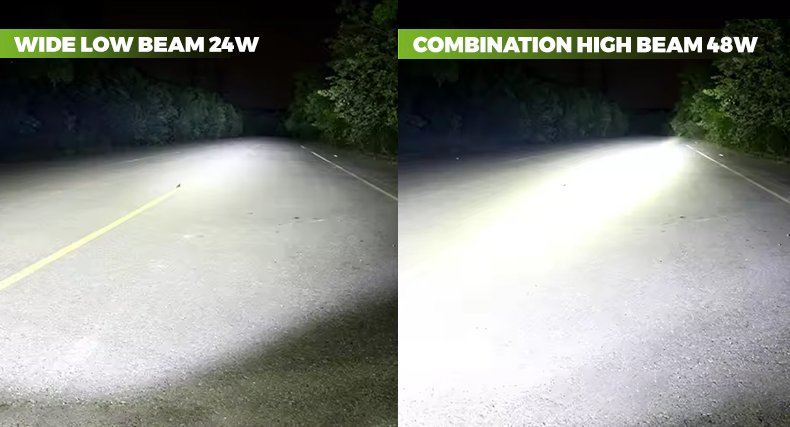
Cargo box and reefer headboard. Interior loading lighting has the tightest glare constraint of any position: walls reflect everything back at the loader’s eyes. A couple of well-diffused flood panels at the headboard beat a bare high-output bar; look for wide beam angles (120°+) and housings that wipe clean, because box interiors are washed and knocked.
Tailgate, rear door and lift gate. Rear-facing task lamps serve dock work, pallet handling and any job done at the back of the truck at night. This position is a weather and impact battleground — pressure washers, boot impacts, and road spray from the tyres below — so sealing and bezel protection decide service life more than optics do.
Chassis, body-side and equipment. Tippers, cranes, hooklifts and refuse bodies increasingly light their own machinery: a lamp on the ram, above the hopper, beside the control station. Bodybuilders specify these during construction, which means the wiring, brackets and spares strategy should be decided on the build drawing, not retrofitted at the first breakdown.
The Main Truck Work Light Formats
Three formats cover most duties. Compact pucks and mini panels (golf-ball to palm-size, typically flush or bracket-mounted) are the workhorses for boxes, tailgates and equipment nooks — low profile, easy to hide from impact, cheap enough to place several. Rectangular flood bars and panels deliver the bulk of cargo and yard lighting; they mount on the cab roof, headboard or crossmembers and come in raw or shielded variants. Combo marker/work lamps fold an FMVSS-107-style side or rear marker into a task lamp body, saving a hole, a circuit and an inspection argument on commercial builds — a favorite with bodybuilders who count wires for a living.
A fourth, increasingly relevant option is the plug-and-play replacement format: LED units that drop into existing incandescent work-lamp brackets and connectors, common on European trucks where the OEM wired a 12 V bay lamp from the factory. Where the connector is a known truck standard, these cut install labor to minutes per lamp — worth more across a 200-truck fleet than any lumen premium.
Electrical Integration: the Specification Nobody Wants to Read (Everyone Should)
Heavy-vehicle electrical environments are hostile in ways passenger wiring is not. A lamp rated “12 V” that sulks whenever the alternator load dumps is worthless. Concrete spec lines to demand:
- Wide voltage tolerance. Run the lamp across the full system envelope — 12 V e 24 V architectures with their charge-state swings (roughly 10–30 V depending on system and alternator regulation) — and ask the supplier how the driver behaves at both rails, including load-dump events.
- Transient immunity. ISO 7637-2 is the reference language for pulses on road-vehicle wiring; a pro lamp datasheet should answer it, not ignore it.
- Reversed-polarity and short protection built into the driver, since body-shop mistakes happen on real fleets.
- Parasitic drain. A lamp that leaks milliamps all week will flatten a parked reefer’s battery; get the quiescent figure in writing for anything wired to a permanent live.
- Connector strategy. Gel-sealed or boot-covered connectors, serviceable pins, and one common connector type across the lamp family. More field failures arrive at the plug than at the LED.
- Circuit protection and switching. In-line fusing sized to the lamp draw, relayed control from the switch rather than running lamp current through a cabin toggle, and — for trailer-facing positions — awareness of what the trailer electrical connector can actually supply before anyone “borrows” trailer power for a work lamp.
Optics: Enough Light, Not More
The failure mode in truck task lighting is not darkness, it is glare. Flood beams in a mirror-lined box bounce into the loader’s face; an unshielded bar on a visor turns every wing mirror into a spotlight. Match the optic to the job: flood (wide, 100–120°+) for interiors, tailgates and ground coverage close to the body; combo (flood plus a spot center) for yard and coupling duties where distance matters; diffused panels where people work directly under the lamp. On output, spec to the task: modern high-efficacy chips mean a box interior can be well served at output levels that would have sounded thin five years ago, and crews notice the difference between good distribution and raw numbers.
Ask suppliers for photometric files — an IES or EULUMDAT distribution, or at least a beam-angle drawing with a lux-at-distance table — before comparing two lamps on lumens. A manufacturer that runs an integrating sphere and beam photometry in its outgoing inspection (as part of XRLL’s nine-stage quality chain) can produce these numbers per model; a reseller of unbranded stock usually cannot.
Durability Specs That Predict Return Rates

- Ingress protection: IP67 as the working baseline for exterior positions; IP68 or a documented pressure-wash test where lamps live downstream of a wash bay. The seal line, the lens gasket and the connector count — a housing rating is only as good as its weakest entry point.
- Vibration: chassis and cab-outer positions see continuous broadband vibration; look for potted drivers, strain-relieved wiring and a stated vibration test rather than “shock resistant” hand-waving.
- Thermal headroom: LED life is a temperature story. A driver run below its ceiling with an aluminum body sized to sink heat outlasts a compact that leans on the airflow it never gets when boxed in by cargo.
- Corrosion: salted winter roads and coastal fleets justify stainless hardware and coated boards; ask what the salt-spray regime behind the claim is.
- Chip provenance: branded dies (OSRAM, Cree and equivalent) with a stated lumen-maintenance figure beat anonymous “super bright” claims — flux decay is the quiet failure that turns a fleet spec into a mixed bag by year three.
Truck Work Light Types Side by Side
| Format | Best Position | Optic | Watch-Outs |
|---|---|---|---|
| Compact puck / mini panel | Tailgate, box corners, equipment nooks | Wide flood | Easy to over-place; manage total circuit load and switch layout |
| Flood bar / panel | Cab roof, headboard, yard and coupling duties | Flood or combo | Glare in mirrors if unshielded; wind load and theft profile up high |
| Combo marker/work lamp | Body sides and rear on commercial builds | Task flood + regulated marker | Marker function carries road-legal obligations — confirm approval status per market |
| Drop-in replacement | OEM-bracket bay and step wells | Matched to original position | Connector compatibility must be verified against the actual truck make, not the catalogue photo |
| Cordless task lamp (vehicle-charged) | Inside boxes, tail lifts, anywhere a cable is a hazard | Flood, often dimmable | Runtime and charging discipline become fleet processes — covered in depth in our rechargeable battery-spec guide |
Compliance and Documentation: What to Ask a Supplier For
Position the paperwork question by market. For vehicles operating in Europe, E-marked lamps (the UN ECE regime, marked with an E-number circle) carry their approval into inspections and MoT-style checks without argument; XRLL’s certified lines include E-mark (E9) approvals held since 2017 alongside CE and RoHS documentation. For North American fleets, forward-road and marker functions reference FMVSS/SAE requirements and DOT alignment — a task lamp tucked under a tailboard is a different conversation from a lamp anyone can see from ahead, and a supplier who cannot tell you which conversation they are having is selling you a risk.
Whatever the market, demand report numbers tied to the exact SKU, and check that the certification body behind them is real. At factory level, ISO 9001 process discipline and a documented final-inspection stage are what make the paperwork mean something shipment after shipment — an importer buying lamp #404 does not care what lamp #17 passed.
A Body-Builder’s and Fleet’s Spec Checklist
- Define every lighting position on the build drawing, with switched-from-what for each — before the first chassis, not at PDI.
- One connector family across the truck; serviceable pins; a documented spare-parts path.
- Voltage envelope, quiescent drain and transient immunity stated per lamp, cross-checked against the truck’s actual electrical architecture (12 V vs 24 V, permanent live vs switched).
- Photometrics on file (beam angle + lux table minimum) so glare positions are resolved with data, not tape and a night shift.
- IP class matched to wash-bay exposure; vibration-proofed driver; hardware finished for the operating corrosion zone.
- Certification set matched to the registration market, with report numbers in the tender file.
- Supplier answers technical questions in 24 hours and can produce a pre-production sample on custom configurations — if they cannot, they are a catalogue, not a factory.
See how these positions are covered across a real manufacturer’s range on the XRLL LED work light line — chip grade, sealing tests and per-model certification documentation, specified the way a bodybuilder wants it.
Specify the Truck, Not the Catalogue
Send your mounting positions, electrical architecture and registration market to the XRLL sales desk — a Foshan factory running four assembly lines at 10,000+ units a day for fleets in 80+ countries — and get a per-position lighting plan with matching connectors and certification documentation inside 24 horas. OEM branding, beam variants and custom brackets run on in-house tooling, with samples before series production.
E-mail: service02@xrlledlight.com · Phone/WhatsApp: +86-15818025687
FAQ
Can I use any LED work light on a 24 V truck?
No — only lamps whose datasheet explicitly covers the 24 V architecture including its charge-voltage peaks and load-dump swings. Many “12 V” lamps fail early at 28 V-plus, and a driver rated for a wide envelope (roughly 10–30 V) with stated transient immunity is the correct specification for mixed 12/24 V fleets.
Do truck work lights need to be E-marked or DOT-approved?
Task lamps that only light cargo and ground positions generally fall outside forward-road lamp approvals, so a pure bay light does not carry the same obligations as a headlamp or marker. The moment a function is road-visible — markers, anything forward-facing, anything used while driving on public roads — the ECE (Marca eletrônica) or FMVSS/SAE (DOT) regime applies in the relevant market, and the supplier should state which tests back the claim.
How many work lights does a truck cargo box need?
Spec to the working plane, not a count: for a standard box, two diffused wide-flood units at the headboard typically deliver even, shadow-tolerant light at the floor through most of the load-out, where one high-output bar leaves hot spots at the door and dimness six metres in. If loaders describe the box as “dizzy” or keep repositioning a portable lamp, the layout — not the lumens — is the problem.
Why do fleet work lights fail at the connector more than the LED?
Because the connector lives at the intersection of vibration, water and electrolysis — the three things LED drivers lose to. Chassis motion worked into an unsealed plug pumps moisture in and out, corrosion raises resistance, voltage drops at the lamp, and diagnostics blame the light. Gel-sealed connectors, strain relief, correct pin plating for mixed metals, and one repeatable connector family across the fleet cut the failure rate more reliably than any lumen upgrade.


