
9-36V Wide Voltage LED Work Lights: Compatibility Across Fleet Types
A maintenance manager running a mixed fleet — 12 V service vans and light plant, 24 V diesel haulers and loaders, a couple of older machines that see jump-starts and a welder on the same battery — does not want three work-light part numbers. They want one lamp that behaves identically on every platform in the yard. That is the operational promise behind led work light wide voltage design, and the honest version of it is more specific than a “12V / 24V” sticker. A genuine 9-36 V input band is an engineering statement about the driver’s ability to hold steady, regulated output while the vehicle’s electrical system swings well outside nominal in both directions. Understanding what that band does and does not guarantee is how a fleet buyer stops paying for lighting that dies on the harshest machine in the yard.
Key Takeaways
- A “9-36 V” rating is a continuous operating band, not two nominal labels — it means one lamp can be stocked and fitted across 12 V and 24 V platforms without a transformer.
- Vehicle electrical systems do not sit at nominal: cold-crank sag, alternator over-voltage, load-dump spikes and reverse-polarity events are the real stress, and the driver’s job is to survive all of them.
- The input stage — regulated DC-DC with proper component ratings and clamping protection — is what turns a wide voltage label into stable, flicker-free light output.
- Standardising on one wide-voltage SKU cuts mis-orders, dead stock and diagnosis time for a mixed fleet, and simplifies OEM wiring built into the machine loom.
- EMC and inrush matter as much as the voltage band: a driver that noise-couples into vehicle electronics or trips breakers on cold start is not “compatible” in practice.
What 9-36V Actually Tells You About a Work Light
Nominal system voltage is a label; operating voltage is a range. A “12 V” vehicle spends real time well above and below 12 — sagging toward 9 V or lower as the starter draws current on a cold crank, and running at 13.8-14.4 V while the alternator charges. A “24 V” diesel system runs around 27-28 V charging and can dip to roughly 18 V or less on a cold start. A work light specified for 9-36 V continuous covers both platforms’ actual operating envelope with headroom, plus the transient excursions that a narrower “10-30 V” part would not shrug off. Some models extend higher still, for equipment on unusual or combined supplies.
The number’s value to a fleet buyer is standardisation: one part number that can be issued to a van, a skid steer and a 24 V dozer without a separate order, a separate install procedure and a separate failure history per platform. The equivalent reasoning for forklift fleets — where the 12 V / 24 V / 80 V lift-battery landscape is even wider — is worked through in our forklift headlight and work-lamp voltage compatibility guide, and the same band logic applies across the machine fleet.
Почему “12V / 24V” Labels Fail on Real Vehicle Systems
The most common field complaint about a work light sold as “12/24 V” is that it flickers, dims or dies on exactly the machines it nominally fits. The reason is that a dual-nominal label is not the same as a wide-input design. Two-part failure:
Under-voltage at start. A cheap driver regulating from a fixed input threshold drops out when the supply sags on a cold crank, so the lamp blinks or resets at the worst possible moment — reversing in the dark at shift start. Over-voltage and transients at the other end: а “12 V” lamp fed from a charging alternator on a 24 V system, a jump-start done backwards, or a welder-coupled circuit sees voltages it was never designed to clamp. Load dump — the voltage spike thrown when an alternator stops charging into a loaded circuit — can push tens of volts into the harness. A properly engineered 9-36 V fixture is designed against this whole excursions envelope, not just two nominal points. For agricultural machines that idle long hours on variable engine speed, the same electrical reality is covered in our tractor work-light voltage and mounting guide.
The Input Stage: How a Wide-Voltage Driver Holds Output Steady
Between the vehicle’s messy supply and the LED chips sits the driver, and on a wide-voltage fixture that front end is the whole ballgame. Its job is to convert any input inside the band into the constant, regulated current the LEDs need, so a lamp on a sagging cold-crank and a lamp on a hot charging rail put out the same steady beam with no visible flicker or dimming. Two design points decide whether a “9-36 V” label is real:
First, regulation topology and component ratings. A switching regulator with correctly rated input capacitors, MOSFETs and inductor can maintain output across the band; a linear or under-rated design can only do it in a slice of the band and quietly drops out elsewhere. Second, protection. Clamping stages that absorb load-dump and reverse-polarity events are what keep the driver alive on the machines where the harness is hostile — jump-starts, welding circuits, backward battery connections. Inrush current is the unglamorous third: a fixture that gulps current on switch-on will nuisance-trip a shared circuit when ten lamps come on together on a cold morning, so a fleet-grade design limits it. These are the properties behind the work-light range specified for 9-36 V on the XRLL LED work light line.
Reading the Electrical Spec Table for a Mixed Fleet
The practical takeaway for a maintenance manager is that the vehicle’s real electrical behaviour, not its badge voltage, is what the lamp must meet. Roughly, the platforms in a yard look like this:
| Platform | Nominal | Cold-Crank Sag | Charging / Transient | Why a 9-36 V Band Fits |
|---|---|---|---|---|
| Petrol van / light plant | 12 V | down to ~9 V or less | ~14 V charging, load-dump spikes | Band covers the sag and the charge rail without dropout |
| Diesel loader / dozer / hauler | 24 V | ~18 V or lower | ~27-28 V charging, high transients | Upper band absorbs the higher charge and spike energy |
| Older / jump-started machine | 12 or 24 V | erratic | reverse polarity, welder coupling | Protection stages, not just the band, keep it alive |
| Combined / special-supply equipment | varies | depends | can exceed standard rails | Extended-voltage models (higher than 36 V) cover these |
The one-SKU conclusion: standardising on a wide-voltage fixture with real protection lets the storeroom issue the same lamp to every line in that table, which is where the maintenance savings actually live — fewer part numbers, fewer wrong fits, one failure history to learn from.
Transient Protection and EMC in a Wide-Voltage Fixture
Wide voltage compatibility is not only about the steady-state band; it is about noise and transients. A vehicle-mounted switch-mode driver on a long harness is both a victim and a source of electrical disturbance. As a victim it needs clamping against load-dump and reverse-polarity pulses; as a source it must not radiate or conduct interference into the machine’s radios, grade-control receivers and engine electronics. That is the job of CISPR 25 Class 4 EMC design — the work-light range is built to that class so it does not interfere with vehicle electronics or radio — and the mechanism is unpacked in our CISPR 25 EMC compliance explainer. For the broader electrical, ingress and vibration spec that sits alongside voltage on a working machine, the industrial work-light sourcing guide for fleet buyers ties the whole set together.

How the Voltage Rating Is Proven on the Line
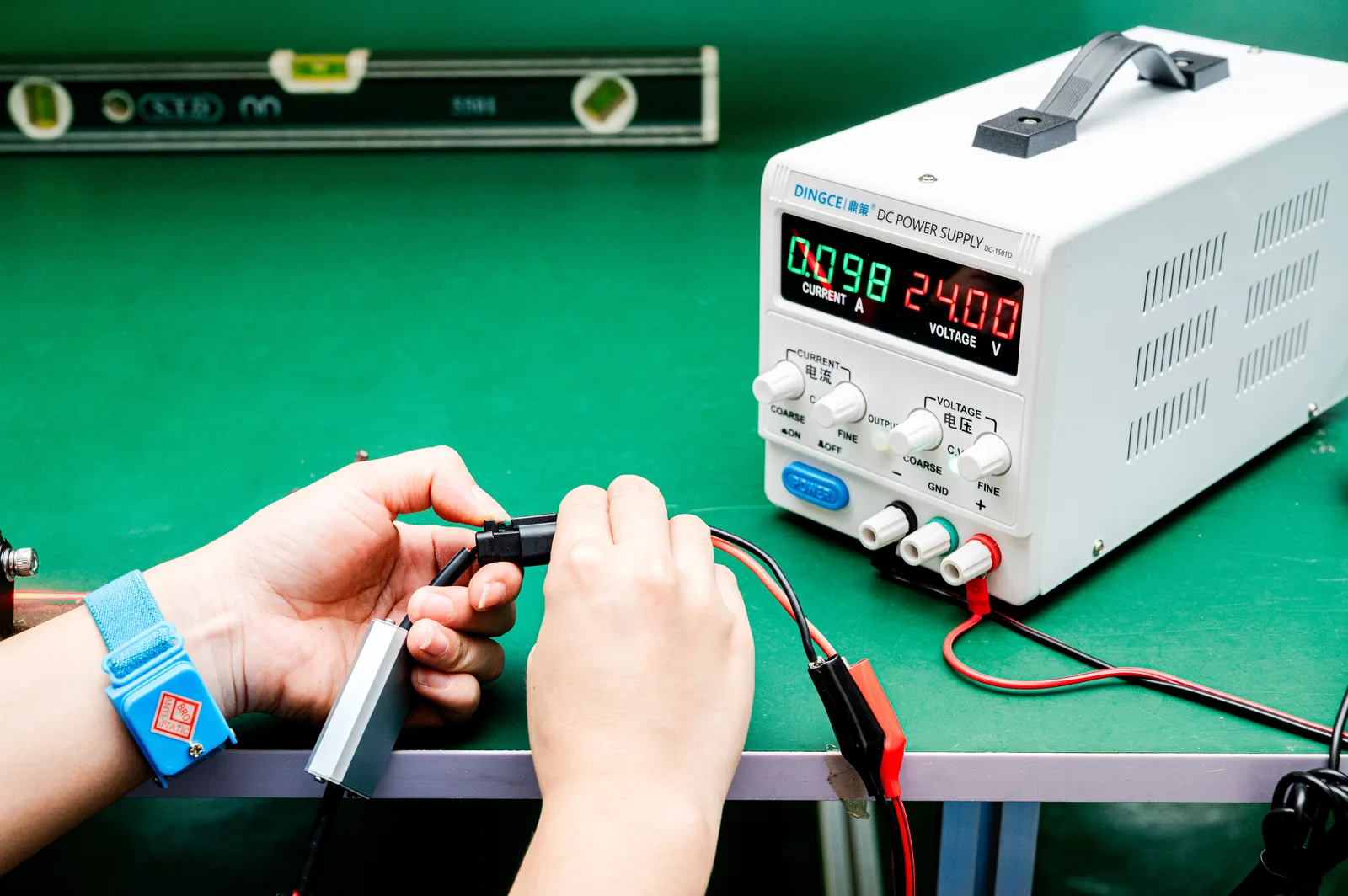
A voltage band is only worth the production test behind it. On a heavy-duty line, the relevant check is a dedicated voltage and electrical-safety station where finished units are exercised across their input range and their protection behaviour is confirmed, not sampled once at type-test. At XRLL this is one of nine standing quality gates — positioned alongside LED chip incoming inspection, IP68 sealing, vibration and shock, and high-low temperature aging, with a final pre-shipment check — which means every lot that ships has actually run the electrical envelope rather than inherited a certificate from the model’s launch year. Ask any supplier which electrical tests are line checks versus type tests; the gap between the two is where mixed-fleet warranty claims come from. It is also the honest context behind a lifespan claim, since driver thermal and electrical stress are the two clocks that usually end a lamp’s life first.

The Fleet Manager’s Wide-Voltage Checklist
- Confirm a continuous operating band (e.g. 9-36 V), not a “12V / 24V” nominal label, and ask whether the upper models cover your highest-charge-rail machines.
- Require documented cold-crank dropout behaviour — the lamp must stay lit and steady when the supply sags on start.
- Ask for load-dump and reverse-polarity protection design (clamped stage, not just a fuse), especially on jump-started or welder-coupled equipment.
- Check inrush current so a bank of retrofit lamps does not nuisance-trip a shared circuit on cold morning switch-on.
- Verify CISPR 25 Class 4 EMC so the driver does not disturb radios, grade control or engine electronics.
- Confirm voltage and electrical-safety testing is a standing production line check you can get per-lot evidence for.
- Standardise on one wide-voltage SKU across the mixed fleet to cut part numbers, mis-fits and split failure data.
Standardise your fleet on one voltage-safe work light
Send your platform mix (12 V / 24 V, any special-supply machines) and mounting count. XRLL recommends a single wide-voltage SKU with the right protection and EMC class, with OEM harness options, and replies within 24 часы.
Frequently Asked Questions
Is a 9-36V work light really OK on both 12V and 24V vehicles?
Да, when it is a true continuous band rather than two nominal labels. A 9-36 V fixture covers a 12 V system’s sag to around 9 V on a cold crank and its ~14 V charge rail, and a 24 V diesel system’s ~18 V cold start and ~27-28 V charge, with headroom for transients. That lets a mixed fleet stock one part number instead of a separate 12 V and 24 V lamp, provided the driver also has proper regulation and protection across that span.
Why do cheap “12/24V” work lights flicker or fail on my machines?
Because a dual-nominal label is not a wide-input design. Under-built drivers drop out when the supply sags on cold crank and cannot clamp load-dump spikes, jump-start over-voltage or a reversed polarity event, so the lamp flickers, dims or dies on exactly the machines it nominally fits. A real wide-voltage fixture regulates across the whole band and protects against those transients rather than only meeting two bench voltages.
What is load dump and why does it matter for work lights?
Load dump is a high-voltage transient thrown onto the vehicle’s electrical system when an alternator stops charging into a loaded circuit — for example a battery cable lifting or a sudden big-load release. It can push tens of volts into the harness for a longer pulse than ordinary spikes. Work-light drivers that lack a clamped protection stage can be destroyed by a single load-dump event, so on 12 V and especially 24 V machines the load-dump protection design matters more than the nominal voltage label.
Does wide-voltage design affect EMC and other electronics?
It should, and a good fixture controls it. A switch-mode driver operating across a wide input range is also a potential noise source conducted and radiated onto the machine harness, which can disturb radios, grade-control receivers and engine electronics. Engineered wide-voltage work lights are built and tested to CISPR 25 Class 4 so the driver stays quiet, which is a practical part of being “compatible” on a modern vehicle beyond simply accepting the voltage.
Can I order OEM wide-voltage work lights wired into my machine?
Да. Equipment brands can specify a wide-voltage fixture with custom wiring harnesses built into the machine loom, along with logo, beam and housing options, with samples and electrical testing confirmed before volume. Send your platform voltages, mounting count and harness requirements for a single-SKU recommendation and a quote within 24 часы.


