AGV Laser Guidance Systems: Safety Standards for Autonomous Warehouses
An automated guided vehicle moves a pallet through an aisle without a driver watching for the person who just stepped around the racking. That single sentence is why AGV safety is a systems problem, not a sensor problem — and why “laser” shows up twice in the conversation with two different jobs. Laser guidance lets the vehicle know where it is; laser-based safety systems let the vehicle know when a person is in its way. Warehouse automation integrators and fleet operators specifying autonomous traffic need both layers documented to the right standards before the first AGV shares an aisle with a forklift. This explainer untangles the two meanings of “AGV laser guidance system” and lays out the safety-standards checklist a buyer should hold suppliers to.
Key Takeaways
- “AGV laser guidance” covers two distinct technologies: laser navigation, which positions the vehicle, and laser safety sensing/projection, which protects people around it. Buyers must specify both.
- Driverless truck safety is governed by a standard family — ISO 3691-4 for driverless industrial trucks, ANSI/ITSDF B56.5 for guided and remote industrial vehicles, with safety-control-system and risk-assessment standards sitting underneath.
- Personnel protection is built from redundant layers: safety laser scanners that command speed zones and stops, plus visible presence cues (blue spot, projected zone lines, strobes) so pedestrians know a vehicle is coming.
- The detection envelope must exceed stopping distance at the vehicle’s maximum configured speed, including load, floor, and latency — this is the number to demand in writing.
- Ask for the classification and performance-level documentation per component, matched to the exact AGV model and duty, exactly as you would for any certified safety product.
The Two Meanings of Laser Guidance
The phrase collides two engineering domains, and confusing them causes real specification errors.
Laser navigation answers “where am I?” A rotating laser rangefinder on the AGV measures angles and distances to fixed reflectors on walls and racking (laser triangulation), or builds a map of natural features and matches the live scan against it (laser SLAM). This is how an autonomous vehicle follows a route without magnetic tape or wire in the floor. It is a positioning technology.
Laser safety sensing answers “is something in my path?” A safety laser scanner projects a fan of laser across the floor in front of and around the vehicle and treats any interruption of the beam field as an object — usually a person — that must trigger a slowdown or stop. Separately, laser projection puts a visible line or zone marker on the floor so a person can read the vehicle’s intended path and safe standoff distance.
Navigation keeps the AGV on its lane. Safety sensing and projection keep people out of trouble with it. A procurement that specifies only the first has bought half the system.
How Laser Navigation Shapes the Safety Problem
Laser navigation is more flexible than tape or wire guidance, and that flexibility is precisely what raises the stakes for pedestrian safety. A tape-guided truck largely does one thing; an SLAM-navigated fleet reroutes dynamically, merges at intersections, and sends vehicles down aisles that were empty a shift ago. The safety envelope cannot be hard-wired to a fixed path — it has to react to wherever the vehicle is actually going.
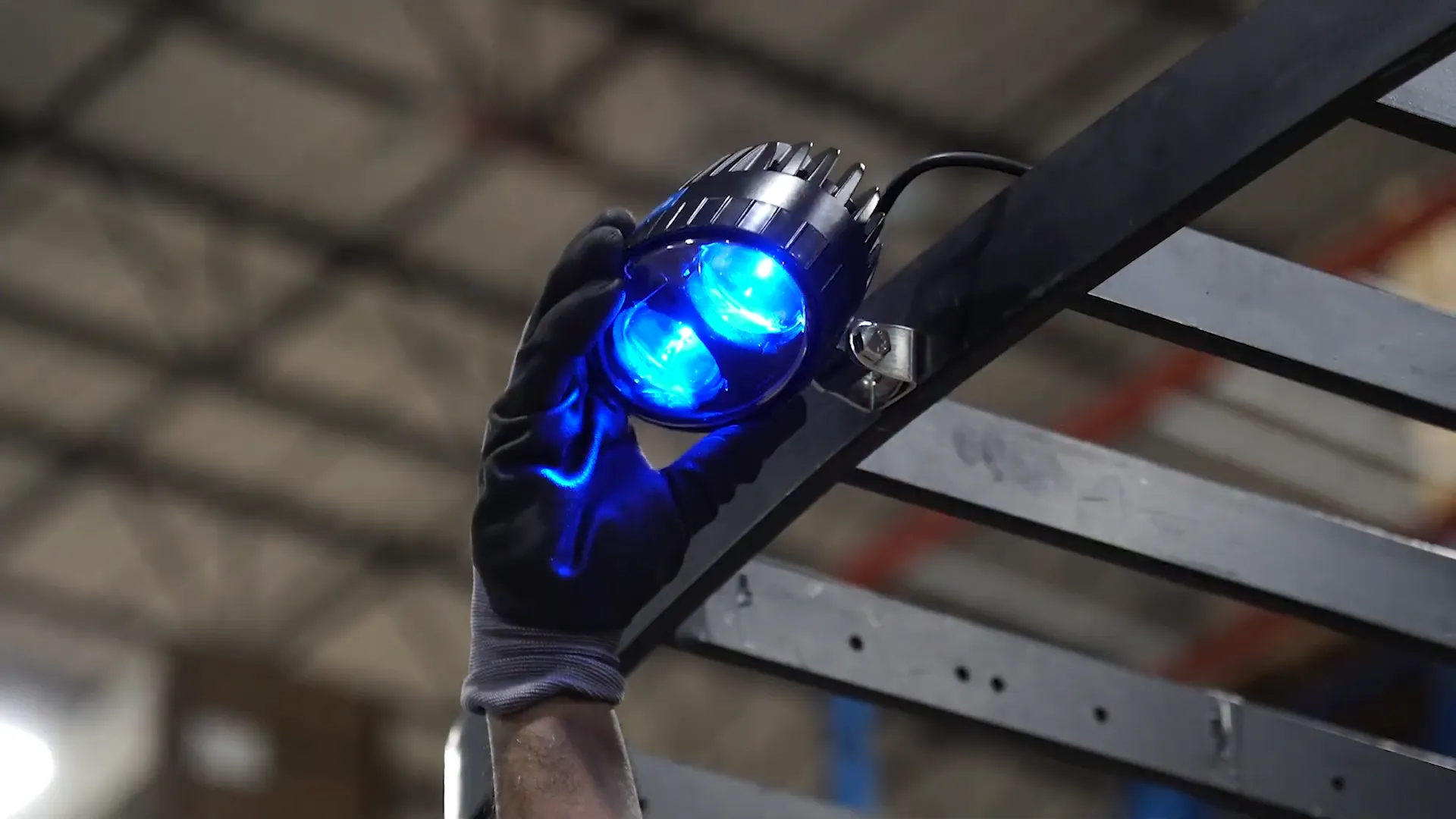
That is why modern AGV safety layers combine the navigation controller with independent safety devices: certified safety laser scanners that define protective and warning fields around the moving vehicle, and presence lighting — blue spots, projected zone lines, strobes — that makes the vehicle legible to a human who was not looking where they were walking. The scanner protects the machine’s blind logic; the lighting protects the person who never saw it coming.
The Standards Framework an Integrator Must Satisfy
Autonomous warehouse vehicles do not fall under ordinary forklift rules alone; the driverless case has its own standard family. Rather than recite clause numbers, integrators and buyers work to what each layer of the framework governs.
- ايزو 3691-4 is the core safety standard for driverless industrial trucks and their systems — covering vehicle design, load handling, and critically the means by which the vehicle detects and responds to persons and obstacles.
- ANSI/ITSDF B56.5 is the North American safety standard for driverless, remote-controlled, and automatic guided industrial vehicles, addressing automatic detection, warning devices, load retention, and maintenance.
- Risk-assessment and safety-control standards sit beneath both: a documented task-based risk assessment (ايزو 12100 methodology) and safety-related control functions graded to a performance level (ايزو 13849) or SIL (اللجنة الانتخابية المستقلة 62061). This is where the “how reliable must the stop function be” answer comes from.
- اللجنة الانتخابية المستقلة 60825 classifies the laser products themselves for eye safety — relevant to both the navigation and projection emitters.
The practical buyer question is not “is this standard-compliant” in the abstract but “show me the documentation for this AGV model at this duty”: the risk assessment, the scanner’s declared performance level, the stopping-distance calculation, and the laser classification for each emitter. Vendors who have engineered to the framework produce these readily.
Designing the Detection Envelope
The single most important safety number on an AGV specification sheet is the relationship between detection range and stopping distance.
A safety scanner is configured with two concentric zones: أ warning field that requests a speed reduction when a person enters it, and a protective field that commands a stop when the field is broken. The protective field must be long enough to cover the vehicle’s full stopping distance at its maximum permitted speed — loaded, on the worst floor condition, plus the response latency of the scanner, controller, and brakes summed together. Get that margin wrong and the vehicle can occupy the same space as a person before it stops.
Because speed and load change with duty, integrators set multiple scanner profiles — faster and wider-field down a clear travel aisle, slower and tighter in a pick face or a pedestrian crossing. Muting (temporarily allowing the protective field to be ignored, for example when the vehicle passes its own docking structure) is a legitimate and necessary feature, but it must be engineered and documented, never improvised to stop nuisance halts.
Mixed Traffic: The Real Hard Case
A fully segregated AGV zone with no people is easy. Most autonomous warehouse deployments are not that — they are mixed traffic where AGVs, manned forklifts, and pedestrians share aisles, dock doors, and blind corners. Three design rules keep mixed traffic survivable.
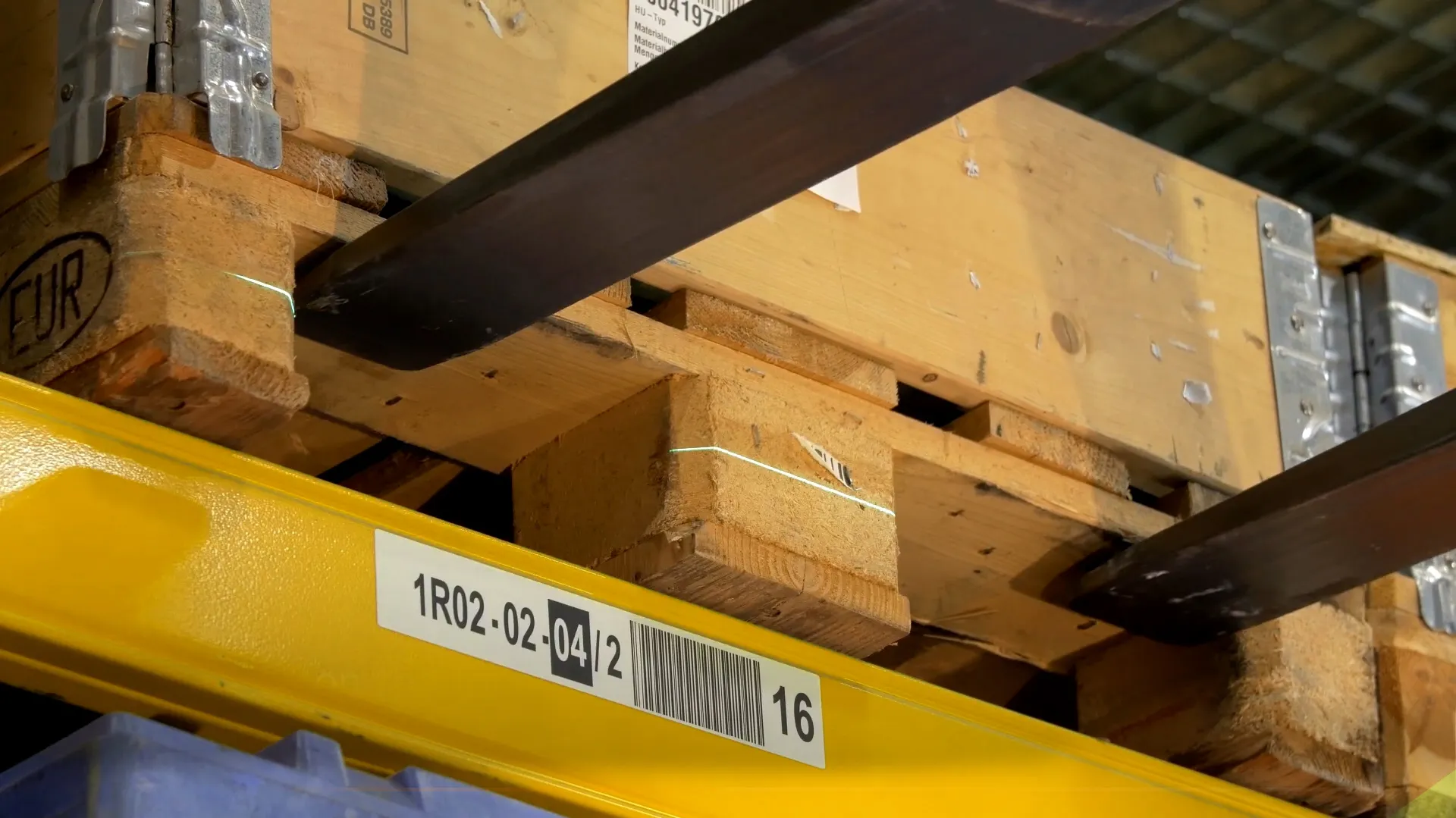
- Make the invisible vehicle visible. Because an AGV runs quietly and has no eye contact or horn-and-wave negotiation, it must announce itself with presence lighting. Blue spot lamps mark the vehicle’s leading and trailing edges on the floor; projected zone lines and strobes signal motion and intent. This is the layer a driverless truck needs more than a manned one, not less.
- Engineer the conflicts, do not policy them away. A sign saying “watch for AGVs” is not a control. Mark crossings and merge points with projected boundaries and physical or virtual speed zones; let the scanner do the protecting.
- Protect the shutdown and recovery path. The safety functions must fail safe — a fault drives the vehicle to a stop, not to a run — and restart after an e-stop or a blocked field must not surprise a person standing in the now-live path.
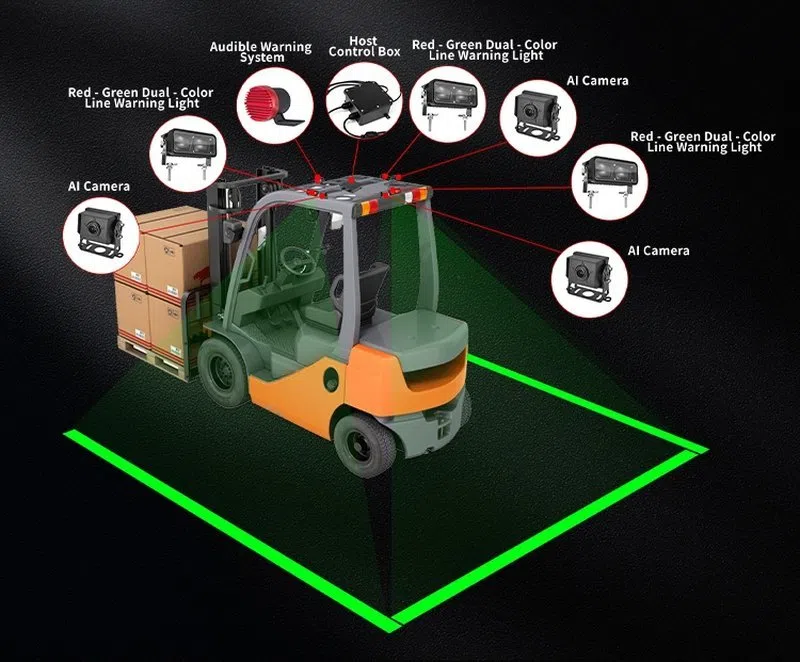
This is the design space XRLL’s AI safety systems address. Its XRL1341 detection platform uses three AI cameras for 360-degree coverage to catch pedestrians 6–7 m ahead and trigger an audible-and-visual alarm, in an IP67 housing aligned to powered-industrial-truck duties under OSHA 1910.178 — the same “detect early, announce clearly” logic an autonomous fleet needs, applied whether the vehicle is driven or driverless.
How the Safety Layers Compare
| Layer | Function | Who it protects | Documentation to request |
|---|---|---|---|
| Safety laser scanner | Detects intrusion; commands slowdown/stop | Person in the path | Declared performance level + field config |
| AI pedestrian detection | Recognises people at distance; alarms | Person outside the scanner field | Detection range + IP + standard alignment |
| Presence lighting (blue/zone) | Makes vehicle location/intent visible | Person not looking | Photometrics + laser class |
| Vehicle controller / e-stop | Executes stop; fails safe | Everyone | Risk assessment + stopping calc |
Each layer fails differently, which is the point: a person who never heard the vehicle sees the blue spot; a person who steps in silently breaks the scanner field; a sensor fault stops the truck. No single device is trusted alone.
A Procurement Verification Checklist
Before signing an AGV or AGV-retrofit safety package, confirm the file contains: a task-based risk assessment for the deployment; the scanner’s declared performance level and the configured warning/protective fields; a stopping-distance calculation showing the protective field covers max-speed, loaded, worst-floor, worst-latency conditions; the laser classification (اللجنة الانتخابية المستقلة 60825) for every navigation and projection emitter; mute logic documented and justified; and the presence-lighting specification matched to the vehicle’s duty cycle. A supplier who can walk through all seven has built to the standards; one who treats them as optional has not.
Deploying AGVs or Automating Mixed Traffic?
Describe your vehicles, aisle widths, speeds, and pedestrian crossings to XRLL. You will receive a layered safety-lighting and detection proposal — blue spot, projected zone lines, strobes, and AI pedestrian detection — with model-specific documentation and a quotation within 24 ساعات. OEM and ODM programmes supported from the 17,000„ Foshan plant.
بريد إلكتروني: Service02@xrlledlight.com| Phone/WhatsApp: +86-15818025687
Frequently Asked Questions
Is AGV laser navigation the same as a laser safety scanner?
لا. The navigation laser finds reflectors or maps features to position the vehicle. A safety laser scanner projects a monitored field and commands a speed change or stop when something breaks the beam. They share a word and a physics, but they are separate subsystems with separate certifications, and you need the safety one regardless of how the vehicle navigates.
What standard covers driverless forklifts and AGVs?
ايزو 3691-4 is the principal international safety standard for driverless industrial trucks, with ANSI/ITSDF B56.5 covering guided and remote industrial vehicles in North America. Underneath them sit risk-assessment and safety-control-system standards, and the laser products themselves are classified under IEC 60825. Ask your supplier which of these each component is documented against.
Why do AGVs need warning lights if they have safety scanners?
Because a scanner protects against collisions but not against surprise. A pedestrian who does not see an approaching silent vehicle can startle, step back into another lane, or cross behind it. Visible presence cues — blue spots marking the vehicle edges, projected zone lines, strobes — give people the awareness a stop command cannot, and they are recognised as a required layer in the vehicle standards.
How far should an AGV detect a pedestrian before stopping?
Far enough that the protective field always exceeds the real stopping distance at maximum configured speed — loaded, on the worst floor, adding the detection, control, and brake latency together. There is no universal metre figure; it is computed per vehicle and duty. Demand the stopping-distance calculation and confirm the scanner’s protective field covers it with margin.
Can existing manned forklifts get the same laser safety systems?
Often yes, and it is a common first step before going fully autonomous. Pedestrian-detection cameras, blue spot and zone-projection lights, and strobes retrofit to powered forklifts to reduce struck-by incidents in mixed traffic. A retrofit programme also lets you standardise the visual safety language across manned and driverless fleets, so workers read one consistent set of cues.


