
Construction Equipment Lighting: Specs for Excavators and Loaders
An excavator working a night pour and a wheel loader cycling a stockpile do not fail their lighting for the same reason a warehouse forklift does. Construction equipment lighting has to survive a moving, dirty, electrically hostile machine while throwing usable light exactly where an operator, a spotter and a grade sensor need it — and it has to keep doing that across 12 V skid steers and 24 V dozers on the same yard. The machines carry their own vibration spectra, their own dust chemistry and their own load-dump transients, so the specification you sign off on reads less like a catalog line and more like a parts list for the vehicle. This guide walks the specification decisions a fleet or rental buyer makes for excavators and wheel loaders: mount geometry, beam selection, the electrical band, the ingress and vibration ratings, and the evidence a heavy-duty supplier should hand you before a single bracket is bolted to a boom.
Key Takeaways
- Construction equipment lighting is a machine spec, not a product category — the same IP68 work light lives for five years on a cab roof and six months on a boom root, and the difference is mounting and vibration class, not the lamp.
- Excavators need layered beams: a wide flood over the dig face, a spot down the haul path, and blue-zone or strobe warning coverage of the swing radius where ground crews walk.
- Wheel loaders punish lighting with cyclic reverse operations, bucket-jaw shock and wind-blown stockpile dust — seal aging and bracket fatigue matter more than the peak-lumen number on the box.
- The site fleet is a mixed-voltage environment; A 9-36 V input band with load-dump and reverse-polarity protection lets you standardise one part number across 12 V and 24 V machines.
- Evaluate a supplier on standing production QC — IP68 sealing, 10 G vibration, high-low temperature aging, electrical safety — not on a launch-year type-test certificate.
Why Construction Equipment Lighting Is Its Own Specification
On a fixed structure, a luminaire fails from one thing at a time. On a mobile machine it fails from all of them at once. An excavator combines the four stressors that kill lighting: continuous broadband vibration through the undercarriage, impulsive shock through the boom every time the bucket bites rock, abrasive silica and limestone dust that finds any optimistic seal, and a 24 V diesel electrical system that throws load-dump transients no datasheet bench test ever reproduces. Add wash-down cycles that arrive without warning and overnight temperature swings that pump dust and moisture through every non-sealed path, and the lighting on the machine is working harder than lighting in almost any fixed industrial setting.
That combination is why a buying decision that looks like “pick a bright work light” is really a systems decision. The lamp, the bracket, the wiring harness, the fused circuit and the position on the machine are one product. Fleet buyers who spec them together get lighting that disappears from the maintenance report; those who treat it as a consumable and swap in whatever is in stock pay for it in replacement labour on machines that were scheduled to be producing. For the underlying durability mechanisms, our companion piece on mining and quarry work-light vibration and dust resistance covers the same failure physics on even harsher duty cycles.
Excavators: Lighting the Dig Face and the Swing Radius
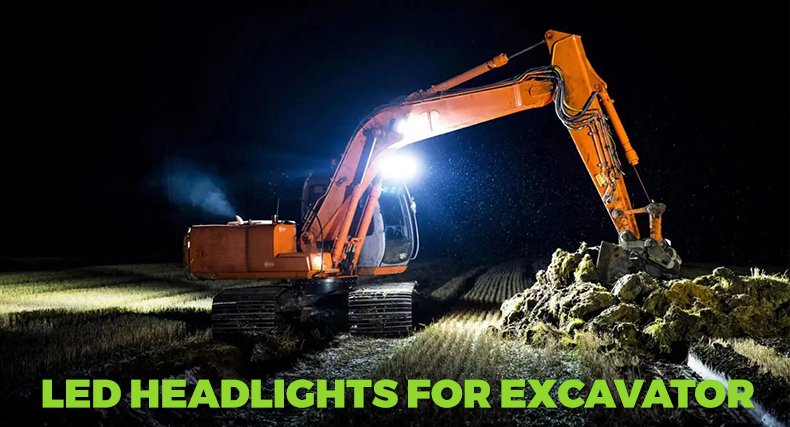
An excavator runs two lighting problems at once. The first is task lighting — putting usable, low-glare light on the bucket, the trench bottom and the material being sorted, so the operator can judge depth and edge without straining. The second is area and safety lighting — making the machine visible and marking the swing radius and counterweight where a spotter or labourer might step into the path of a rotating upper structure.
For the dig face, mount position beats raw output. A flood or combo unit on the right-hand cab corner or boom base throws light forward and down where the bucket works, but pure flood close to the cab can wash out the operator’s own reflection in the glass on night swings. The practical build pairs a wide flood for the immediate work zone with a spot that reaches down the haul path or into a deep trench — the same spot-and-flood logic we break out in the work-light wattage and application-matching guide. For the safety side, blue-zone projection and strobe warning coverage of the swing radius marks the danger envelope on the ground without the operator needing to look for it.
Undercarriage and counterweight lighting is the third layer, mostly for machines that travel public-road segments or work live traffic. These positions see the worst of the shock and road-spray environment, so they want the same IP68 sealing and vibration class as the primary work lights, not a lighter-duty unit because “it’s just a marker.”
Wheel Loaders: Cyclic Load, Dust and Reverse Operations
A wheel loader is, from a lighting standpoint, a harsher machine than an excavator in three specific ways. It works in reverse constantly — backing into a muck pile, dumping into a hopper — so the rear and side of the machine need working light, not just a beacon, and the reversing cycle loads the electrical and mounting hardware differently than a mostly-forward duty.
Second, the bucket jaw and the pivot pins throw impulsive shock straight back through the frame into whatever is mounted on the cab ROPS or the lift arm. A flat-stock bracket resonates at that frequency and walks its fasteners loose within weeks; engineered die-cast or thick steel brackets with prevailing-torque hardware and isolation are the difference between a six-month and a five-year service life on the same part number.
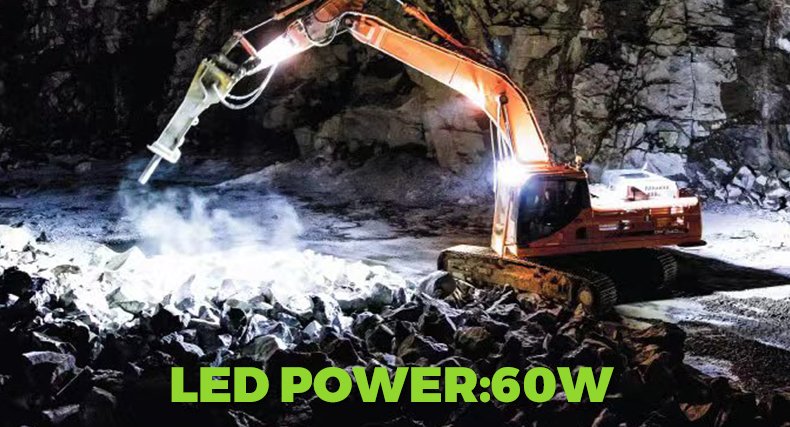
Third, a loader handling aggregate, stockpile or muck works in airborne dust that is abrasive and fine. Silica and limestone behave like slow sandpaper on gasket faces and lens surfaces. Dust ingress is a sealing-system failure rather than an IP-rating failure — the rating measures a clean sample at one moment; the yard measures how the sealing ages over a hundred wash-downs. Specify the seal material and ask what the supplier’s production line checks per lot, not just the type-test certificate that got the product launched.
Matching Beam Pattern to the Construction Task
Beam choice is where most construction lighting specs go wrong, because buyers default to “brightest wins.” On a machine close to crews and reflective surfaces, glare and wash-out cost more productivity than a few hundred missing lumens. The honest mapping for excavators and loaders looks like this:
| Beam / Light Type | Best Task on an Excavator or Loader | Why It Fits |
|---|---|---|
| Flood (wide) | Dig face, trench bottom, sort/grading work close to the machine | Even, low-glare coverage of the immediate work zone; reduces operator eye strain on detail work |
| Spot (narrow) | Down the haul path, deep excavations, long-throw visibility | Concentrates output into a cone for distance; pairs with flood so the near field is not left dark |
| Combo (spot + flood) | General-purpose primary work light on a shared fleet unit | One unit covers near and far, simplifying SKU count when machines rotate between tasks |
| Blue-zone / red-zone projection | Marking the swing radius, rear path and pedestrian danger zone | Projects the hazard boundary on the ground so crews stay clear without the operator scanning mirrors |
| Strobe / beacon warning | Machine conspicuity in mixed-traffic and low-light site conditions | Makes a slow-moving or reversing machine visible against a cluttered site backdrop |
The construction conclusion: you rarely spec one beam. A typical excavator build is a combo work light on the cab corner plus a flood over the swing motor plus blue-zone and strobe coverage of the ground envelope, all fed from the same machine circuit. For the product families that fill those roles, the machine-mounted lines sit under our LED work light range, and the warning and zone-marking side is grouped under the construction and heavy-equipment lighting solutions.
The Electrical Specification: 9-36 V Across Site Power
A contractor’s yard is a mixed-voltage world. Compact excavators, skid steers and light plant run on 12 V systems; full-size dozers, wheel loaders and large haul machines run 24 V diesel. Buying a lamp that honestly covers 9-36 V continuous lets you standardise on one part number across that whole fleet instead of stocking two SKUs and mis-ordering between them. That is the practical value of a wide input band, and it is why the machine lighting we specify is built for 9-36 V (with some models extending higher), covering both 12 V and 24 V platforms without a separate transformer.
But the voltage label is the beginning of the electrical spec, not the end of it. A 24 V diesel system is not the clean bench supply a datasheet implies. Load dump when the alternator stops charging a loaded circuit throws tens of volts of transient; jump-starts and welder circuits introduce reverse-polarity and over-voltage events; inductive loads switching create spikes. A work light’s driver is the component that absorbs all of that, and under-built drivers in well-built housings are a staple construction-fleet failure. Write the electrical lines the way the machine’s own engineers would: the true voltage band, transient and load-dump protection design, inrush current (so ten retrofit lamps on one switched circuit do not nuisance-trip a breaker on a cold start), and reverse-polarity protection.
EMC belongs on the same line. Switch-mode drivers on long machine harnesses are noise sources, and on a site with radio comms, grade-control receivers and blasting systems in proximity, conducted noise is an operational problem, not a lab formality. Our work-light range is built to CISPR 25 Class 4 so it does not interfere with vehicle electronics or radio; the mechanism behind that requirement is covered in the CISPR 25 EMC compliance explainer for vehicle-mounted work lights.
Ingress, Vibration and Lens Ratings That Survive the Site
Three ratings carry most of the construction-durability weight. First, sealing: IP68 — dust-tight and rated for temporary immersion — is the target for machine-mounted work lights that face wash-down and rain-driven dust slurry; the practical distinction between IP67 and IP68 for these fixtures is laid out in our IP67 vs IP68 comparison. Second, vibration: mount mass and isolation matter, and units that clear a 10 G vibration class with the assembly mounted in its real bracket survive the boom-root positions that kill lighter lamps. Third, the lens: an outdoor machine in sun and abrasive air yellows and hazes polycarbonate; a UV-coated PC lens that resists yellowing across years of exposure keeps the beam you specified on the ground where it was designed, instead of scattering it. A die-cast aluminium housing that also handles the site’s heat load is covered in depth in the work-light lifespan claims guide.
Smart Work Lights: Dial In Colour and Output for the Conditions
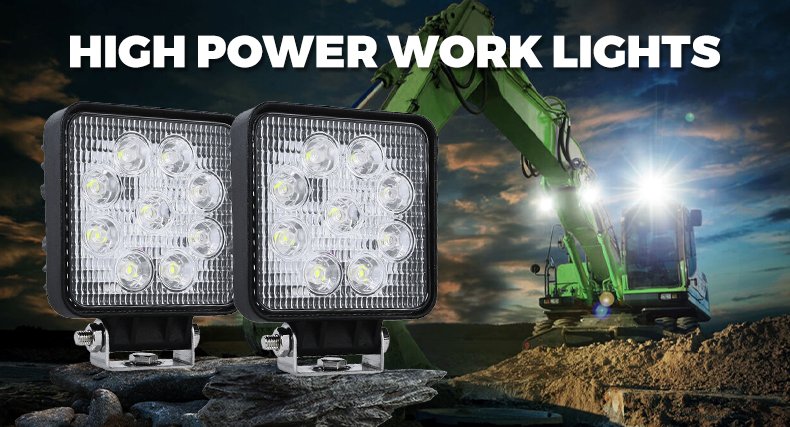
A useful subset of machine lighting lets the operator adapt the beam to the job rather than accepting one fixed compromise. XRLL’s intelligent work-light line for mining, construction and forestry lets the operator switch colour temperature between warm and cold white for fatigue-free visibility in different conditions, select green or amber output that measurably improves contrast in dust, fog, rain or snow, and dim the beam to avoid self-glare off a reflective bucket or neighbouring machine — with a daytime-running function that trims power draw when full output is not needed. This is not a gimmick category: on a site where the same loader runs a sunny stockpile in the morning and a foggy pour at dusk, the ability to change light colour and intensity on the fly directly affects how much the operator can see without adding glare to everyone else on the pad. Custom beam and configuration options are available for OEM orders where an equipment brand wants the control set built into the machine harness from the factory.
The Rental and Fleet Buyer’s Construction Lighting Checklist
- Mount plan first: specify position, bracket material and load rating per machine, and reserve boom-root positions for the highest vibration class — the same part number lives very differently on a cab roof than on an arm.
- Beam layering: combo or spot-and-flood for task light, plus blue-zone and strobe for the pedestrian and swing-radius envelope; do not rely on one “brightest” unit.
- Electrical honesty: true 9-36 V band, load-dump and reverse-polarity protection, published inrush, CISPR 25 Class 4 EMC.
- Sealing and vibration: IP68 with named seal material, 10 G vibration class tested in the real bracket, UV-stabilised lens to hold the beam over years.
- Wattage discipline: match 10 W pods to 150 W flood panels to the actual task and mounting distance rather than maxing every position.
- Supplier evidence: ask what the production QC line checks per lot, not which certificates hung on the wall the year the model launched.
- Serviceability: brackets, lenses and driver modules as orderable wear parts with published numbers, so a rental fleet can turn a damaged unit in an hour instead of a week.
Spec your excavator and loader lighting with the manufacturer
Send your machine types, mounting positions and site power (12 V / 24 V mix). XRLL engineers recommend beam, voltage and sealing configuration against your duty cycle, with OEM and custom-beam options for equipment brands, and reply within 24 Std..
Frequently Asked Questions
What wattage LED work light do I need on an excavator?
Match wattage to the task and mounting distance, not to the brightest option. Close dig-face and grading work is well served by 20-40 W flood or combo units on the cab corners; long-throw visibility down a haul path or into a deep trench wants higher-output spot or combo units in the 60-100 W range. A typical excavator build mixes several of these rather than putting a single 150 W panel on every position, because over-powering near-field lighting creates glare that costs the operator more than the extra lumens gain.
Can one work light fit both 12 V and 24 V machines on my yard?
Ja, if it carries a genuine wide input band. A fixture rated for 9-36 V continuous covers 12 V compact equipment and 24 V diesel loaders and dozers without a transformer, so you can standardise on one part number across the mixed fleet. Confirm the rating is a true operating band with load-dump and reverse-polarity protection, not just a “12 V / 24 V” label, since the 24 V system’s transients are what actually kill under-built drivers.
Is IP67 or IP68 better for construction work lights?
For machine-mounted lighting on excavators and loaders, target IP68. Construction fixtures face wash-down, rain-driven dust slurry and temporary water exposure, and IP68 adds dust-tight protection plus immersion tolerance that IP67 does not guarantee. The more important number, though, is how the sealing ages: abrasive dust polishes gasket faces over time, so ask the supplier what the production line checks per lot, not just which rating the launch certificate carried.
Why do work lights on a boom fail faster than the same lamp on the cab?
Because of where the vibration enters the machine. A boom root or bucket hinge is a shock zone — every bite sends an impulsive load through the structure the lamp is bolted to, fatiguing brackets, walking fasteners loose and micromoving connectors. The same part number mounted on a cab roof or upper deck drops to a far lower vibration class and can last years longer. The fix is mounting design and bracket isolation plus a proven 10 G-class lamp, not simply buying a more powerful light.
Do you offer custom construction lighting for equipment brands?
Ja. OEM and ODM work for equipment brands covers custom logo, beam pattern, housing tooling and wiring harnesses built into the machine loom, with samples and testing confirmed before volume. Send your mounting positions, site voltage mix and target quantity for a configuration recommendation and a quote within 24 Std..


