IEC 60825 Laser Safety Classes Explained for Industrial Warning Lights
An AGV integrator fills in the risk assessment for a new automated warehouse, and one row keeps coming back: the projected safety lines that will guide pedestrians around the vehicle routes. The safety file asks for the laser safety class of each projector, the reasoning behind it, and the verification documents. The integrator knows the lines are bright, red and useful — but “bright and useful” is not a compliance answer. This guide is written for the people who sign that file: safety engineers, AGV integrators and plant EHS staff who need to understand what IEC 60825-1 actually grades, how the classes differ, and what a laser class claim should look like when it arrives from a supplier.
The stakes are concrete. A laser-projected warning zone is a laser running in a pedestrian environment, hours a day, at exactly the height where people walk. The class system exists so that nobody has to judge that risk by eye — the measurement and the label do the judging. Understanding the classes turns an unfamiliar compliance row into a routine specification decision.
Key Takeaways
- IEC 60825-1 grades accessible emission, not intent. The standard measures the laser radiation a person can realistically access, compares it against Accessible Emission Limits (AELs), and assigns Class 1 through Class 4 — Class 1 being safe under any foreseeable use, Class 4 being hazardous even to skin and via diffuse reflections.
- Projected warning lines belong in the low classes. Floor-projection duty in pedestrian areas is engineered around the low end of the scale — the visible-beam classes protected by the blink reflex — so the geometry of an installation, not raw power, does the work of visibility.
- The class is assigned by measurement and must be labeled. Classification comes from AEL testing at defined conditions, and every unit must carry its class marking. A supplier quoting projectors without per-model class documentation is asking you to underwrite their engineering.
- Installation geometry is part of laser safety. Mounting height, projection angle and beam path determine whether anyone can put an eye in the beam. Keep beams below eye level and pointed at the floor, and the class does the rest.
- Match the verification paper to the market. IEC 60825 grading underpins CE conformity for laser products in Europe; North America adds FDA/CDRH registration under 21 CFR 1040. Ask for both when the equipment ships across both.
What IEC 60825-1 Actually Does
IEC 60825-1 is the international safety standard for laser products — “Part 1: Equipment classification and requirements.” Its scope is deliberately broad: any product that contains a laser, from a barcode scanner to a surgical system, passes through the same classification machinery. For each product, the manufacturer (or a laboratory acting for them) measures the accessible laser radiation — the emission a person could actually receive during operation, maintenance and reasonably foreseeable misuse — and compares it against the AELs defined per class.
Three properties drive the measurement: wavelength (the eye’s vulnerability varies sharply across the spectrum, with the retinal-hazard region spanning roughly 400 to 1400 nm), emission duration (continuous wave versus pulsed operation), and beam geometry (a wide diverging beam delivers less concentrated power to a small aperture than a collimated one). The interaction of these properties with the AEL tables produces the class. That is why two projectors with identical diode power can land in different classes: optics, divergence and duty cycle are part of the arithmetic.
The classification carries two obligations that matter to buyers. First, the product must be labeled with its class — the numbered label is the interface between the standard and everyone who will ever stand near the machine. Second, the manufacturer must supply user information covering the class and the operating conditions behind it. When you evaluate a projected-zone product, these two artifacts — label and documentation — are where the class claim becomes checkable.
One boundary worth drawing early: IEC 60825-1 classifies the product. It does not perform your site risk assessment. An installation can be built entirely from Class 1 and Class 2 devices and still warn nobody if the lines are aimed where no one looks. Classification and application engineering are separate duties, and the second half of this guide covers it.
The Classes, One by One
The scale runs from Class 1 to Class 4, with two “M” variants inside it. The reasoning differs between the visible and invisible parts of the spectrum; the summary below keeps to the visible-beam logic that governs floor-projection products, and the numbers are the familiar order-of-magnitude anchors engineers quote — always verify against the standard’s tables for a specific product.
Class 1
Safe as used. The accessible emission stays below the Class 1 AEL under all reasonably foreseeable operating conditions, including direct beam viewing. Many Class 1 products contain more powerful lasers that are fully enclosed — the classification applies to what can escape the housing. For warning-zone duty, an inherently low-power visible projector can qualify directly; a fully enclosed system qualifies by containment.
Class 1M
Safe for the naked eye in the same sense as Class 1, but the protection assumes no optical concentrating instruments. The “M” stands for magnification: viewing the beam through binoculars or a magnifying optic can concentrate enough energy to exceed safe limits. In pedestrian industrial areas, where nobody inspects floor lines through telescopes, the practical risk profile resembles Class 1 — but the label changes what you write in the safety file, and some sites prefer to exclude the M variants on policy grounds.
Class 2
The visible continuous-wave class protected by the blink reflex. Emission is capped around 1 mW in the visible band; the aversion response — a blink in roughly a quarter second — is treated as limiting accidental exposure. Momentary accidental viewing is considered safe; deliberate staring is not. This is the workhorse class for line-projection products operating where people walk: bright enough to paint a line across a warehouse floor, bounded enough that an accidental glance carries no lasting consequence.
Class 2M
Same blink-reflex logic as Class 2, with beam geometry — a large or divergent beam — doing part of the limiting. The caveat matches Class 1M: optical instruments can concentrate the beam past the safe limit. The label matters for the same documentation reasons.
Class 3R
“R” for reduced requirements: accessible emission may reach five times the Class 2 AEL — on the order of a few milliwatts visible — with direct eye exposure avoided by handling rules rather than physiology alone. Alignment lasers in industrial settings often sit here. Acceptable in controlled industrial installations with trained personnel and defined beam paths; not the natural choice for lines projected through public walking space.
Class 3B
Direct beam viewing is hazardous — the exposure can injure the retina faster than any reflex helps. Skin injury is generally not the concern at this level, and diffuse reflections are usually not, but the beam itself demands control: beam path management, access restriction, and eye protection for anyone working in the optical plane. Legitimate in industrial processing and some outdoor signaling roles; out of place in a pedestrian walkway.
Class 4
The top of the scale: emission capable of causing permanent eye injury from direct and diffusely reflected beams, skin burns, and fire hazard in materials. Industrial cutting, welding and marking lasers live here. A Class 4 product in a warning-light context would mean the safety equipment is more hazardous than the hazard it marks — the classes exist precisely to prevent that inversion.
| Class | Protective logic | Visible-beam order of magnitude | Fit for projected pedestrian warning zones |
|---|---|---|---|
| Class 1 | Safe under foreseeable use, incl. direct viewing | Below Class 1 AEL / fully enclosed | Natural fit — no exposure controls needed |
| Class 1M | Safe naked-eye; optical instruments excluded | Depends on beam geometry | Acceptable; policy review recommended |
| Class 2 | Blink reflex limits accidental exposure | ≈ 1 mW visible CW | The workhorse class for walkway lines |
| Class 2M | Blink reflex plus beam geometry; optics excluded | Beam-geometry dependent | Acceptable with the same policy review |
| Class 3R | Handling rules, not physiology | Up to ≈ 5× Class 2 AEL | Controlled industrial zones only |
| Class 3B | Direct beam hazardous; controls mandatory | Milliwatts to hundreds of mW | No — beam-path control conflicts with public access |
| Class 4 | Eye, skin and fire hazard incl. diffuse reflections | Half-watt and above | No — processing-laser territory |
How the Classes Apply to Projected Warning Zones
A projected warning zone is a specific optical arrangement: a laser diode behind collimating optics, mounted above or beside a vehicle or walkway, aimed at the floor. The beam crosses space people occupy before it lands. Everything about the acceptability of that arrangement follows from two questions — how much power is in the beam, and where the beam can point.
The power question is settled by the class. Well-engineered floor-projection products for pedestrian environments are designed to deliver visible lines from the low classes — the blink-reflex-protected territory — because the reflection off the floor scatters the energy and the line’s brightness comes from contrast engineering, not brute wattage. Red diodes dominate the category; green variants buy higher perceived brightness at the same output level, because the human eye peaks in sensitivity near the green part of the spectrum — useful under bright ambient light where a red line washes out.
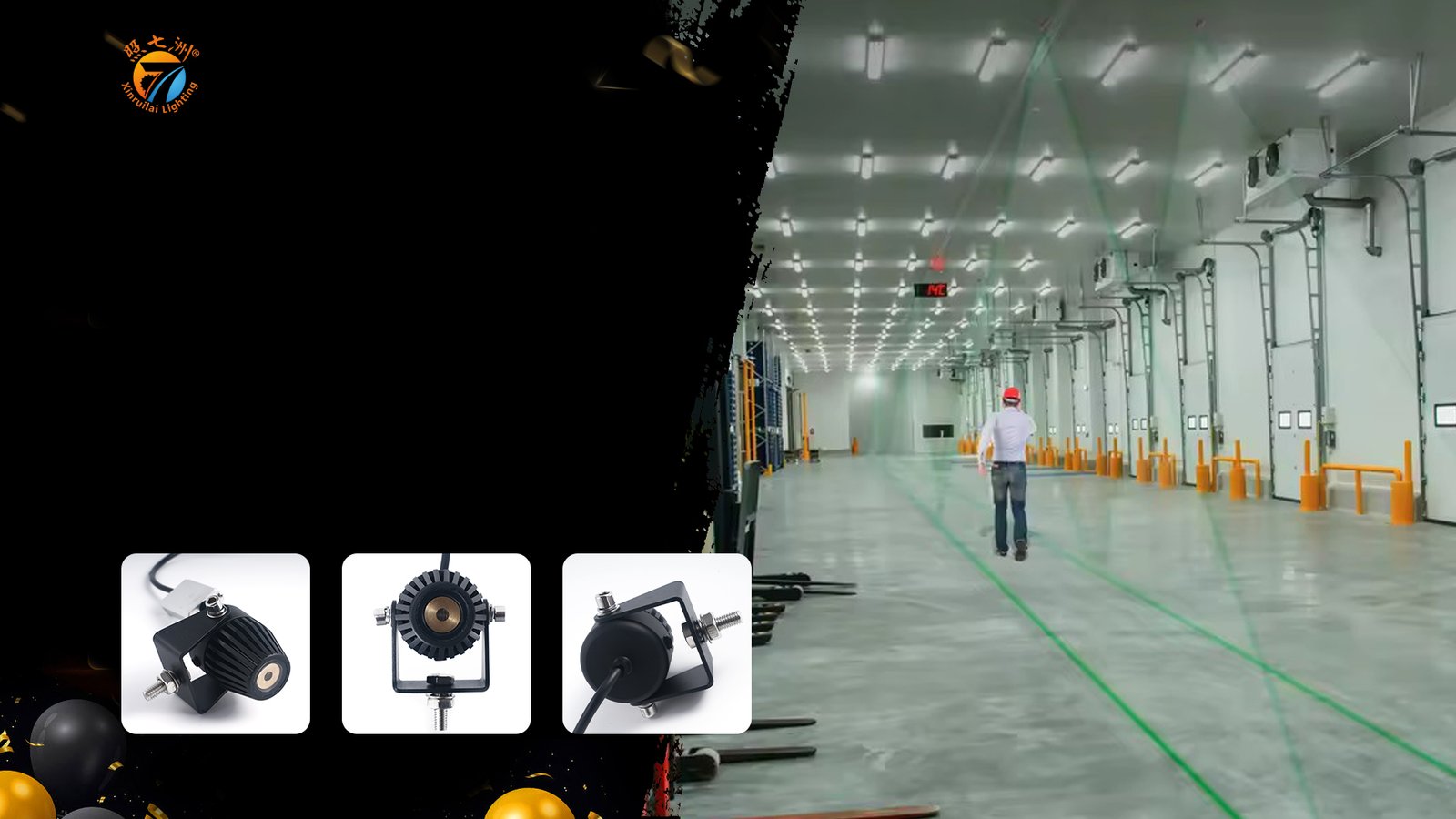
The geometry question is settled by the installation. A projector mounted at 2 to 4 meters and angled steeply at the floor puts its beam where eyes are not: the hazardous region — the direct beam path between aperture and floor — sits below head height in the walking zone. Mount the same unit at eye level firing horizontally down a corridor, and you have re-engineered the exposure geometry the classification assumed. The install rules that keep projected zones boringly safe are short: mount above head height, aim at the floor, keep the aperture not stare-able, and prevent mechanical drift (vibration-loosened brackets slowly repointing beams) with locked mountings and periodic checks.
AGV and machine-mounted duty follows the same logic at smaller scale. A projector on a vehicle chassis or AGV body paints the line ahead of the machine as it moves; the beam stays low, the line moves with the hazard, and the class documentation folds into the vehicle’s safety file alongside the functional safety arguments. Integrators handling automated industrial trucks work within the applicable machine-safety and driverless-truck standards for the overall system; the laser class is the piece of that file covering the projector specifically.
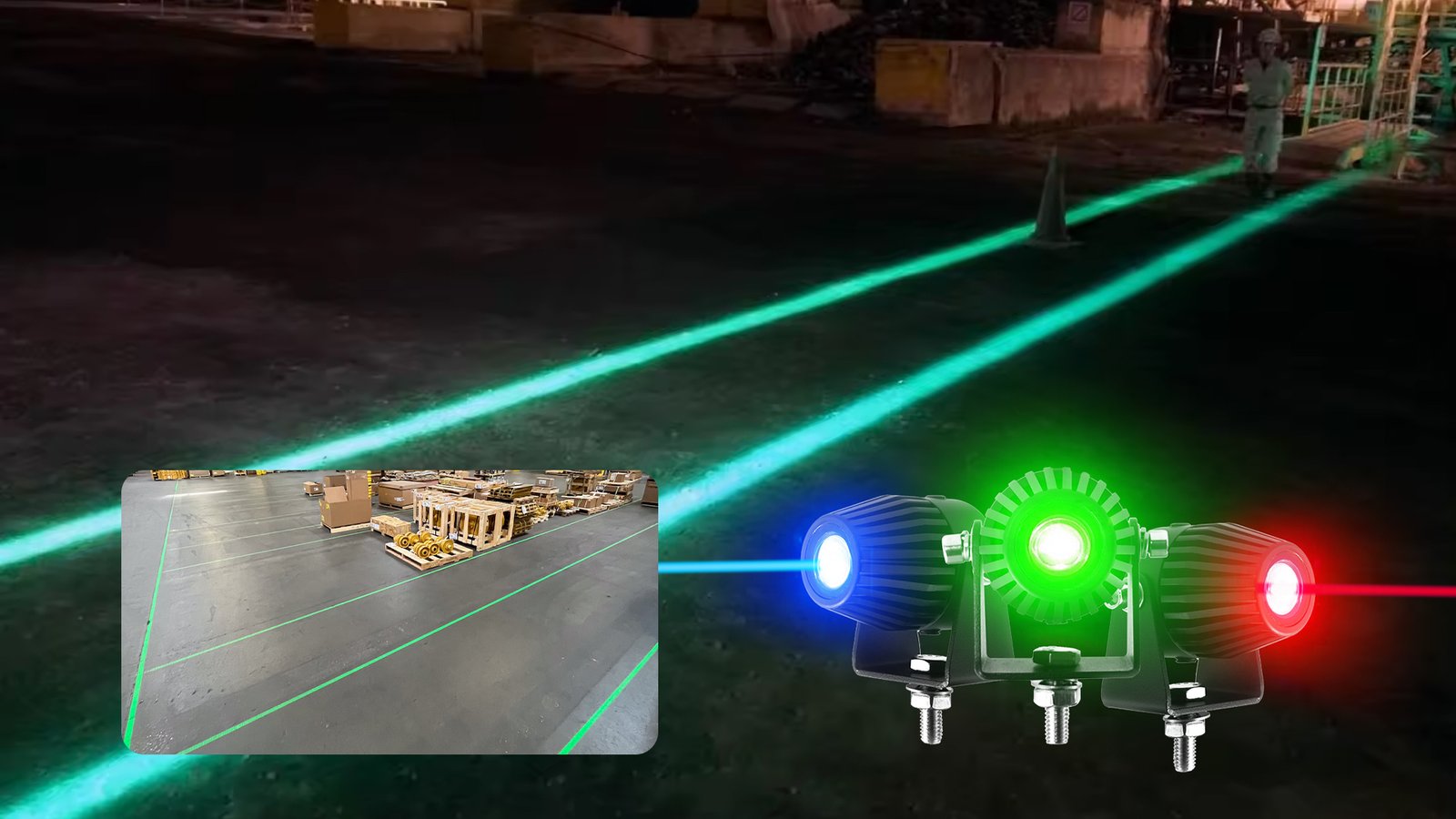
One practical note on the environment: the class is measured for the product, but visibility is a property of the site. Dark polished concrete makes a modest line look confident; bright epoxy under strong skylight demands either the green variant, more output (within class), or supplementation with physical marking. Site lighting surveys before layout planning prevent the most common disappointment — a compliant line nobody notices.
Verification Duties for the Safety Engineer
The class row in your risk assessment is only as good as the documents behind it. When a supplier’s quotation arrives, the verification sequence is short but non-negotiable:
- Per-model class declaration. The projector’s IEC 60825-1 class, stated for the exact model and variant, with the measurement conditions identified. “Laser class 2” in a brochure is a hint; the same figure in the product documentation, with the label photographed on the unit, is a claim.
- Label check on arrival. The class marking on the housing must match the documentation. Units arrive mislabeled rarely — but that is why sampling exists.
- Market conformity files. For Europe, laser-product conformity under the CE framework referencing the classification; for the United States, FDA/CDRH compliance under 21 CFR 1040 with its own class conventions. Cross-border installations need the pair.
- Companion documentation. EN 62471 photobiological assessment where high-output LED components share the product, CE EMC files, and the IP rating evidence for the enclosure — the projector is an electrical product first and a laser second.
- Installation and maintenance instructions. Mounting geometry limits, beam-distance envelopes, and the checks that keep the beam aimed where the classification assumed. These belong in your maintenance system, not in the shipping carton.
Suppliers who manufacture laser projection equipment seriously maintain this file per model and hand it over at quotation — XRLL, whose laser line projection range for forklift, crane and AGV duty has been in production since 2021, works under an IEC 60825-referenced compliance posture alongside CE, E-mark (E9), DOT-referenced and ISO 9001 documentation, and builds projector products on the same nine-gate inspection discipline as the rest of its warning-light line. The pattern to look for in any supplier is continuity: one certification story, per model, maintained across the years.
Choosing the Projector Within the Class
Once the compliance row is satisfied, selection is an application exercise with four variables:
Line geometry. Fan angles determine line length at your mounting height — a projector meant for a 4-meter corridor and one meant for a 15-meter crane bay are different optics. Sketch the isosceles triangle from aperture to floor before specifying.
Color. Red as the default; green where ambient light is hostile or the floor scatters red poorly. The eye’s green sensitivity does the heavy lifting at equal class.
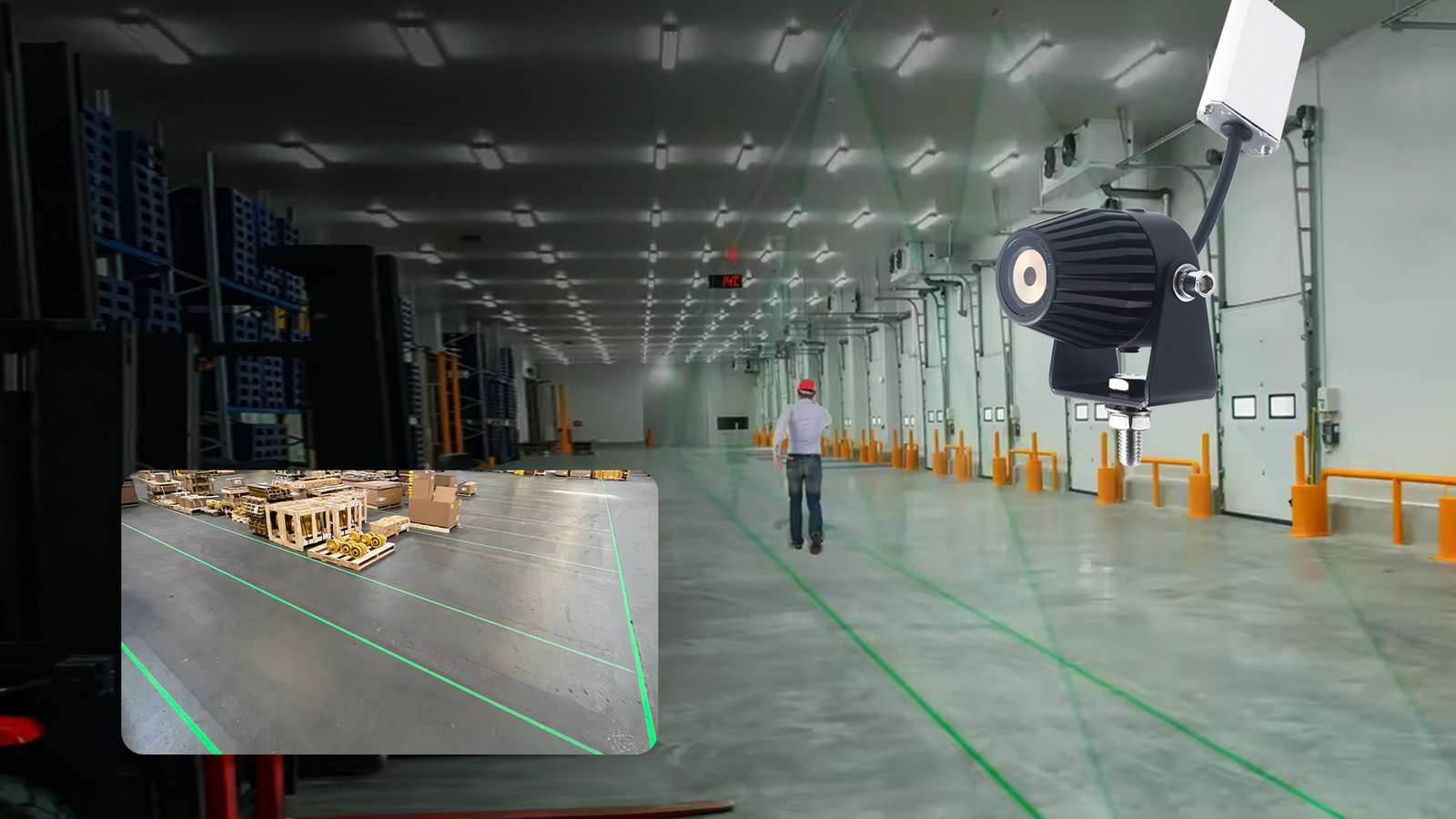
Pattern capability. Lines are the standard; symbols, arrows and zones extend the vocabulary for crossings, loading positions and machine envelopes. Custom projection patterns are a standard OEM/ODM item — a manufacturer who molds housings, cuts optics and writes pattern specifications in-house can deliver a site-specific symbol with the same certification file as the catalog line.
Mechanical and electrical integration. Voltage matching the vehicle or building supply, vibration-rated mounting for machine duty, sealed housings for wash-down areas, and connector standards your maintenance crews can service. The laser does the safety talking; the enclosure decides whether it keeps talking.
Specifying Laser-Projected Warning Zones?
Send your layout drawings, mounting heights and ambient-light conditions to the XRLL team. Within 24 hours you will receive a projector specification per zone — line length, color, class documentation and mounting geometry — with evaluation units for on-site trials and OEM/ODM pattern development for custom zone symbols. Laser line projectors for forklifts, overhead cranes and AGV fleets have been part of the range since 2021, supported by per-model compliance files.
See the warning light range including laser line projectors and zone projection systems, then talk to the factory directly.
Email: service02@xrlledlight.com · Phone / WhatsApp: +86-15818025687
Frequently Asked Questions
What laser safety class should a floor-projection warning light have in pedestrian areas?
Products engineered for pedestrian zones belong in the low visible-beam classes — Class 1, 1M, 2 or 2M — where accidental brief exposure is bounded by physiology (the blink reflex) rather than by access control. Class 2 is the common choice: bright enough to paint a confident line on a working floor, with the quarter-second aversion response covering accidental glances. Anything from Class 3R upward demands beam-path controls that conflict with public walkways.
Who assigns the laser class — the supplier or a regulator?
The manufacturer is responsible for classifying the product against the IEC 60825-1 Accessible Emission Limits, usually with measurements performed or verified by a competent laboratory, and for labeling every unit with the resulting class. Regulators do not assign classes product by product; they audit and enforce the framework — the FDA/CDRH regime in the United States, and the conformity process behind CE marking in Europe. Your verification job is to obtain the per-model documentation and check the label against it.
Can a Class 2 laser projector be used around AGVs and automated warehouses?
Yes — low-class projection is the standard approach for marking AGV routes and exclusion envelopes, because the beam geometry (mounted low, aimed at the floor, moving with the vehicle) keeps the direct beam out of the eye plane. The class documentation then becomes one component of the vehicle’s overall safety file, alongside the functional-safety arguments your driverless-truck standards require. Keep mountings locked and check beam alignment on your maintenance schedule so vibration cannot repoint the beam.
Why do some projectors use green lasers and others red?
Eye sensitivity is the reason. Human vision peaks near the green part of the spectrum, so at equal output a green line reads substantially brighter than a red one — which matters under strong ambient light or on light-scattering floors where a red line fades. Red remains the default because the diodes are mature and the color reads unambiguously as a boundary. Select by site lighting: red for ordinary interiors, green for bright floors, skylit halls and outdoor-adjacent zones.
What documents should I request before buying laser warning projectors?
Four items settle it: the per-model IEC 60825-1 class declaration with measurement conditions; the market conformity files (CE framework documentation for Europe, FDA/CDRH under 21 CFR 1040 for the United States); companion assessments — EN 62471 photobiological files for high-output LED components, EMC reports, and IP-rating evidence for the housing; and the installation instructions defining mounting heights, angles and beam-distance envelopes. Photograph the class label on delivered units and match it to the file.


