LED Warehouse Lighting Solutions: Designing for Safety and Efficiency
A warehouse manager at a third-party logistics site keeps two spreadsheets open on the same screen: one tracks near-miss reports, the other tracks the electricity bill. Both numbers move with the same piece of infrastructure — the lighting. When the aisles run dim, near-misses climb and picking errors follow; when the old metal halide high bays burn around the clock, the energy line never comes down. A properly engineered set of LED warehouse lighting solutions treats those two spreadsheets as one design problem: make people and machines visible to each other, and cut the watts needed to do it.
This article walks through warehouse lighting as an engineering plan rather than a fixture order. It covers the three layers every facility should design for, how the warning layer around forklifts is specified, what OSHA 1910.178 expects a facility to control, and how to run a pilot that proves the numbers before a site-wide rollout.
Key Takeaways
- Design in three layers. Ambient light keeps the building navigable, task light supports close work at benches and inspection bays, and the warning layer makes moving equipment visible. Each layer has its own specification, and a fixture-first purchase usually gets all three wrong.
- The warning layer travels with the truck. Blue spots, red zone lines, laser projections and AI pedestrian detection attach to the vehicle, so the warning follows the hazard instead of relying on static floor paint.
- Compliance is a paperwork trail, not a feeling. OSHA 1910.178 ties forklift lighting to the site’s powered-industrial-truck program. Certification files — ISO 9001, CE, E-마크, 점, ROHS, EN 62471 for laser products — are what an auditor actually reads.
- Energy savings fund the project; safety justifies it. LED conversions cut lighting energy sharply, but the business case for the warning layer rests on avoided incidents, which cost far more than lamps.
- Pilot before rollout. A two-week trial in the worst aisle — narrowest, coldest, busiest — settles beam pattern, projection distance and mounting questions with evidence instead of opinions.
Why a Lighting Plan Beats a Fixture Order
Most warehouse lighting projects start in the wrong place: a catalog, a lumen-per-fixture number and a purchase order. That approach can light a building, but it rarely solves the problems that triggered the project. The near-misses keep happening at the blind corner because no lamp aimed at the ceiling changes what a pedestrian can see at floor level. The energy bill drops, then creeps back as maintenance crews swap failed drivers. And when an insurance surveyor or an OSHA inspector walks the floor, nobody can produce the documentation that shows the lighting was specified against a standard.
A plan inverts the sequence. It starts from the building and the work: aisle widths, racking height, truck routes, pedestrian walkways, docking schedule, cold zones, and the incident history of the past two years. Those inputs decide where ambient light is enough, where task light is required, and where the real risk sits — which is almost always at the interface between moving forklifts and people on foot. Only after that does fixture selection begin, and by then the specification writes itself: output targets per zone, mounting heights, beam angles, sealing ratings and, for the warning layer, projection patterns and detection distances.
The distinction matters commercially, too. A facilities team that tenders “400 units of a 150-watt high bay” receives quotes that compete on price alone. A team that tenders a layered plan receives proposals that compete on design — and suppliers capable of that design conversation are the ones worth shortlisting.
The Three Layers of a Warehouse Lighting Plan
Layer 1 — Ambient light: the navigational base
Ambient light is the general illumination that lets people move, scan labels and operate equipment safely across the whole floor. In a modern distribution center this layer comes from LED high-bay fixtures, and the design questions are distribution and glare rather than raw brightness. Uniformity matters more than peak output: a bright fixture over the aisle with dark pockets between racking rows creates contrast that hides pedestrians stepping out of an aisle end. That is precisely the scenario blue spot and arrow lights exist to cover, which is why the ambient and warning layers are designed together, not sequenced.
Reflectance is the underrated variable. Light grey racking, white ceilings and clean floors bounce far more usable light than the same fixtures under dark surfaces, so two buildings with identical fixtures can measure differently at working height. A competent supplier asks for racking layout and surface finishes before quoting lumen packages; one who quotes straight from square metres is selling boxes.
Layer 2 — Task light: where the work gets checked
Packing benches, quality-control stations, battery-charging bays and returns inspection all need light concentrated at the work surface, usually at much higher levels than the surrounding aisle and from a defined direction so labels, dates and damage are readable. Under-shelf strips and machine-mounted lamps do this job without raising the whole building’s output. The common design error is solving a task-light complaint by raising the ambient layer — which multiplies energy cost for a change the worker barely notices at bench height.
Cold rooms deserve their own line item. Sealed LED units rated IP68 — meaning the housing keeps out dust and survives immersion — handle the condensation cycles that defeat cheaper seals, and they reach full output instantly at low temperatures where fluorescent tubes dim and flicker. For food and pharmaceutical cold chains, instant-on also matters at the door, where every second of delay compounds across a shift.
Layer 3 — Warning light: making machines announce themselves
The third layer is the one general lighting design routinely misses: active warning projected by the equipment itself. Overhead cranes, AGVs and forklifts carry lamps whose job is not to illuminate the space but to project a signal onto it — a blue spot ahead of a reversing truck, a red no-go halo around a vehicle body, a laser line marking a sweep zone. Because the signal moves with the machine, it stays accurate through every temporary position, aisle change and load swing that static floor marking cannot track.
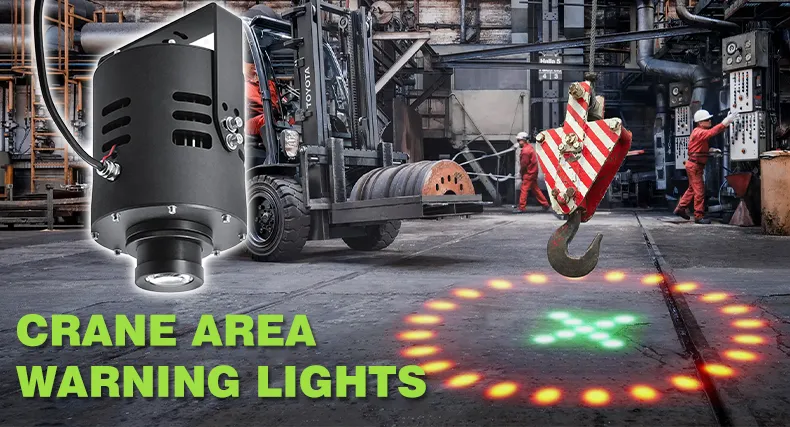
In facilities that mix crane traffic with fork trucks — steel service centers, heavy manufacturing stores, big-box distribution with mezzanine hoists — crane warning lights mark the moving overhead hazard while forklift lights cover the floor-level one. A layered warning design assigns each machine class its own signal grammar so workers can read what is moving and where, at a glance, from twenty metres away.
Specifying the Warning Layer Around Forklifts
Inside the warning layer, four tool families do most of the work. They are complementary rather than interchangeable, and a sound plan usually combines at least two.
| Tool | What It Projects | Message to the Pedestrian | Best-Fit Location |
|---|---|---|---|
| 푸른 반점 / arrow light | Blue dot or directional arrow on the floor ahead of or behind the truck | “A truck is approaching this point” | Blind corners, doorways, aisle ends |
| Red zone light | Red line or halo along the truck’s sides and rear | “Stay outside this moving boundary” | Shared pedestrian aisles, docking zones |
| Laser line projector | Sharp laser line or custom pattern marking a sweep or no-entry zone | “This equipment’s path covers this area” | Cranes, AGV paths, wide-swing equipment |
| AI pedestrian detection | Camera-based detection with audible and visual alarms on the truck | Alerts operator and pedestrian before contact | High-traffic mixed zones, retrofits on older fleets |
Projection lights change behaviour passively: the pedestrian sees the signal and moves. AI detection adds an active layer. XRLL’s XRL1341 system, for example, uses three AI cameras for 360-degree coverage around the truck and flags pedestrians up to six to seven metres out, triggering sound and light alarms before an encounter develops. The unit is IP67-sealed for dusty and wet environments, and the design intent aligns with the powered-truck controls described in OSHA 1910.178. For a fleet manager, the practical reading is this: projection lights cost little and belong on nearly every truck; AI detection earns its cost on the routes where near-miss data says people and machines actually conflict.
One caution belongs in every specification: projection visibility degrades in direct sunlight. Indoor warehouses see reliable performance; open yards wash projected patterns toward invisibility. Outdoor facilities should treat projection as one layer of the warning stack and weigh AI detection — which does not depend on projected light — more heavily.
Matching Output and Beam Pattern to the Building
The warning layer aside, the ambient and task layers live or die on photometrics. Lumens measure total light output from a fixture, but placement and optics decide whether those lumens land where work happens. Three checks keep a proposal honest:
Spacing-to-mounting-height ratio. A high-bay optic that throws a wide cone suits low racking and open floor; a narrower optic suits tall aisles where light must reach the pick face without glare at the operator’s eye. Suppliers should publish the ratio and stand behind a layout simulation.
Glare control at sightlines. Forklift operators work with their heads up, scanning rack faces and mirror images. Fixtures that place a bare LED array in that sightline create disability glare — the operator sees the lamp, not the pedestrian behind it. Shielding, diffusers and mounting position outside the typical eye line are design decisions, not accessories.
Environmental derating. Dust film on lenses, cold-store temperatures and voltage sag on long runs all reduce delivered light. A specification written from a datasheet’s lab numbers overstates real performance; one written from a pilot in the building’s worst zone does not.
This is also where chip provenance enters the commercial conversation. XRLL builds with OSRAM and Cree LED chips as standard, verified at incoming inspection — the first of nine in-house quality gates that run from chip check through PCB and driver inspection, assembly, IP68 sealing tests, photometric and beam-pattern measurement, high-low temperature aging, vibration and shock, electrical safety, and final pre-shipment inspection. The point for a buyer is not the count of gates; it is that photometric claims trace back to measured units rather than marketing copy.
Compliance: What OSHA 1910.178 and Auditors Actually Require
OSHA 1910.178, the powered industrial trucks standard, does not name a lumen figure for forklift lights. What it does require is that trucks operating in areas with deficient ambient light carry directional lighting, and it places auxiliary lighting, warnings and controls within the facility’s broader traffic-management obligations. In practice, an EHS manager demonstrates compliance through the program: hazard assessment of routes, training, marked walkways — and the visible warning devices that engineering controls contribute. Projection lights and AI detection strengthen that file; they do not replace it.
Documentation discipline matters as much as hardware. Auditors and insurance surveyors respond to records: the hazard assessment that identified the blind corner, the specification that selected the light for it, and the certification file behind the product. For laser projectors, IEC 60825 governs laser product safety, and a photobiological report to EN 62471 covers the blue-light hazard question that some European buyers now ask for explicitly. A supplier who can hand over CE, ROHS, E-마크, 점, ISO 9001 and EN 62471 files with shipment — as XRLL does for its export markets across the US, UK, Germany, Spain, Italy, Australia and Japan — turns a compliance conversation from a risk into a formality.
The Energy and Maintenance Case, in Numbers That Survive Finance Review
Safety carries the project; energy pays for it. The arithmetic is familiar: LED high bays typically draw a fraction of the power of the metal halide or fluorescent units they replace for equivalent delivered light, they reach full output instantly, and they stretch relamping intervals from months to years because lumen depreciation is slow. In a facility running two shifts, lighting hours are long, so the kilowatt-hours saved compound quickly — and facilities that add occupancy dimming or daylight harvesting on top of the LED conversion widen the gap further.
Maintenance is the quieter half of the case. Every high-bay relamp means a lift, an operator and a work-at-height exposure. Sealed IP68 housings, verified in the sealing gate of the production line, keep dust and washdown moisture out of the driver compartment, which is where most premature failures start. A fleet of forklift warning lights rated the same way survives dock spray and pressure washing — the conditions that kill cheap units in their first winter. When finance compares proposals, the durable build is usually the cheaper one on a five-year view; the specification just has to make that visible.
Rollout: Pilot, Phasing and Choosing a Supplier
Well-run warehouse lighting projects move through the same three steps regardless of size. First, a pilot: install the proposed mix in the facility’s worst zone — narrowest aisle, coldest room, busiest crossing — and run it for two weeks with structured feedback from operators and pedestrians. Second, phasing: roll out by zone, keeping old and new systems isolated electrically so a fault in one does not darken a shift. Third, standardization: lock the verified specification into the site’s traffic management plan and procurement documents so future expansions buy the same performance.
Supplier selection deserves the same rigor as the fixtures. The shortlist questions that separate manufacturers from box-sellers: Can they propose a layered design from your layout, or only quote a fixture count? Do they manufacture in-house — XRLL runs 17,000 square metres of factory with four assembly lines and daily capacity above 10,000 units — or trade? Will they provide certification files per shipment and evaluation samples before the bulk order? Can they support OEM or ODM customization of beam patterns, projection patterns and branding for fleet-wide standardization? A partner answering yes to all four, with 5,000-plus B2B customers across 80-plus countries since 2011, is positioned to support a multi-site program rather than a one-time order.
For facilities mapping this layered approach against their own floor plan, XRLL’s warehouse and logistics lighting solution page consolidates the product set and application notes in one place.
Planning a Warehouse Lighting Upgrade?
Send XRLL your floor plan, aisle widths, racking height and truck routes. The sales team responds within 24 hours with a layered design proposal, model recommendations, certification files and evaluation samples for a two-week pilot. OEM and ODM support covers beam pattern, projection pattern, housing and logo for fleet standardization.
이메일: service02@xrlledlight.com · Phone / 왓츠앱: +86-15818025687
Frequently Asked Questions
How many lumens does a warehouse aisle need?
It depends on racking height, surface reflectance and the task, which is why experienced suppliers specify from a layout rather than a single number. Open floor and bulk storage typically sit at modest ambient levels, while pick faces and packing benches need more light concentrated at the work surface. A two-week pilot in your worst aisle settles the question with measured results instead of generic guidance.
Are blue forklift lights required by law?
No specific lamp colour is mandated. OSHA 1910.178 requires trucks operating where ambient light is deficient to carry directional lighting, and it holds the facility responsible for traffic management. Blue spots, red zone lines and AI detection are engineering controls that help a facility meet that obligation and demonstrate it during an audit — the program, not the lamp colour, is what gets inspected.
Do LED warning lights interfere with scanners or radios?
Certified units are engineered for electromagnetic compatibility — CE files for XRLL products include EMC test reports, and the production line runs a dedicated electrical-safety gate. Warehouse-grade LED lamps and laser projectors from a certified manufacturer coexist with barcode scanners, Wi-Fi and telematics without interference. Uncertified units are where the risk sits, which is one more reason certification files belong in the purchase order, not after it.
Can we phase the rollout without mixing old and new systems badly?
예, and phasing by zone is the standard approach. Keep old and new circuits electrically separate during transition, complete one zone end to end — fixtures, task light and warning layer together — before starting the next, and verify each zone’s measured light levels against the pilot baseline. Mixed zones work safely when the warning layer is installed first, since it protects people while the ambient conversion catches up.
What should a supplier provide before we place the bulk order?
Four items cover most of the risk: a layout-based proposal showing where each light layer lands, certification files matching your market (ISO 9001, CE, ROHS, E-mark or DOT, plus EN 62471 for laser products), evaluation samples for a supervised pilot, and written confirmation of rated input details for your voltage groups. Manufacturers with in-house production and nine inspection gates can usually turn all four around inside a week; get a quote in 24 hours and judge the response quality from there.


