Mining and Quarry LED Work Lights: Vibration and Dust Resistance
A quarry tests lighting differently than a highway does. There is no steady cruise here, no gentle suspension and no clean air — there are haul roads that hammer continuous vibration into every bracket, silica and limestone dust fine enough to find any seal that was merely designed optimistically, and washdown cycles that arrive without warning. A mining quarry led work light fails in the field through a short list of mechanisms — fatigue, ingress, abrasion and thermal cycling — and every one of them is predictable, testable and specifiable in advance. Operations managers and fleet buyers who treat work lighting as a consumable in this environment pay for it in replacement labor on machines that were scheduled to be producing; those who write the durability spec properly get a lighting line that disappears from the maintenance report. This guide walks the failure modes, the standards that measure them, and the evidence a heavy-duty lighting supplier should be able to hand you before the first unit is mounted on a loader arm.
Key Takeaways
- Vibration kills through fatigue and loosening, not sudden failure: bracket hardware, connector sockets and solder joints are the chain’s weak links, and the specification should name the test, not the promise.
- In mining dust, IP6X is the floor conversation and seal engineering is the real one — abrasive dust polishes gasket sealing faces until “dust protected” quietly becomes “dust inside.”
- The machine’s electrical system is harsher than the datasheet admits: 24 V systems with load-dump transients, alternator whine and reverse polarity events kill under-built drivers; voltage range and protection circuits belong on the PO.
- LED technology earned its place in mining because it tolerates the two things that destroyed filament lamps — shock and duty cycling — provided the driver, optics and sealing are engineered to the same standard as the chips.
- Evaluate suppliers by production QC, not launch certificates: plants that run vibration, shock, thermal and sealing verification as standing line checks can show per-lot evidence; ones that type-tested once cannot.
The Four Ways Mining Environments Kill Work Lights
Vibration and shock. A haul truck’s cab sees continuous broadband vibration from graded road and washboard surfaces; a rock breaker or excavator adds impulsive shock with every impact through the boom the lamp is mounted on. The damage mechanisms are mechanical fatigue — the mount arm or bracket cracking at a weld or cast corner over thousands of cycles — and progressive loosening: hardware walking free, connectors micromoving in their sockets, and solder joints at the driver board fatiguing where mass meets stiffness. Rotating machinery taught the reliability world these failure modes; lighting that lives on construction and mining equipment inherits all of them.
Dust. Quarry dust is not just dirty, it is abrasive and it is fine. Silica and limestone particulate behaves like slow sandpaper on gasket faces and lens surfaces; once inside a housing it blankets thermal interfaces (raising junction temperature and accelerating lumen depreciation), bridges conductor spacings when damp arrives, and turns adjustable bezels into fixed ones. Dust ingress is a sealing-system failure, not an IP-rating failure — the rating measures a clean sample at a moment in time; the quarry measures how the sealing ages.
Thermal cycling. Winter dawn starts, midday sun load on a black housing, the heat-cool breathing of every shift change — each cycle pumps air, carrying dust and moisture, through any path that is not a true seal, and stresses materials with different expansion coefficients at their joints: glass-to-metal, plastic-to-aluminum, potting-to-housing. The mining fleet sees the full amplitude daily; a coastal fleet does not.
Electrical violence. 24 V diesel electrical systems are not the clean bench supply of a datasheet test. Load dump when the alternator stops charging a loaded circuit throws tens of volts of transient; inductive loads switching create spikes; jump-starts and welder circuits introduce reverse and over-voltage events. A work light’s driver is the component that meets all of this, and cheap drivers in expensive housings are a mining-fleet staple failure.
Testing the Claims: Which Standards Actually Measure Mining Durability
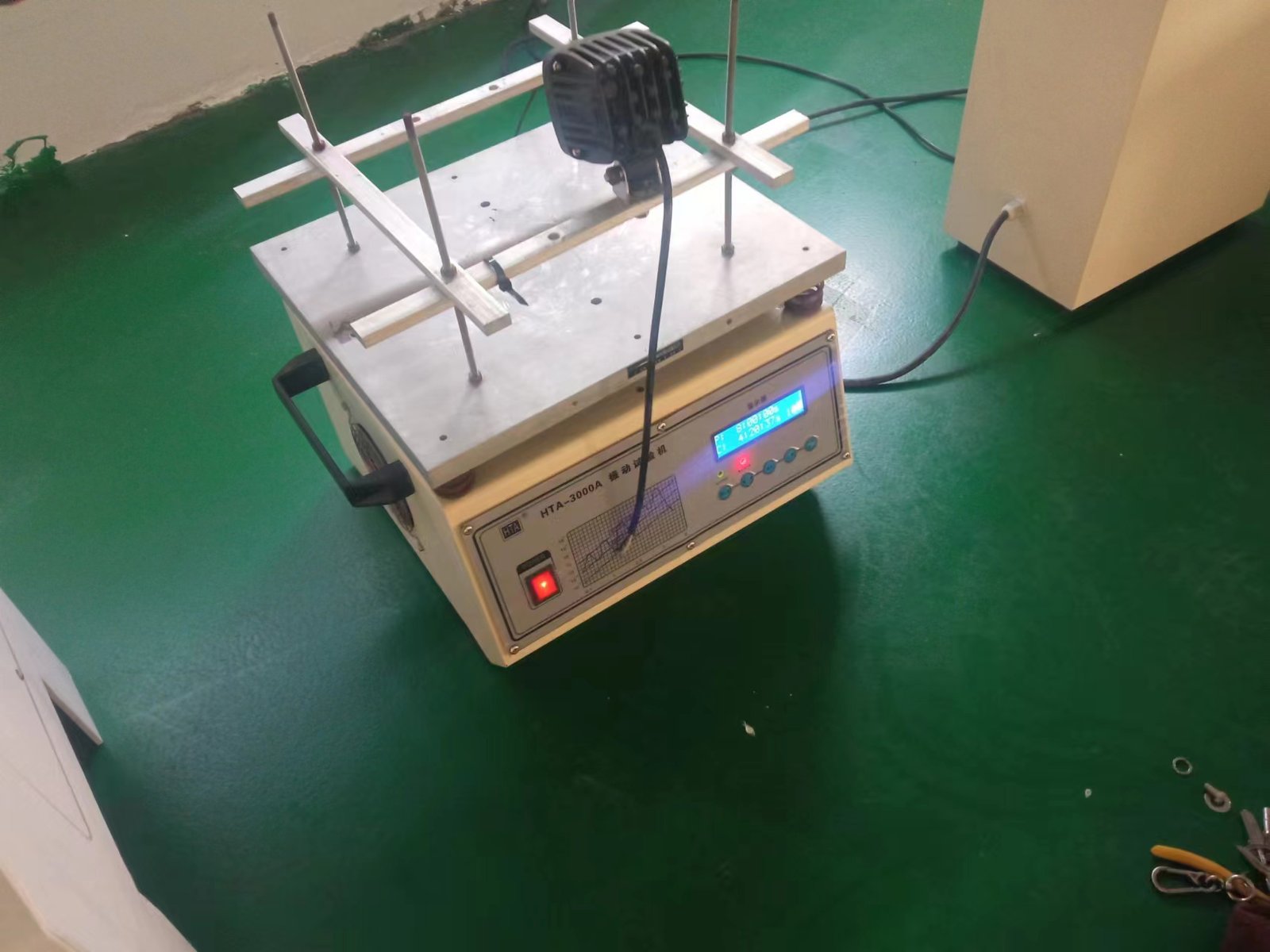
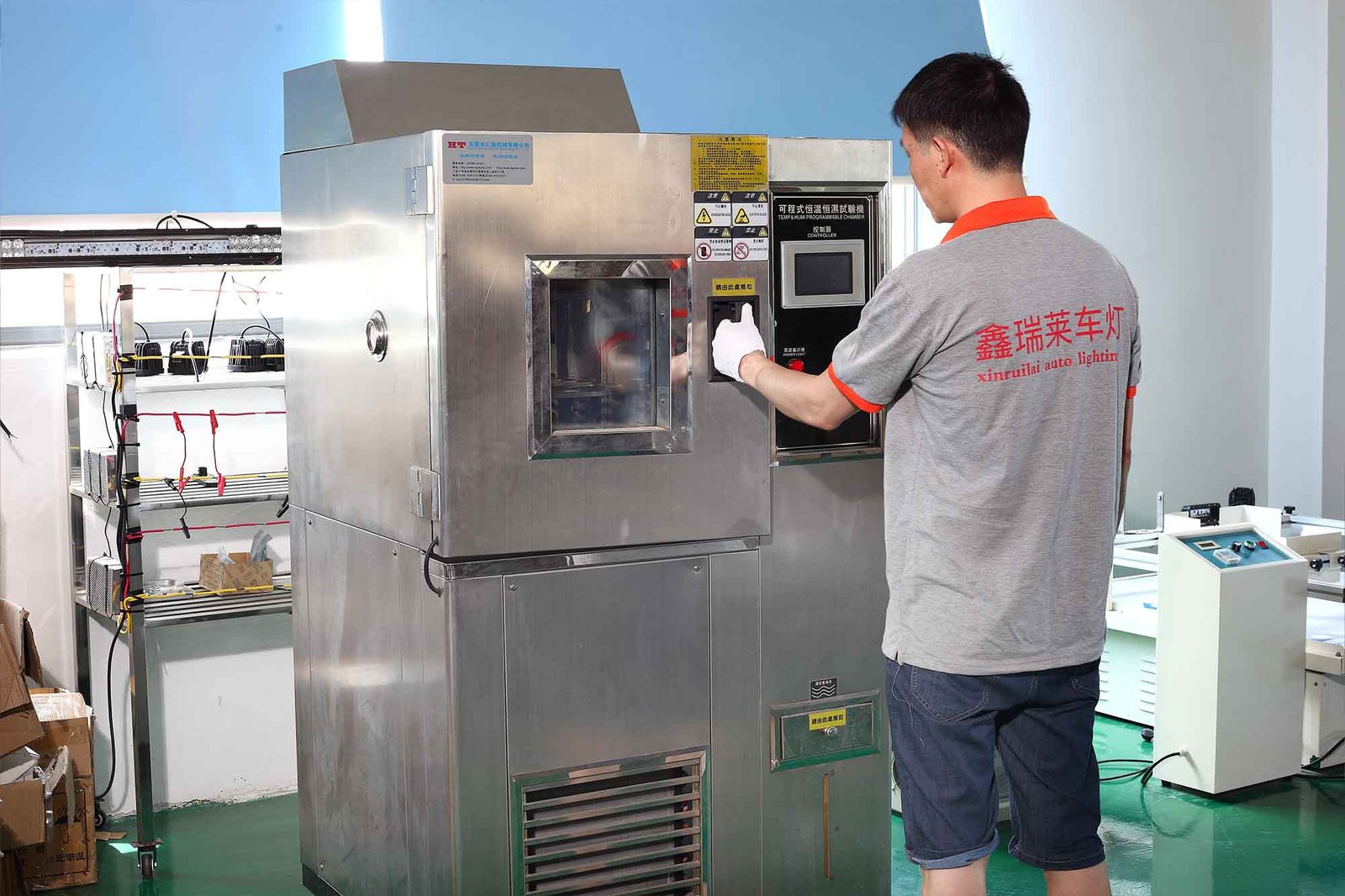
Vibration evidence lives in the IEC 60068-2 family: 60068-2-6 for sinusoidal sweep — the resonance hunt — and 60068-2-64 for the random vibration that actually resembles a haul road spectrum, with severity set by acceleration spectral level and duration. Automotive-derived component specs (the various ISO 16750 and manufacturer body-engineering specs) define road-vibration profiles with the electrical system running simultaneously. Shock is 60068-2-27 — half-sine pulses, the classic 15 g/11 ms territory for rugged equipment, with harsher classes where impact machinery lives. Dust is IEC 60529 IP6X: the first digit’s maximum category, tested in a chamber with talc-like dust under vacuum differential for a stated period — and for abrasive quarry service, ask what the seal material is and how the sample looked after a second and third IP6X run rather than the first. Temperature is cycled storage and operation testing across the stated range, and the mining-relevant question is low-temperature starting: an LED driver with the wrong capacitor chemistry simply refuses to boot at a cold morning start. A serious manufacturer treats these as standing production checks, not one-time certificates: XRLL’s nine-stage QC line, for example, runs sealing verification at IP68 level, vibration and shock, high-low temperature aging and a pre-shipment final inspection as routine steps — which is the kind of QC architecture that produces per-lot evidence instead of a launch-year report.
Mounting Is the Product, Too: Brackets, Hardware and Position on the Machine
Field failure logs from mining fleets are dominated by mounting, not lighting: the lamp works, the interface surrenders. The specification consequences are concrete. Brackets want engineered steel or thick die-cast with defined load ratings, not flat stock that resonates; hardware wants prevailing-torque nuts or thread patch, stainless against the washdown chemistry, and isolation where dissimilar metals meet. Position matters more than crews assume: boom roots and bucket hinges are shock zones where even a well-built lamp suffers, while cab corners and upper-deck mounts drop the vibration class dramatically — the same part number can last six months or five years on the same machine depending on where the installer puts it. For rotating booms and high-vibration positions, ask whether the supplier offers a reduced-mass version or an isolated-mount accessory; the industry’s answer to breaker-mounted lighting has always been mounting design, not more screws.
The Electrical Specification for 24 V Mining Systems
Write the electrical lines the way a machine’s own engineers would. Operating voltage range, stated as a band (a competent 24 V fixture covers the real world, roughly 18–36 V continuous, with the cold-crank sag below that handled), not just a nominal label. Transient withstand: ISO 7637-2 defines the pulse family mining electricals live with — load dump being the headline, with ISO 11898-2 territory relevant only if the fixture carries bus electronics — and a supplier that designs against these pulses publishes a clamped-MOS protection stage rather than a hopeful fuse. Inrush current, because ten retrofit lamps on one switched circuit will nuisance-trip breakers on cold mornings. Reverse-polarity protection, because 24 V jump practices vary by pit. And EMC sanity: switch-mode drivers on long machine harnesses are noise sources — covered in depth in our CISPR-adjacent EMC explainer for vehicle-mounted lighting — with ferrite treatment or filtered inputs available where radio receivers in the cab or blasting systems in the pit make conducted noise a real operational issue.
Underground vs. Open Pit: Two Different Conversations
Open-pit and quarry surface equipment — haul trucks, loaders, drills, breakers — is a durability conversation, everything above applies directly, and the product classes used are the same families as construction lighting with the spec raised. Underground is a separate regulatory world: in many jurisdictions equipment entering a mine takes approval through the national mining-safety authority (MSA and related schemes in the US, country-specific certification regimes elsewhere), covering electrical safety, and for coal specifically flammable-gas suitability. Gas-sensitive areas, permissibility and equipment listing are jurisdictional and not interchangeable with surface IP ratings. An equipment brand or fleet buying for underground coal needs to open that conversation with the lighting supplier before product selection — approvals are per-country and per-duty, and a supplier without them is not necessarily wrong for surface fleets but is simply not in the underground game.
Where LED Beats Everything That Came Before (and Where It Still Loses)
Mining adopted LED work lighting because filament lamps were mechanically absurd in this environment: a hot tungsten wire in a glass envelope is exactly the structure vibration breaks, and HID’s ballast and strike behavior misbehaves on wide-voltage machine systems. Solid-state chips tolerate shock and cycle instantly, reach full output without warm-up on cold starts, and with the right chip class — the OSRAM and Cree component tiers used on engineered lines — deliver thousands of hours between interventions. What LED still loses on, in the honest assessment: lumen maintenance under constant dust-blanketed thermal load if the heatsink was undersized for the job; glass lens scratch clarity against polycarbonate in abrasive air (spec hardened or coated lenses where the dust chemistry says so); and driver longevity under electrical transients, which is the component most likely to die before the chips and the clearest signal of how the fixture was engineered.
The Mining Buyer’s Specification Checklist
- Vibration and shock evidence: standard and level (IEC 60068-2-6/-2-64/-2-27 or the OEM’s machine spec), tested assembly configuration, post-test function criteria.
- Dust: IP6X rating plus seal material, and what the supplier’s production QC checks per lot — not just the type-test certificate.
- Thermal: operating and storage range with low-temperature start confirmed; heatsink mass or stated maximum ambient at full output.
- Electrical: true voltage band, load-dump and transient protection design, inrush figure, reverse-polarity scheme.
- Mounting: bracket material and load rating, hardware grade and finish, isolated-mount options for boom and breaker positions.
- Lens and finish: abrasion-resistant glazing, UV-stabilized bezels, corrosion class for coastal or salty-pit environments.
- Serviceability: gasket kits, lenses and driver modules as orderable wear parts with published numbers.
- Application honesty: surface duty versus any underground entry — jurisdictional approvals are a separate gate, raised before selection, never after.
See how heavy-duty equipment lighting is documented per model — sealing, vibration and electrical evidence — on the XRLL mining and quarry solutions page and the LED work light range; the factory-verification questions behind that documentation are in the industrial sourcing guide, and what the sealing digits mean is broken down in the IP67 vs IP68 comparison.
Send the Machine and Duty Cycle, Get the Durability Spec
Tell the XRLL sales desk the equipment type, mounting positions, voltage system and shift pattern — and receive a matched fixture-and-bracket recommendation with vibration, sealing and transient-protection documentation, from a Foshan factory running nine documented QC stages including IP68 sealing verification and vibration-shock testing across 17,000 m² and four lines, answering in 24 시간. Custom brackets, lens treatments and voltage configurations run on in-house tooling with samples before series production.
이메일: service02@xrlledlight.com · Phone/WhatsApp: +86-15818025687
FAQ
What IP rating is enough for quarry dust?
IP6X — dust-tight — is the category to specify; anything less (IP5X “protected”) assumes the interior tolerates some ingress, which abrasive silica dust eventually punishes. The rating alone is the entry ticket: the productive questions are the seal material, whether the lens is removable without tooling the gasket face, and what the factory checks per production lot, because quarry sealing fails by aging, not by initial design.
How do I stop work lights failing at the bracket on rock breakers?
Treat breaker and hammer positions as a higher shock class than the machine catalog assumes: mount at the cab or upper deck wherever the task allows, and where the impact zone itself must carry light, use the shortest rigid bracket that reaches — every cantilevered centimeter multiplies the acceleration at the lamp. Specify prevailing-torque hardware, inspect by torque pattern on a schedule, and ask the supplier which vibration-shock class the fixture was actually tested at rather than which machines it was sold onto.
Do mining work lights need special electrical protection on 24 V trucks?
Yes — the 24 V diesel environment’s load-dump, switching transients and cold-crank sag are outside what a consumer-grade driver survives, so specify the continuous voltage band, the transient protection design (clamp stage, tested pulse family) and the inrush figure as line items. This is the same engineering territory as automotive component EMC and environmental specs; a lighting supplier who can discuss ISO 7637-style pulses and voltage bands in the quote stage is signaling real vehicle-mount design, not repackaged industrial fixtures.
Is LED lighting acceptable for underground mine use?
LED as a light source is entirely suitable underground — it is the electrical equipment regime that changes, not the physics. Underground entry, especially in coal, routes through jurisdictional approval schemes covering electrical safety and, where flammable gas exists, equipment permissibility — separate from any IP or vibration spec and controlled by the mine’s regulator rather than the equipment market. Treat it as a distinct supplier question raised at project start: which approvals does this manufacturer hold for which countries and which mine atmospheres, verified on certificate numbers, before surface-style product selection enters the conversation.


