
LED Work Lights for Tractors: Voltage and Mounting Compatibility
A tractor is the hardest electrical customer a lamp ever serves. Half the machines doing night work in Europe and North America were built before LED fixtures existed — generators instead of alternators, 6 V systems instead of 12, magneto lighting that runs on alternating current — and the other half are modern cabbed machines whose lighting circuits were designed around a handful of halogen bulbs, not a fleet of work lamps. Then come the mounting questions: a ROPS structure you must not drill, loader arms that sweep through every beam you might want to fit, and a machine that gets pressure-washed every Friday. Getting a led work light for tractor application right is mostly compatibility work — voltage, wiring and brackets — and only secondarily a lighting decision. This guide walks dealers, farm fleet managers and equipment buyers through all three.
Key Takeaways
- Match the lamp driver to the machine’s real electrical behavior, not its badge voltage: 12 V negative-ground is the modern norm, but legacy 6 V, unregulated generator output and magneto AC lighting all exist in working fleets.
- Feed new work circuits from the battery through a relay and fuse; never piggyback the implement socket or hazard circuit and call it finished.
- ROPS and FOPS structures are certified steel — drill nothing into them. Use OEM bracket positions, saddle clamps and standardized agricultural mounts instead.
- Mounting height and position decide glare: front lights that wash out the loader bucket’s own shadow are worse than no lights for coupling work.
- Farm duty is a sealing and corrosion story before it is a lumen story: dust, silage effluent, fertilizer and weekly pressure washing select the product long before the field does.
Why Tractor Lighting Is Its Own Category
Trucks run regulated 12 or 24 V systems with substantial electrical capacity; tractors run everything from a 1960s original with a dynamo charger to a 400-hour-per-year ISOBUS machine. The lamps have to survive cab-off vibration, days of dust exposure, chemical contact that would eat automotive hardware, and a cleaning regime that attacks every seal twice a week. And unlike a truck, a tractor’s lighting is often doing two jobs at once — illuminating a static task (a trailer at dusk) and a moving one (a headland at night) — with the same fixtures.
The consequence for procurement: a work lamp bought on automotive logic fails agricultural service. Buy on voltage behavior, mounting legality and sealing class first; the light output conversation is the easy part.
Voltage Compatibility: What the Tractor Actually Supplies
The modern baseline — 12 V, negative ground. Virtually all tractors in normal dealer service are 12 V systems with the chassis as the negative return. A lamp specified “12 V” but engineered for a vehicle environment should run across the whole real envelope — cranking dips, charge-voltage peaks — not just at the nominal rail.
Legacy 6 V machines. Pre-1960s tractors (and a surprising number of restored classics still working on smallholdings) run 6 V systems. LED drivers designed for 12 V minima will flicker or refuse to start; either fit lamps with genuine low-voltage support or accept that this niche needs dedicated product, not an adapter argument.
Generators, voltage regulators and load dump. Older tractors with dynamo/generator charging swing their rail voltage far more than modern alternators, and the classic failure mode when owners bolt on new electrical loads is the aging regulator struggling with the extra current — before LEDs, four 55 W halogen work lamps could demand more current than a small generator comfortably supplied at idle. One practical benefit of LED retrofits: tens of watts instead of hundreds. The risk to manage is load-dump transients when a heavily-loaded battery is suddenly disconnected — a driver with stated transient immunity (ISO 7637-2 is the reference language) keeps working-lamp electronics alive through it.
Magneto and AC lighting on vintage kit. Some very old tractors power lighting from an AC magneto system — no battery at all. Passing that through a DC-only LED lamp is a guaranteed failure; on these machines, either keep period-correct bulbs or add a rectified, properly earthed auxiliary circuit before buying any modern work light.
24 V and mixed fleets. Large row-crop and tracked machines increasingly run 24 V electrics. For dealers stocking one lamp family across a region’s fleet mix, a driver rated for a wide input window (roughly 10–30 V DC across the models a factory documents) eliminates half the compatibility calls.
Wiring and Switching Without Creating a Fire Risk
- New circuits come from the battery, via an in-line fuse sized to the lamp draw and a relay switched from an ignition-on or cabin-toggle source. Tape, splice and “borrowed” power from the lighting board is how farm electrical fires start.
- Ground to a clean chassis point, bolted and star-washer tight — painted or corroded grounds produce dim flickering that gets blamed on the lamp.
- Trailer sockets are not power outlets. The rear 12 N/12 R (ISO 7357 / ADR) socket circuits are sized for indicator and lamp loads; using them for a bank of work lamps overloads wiring designed for a trailer’s own lights. If implement-side lighting is the recurring job, wire a dedicated fused socket or a switched cable to the battery instead.
- Keep cabling away from belts, exhaust and hydraulics. Route and clamp on the drawing board, not with the first spare tie strap; check full steering lock and full loader lift before committing a run.
- Parasitic draw matters on machines that sit. A tractor parked over winter with a milliamp leak can fail to start at the worst possible week; get the quiescent figure for anything wired to a permanent live.
Mounting Compatibility: Brackets, ROPS and Clearances
Never drill a ROPS or FOPS. The roll-over and falling-object protection structures are certified engineering; perforating them voids the protection the certification exists to provide. Every agricultural mounting method worth using clamps around the structure instead — saddle and strap clamps that bite two faces of the ROPS tube, OEM holes that the factory already provided, or bracket systems the cab manufacturer supports.
Standardized agricultural mounts. Front work lighting on European tractors has largely converged on pin-and-spring mounting sets (widely sold as AEV-style mounts) that locate lamps at the correct height and angle relative to the machine, plus front-hitch categories with documented lamp positions. Where the tractor already carries the factory provisions, matching the standard mount beats an improvised bracket on price, angle discipline and resale neutrality.
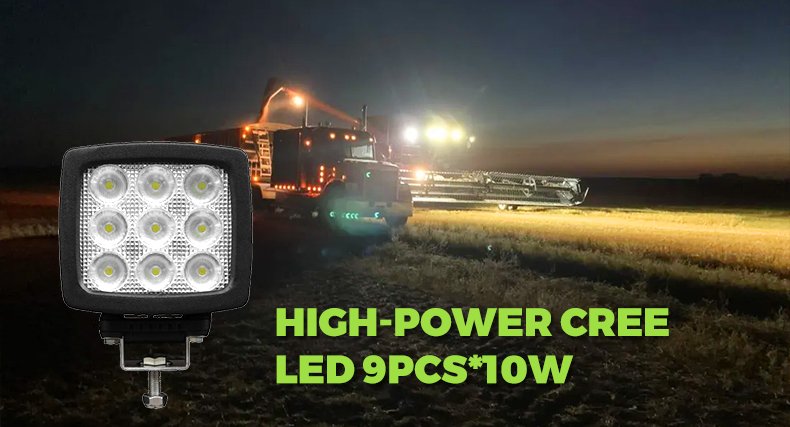
Loader and implement clearances. The front-mount trap: a lamp that clears the bucket in transport but gets swept off at full curl, or lights the bucket’s shadow exactly where the operator needs to see the forks. Resolve mounting by walking the machine through full lift, curl and steering lock before drilling anything; side-of-fender and cab-roof positions often beat the “obvious” central visor spot for loader work.
Shared lamps and quick-release. Fleets that light several machines with a small stock of lamps (contractors, council work gangs, mixed-row farms) standardize on quick-release brackets — one permanently mounted base per tractor position, lamps moved as the job demands. It converts a wiring project on every machine into a bracket on each and a lamp carried in the cab.
Light Distribution for Field Tasks
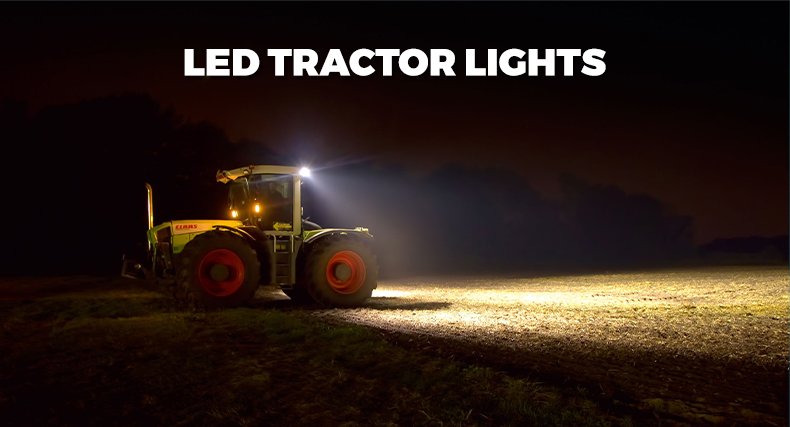
Field optics fight a different enemy than road optics: dust and moisture haze scatter light straight back at the driver. A tight spot mounted at eye height becomes a white wall in a dry, harrowing wind, while wide, moderately aimed flood washes the working zone with less return glare. The layouts that work combine positions: front-wide at fender or ROPS height to light the loader and hitch, rear flood for the implement and three-point linkage, and — on sprayer and slurry tankers — task lighting for the reel and hoses at the back. Cool, high-CRI light is a genuine aid for reading gauge boards and hay at midnight; but the specification that prevents complaints is distribution, not color.
One number worth understanding is lux at the working plane rather than lumens on the box, and it is exactly what a manufacturer that tests beam output in production can supply: a lux table for the model at 3, 5 and 10 m. Ask for it before comparing two lamps on wattage.
Durability: Dust, Wash-Down and Chemicals
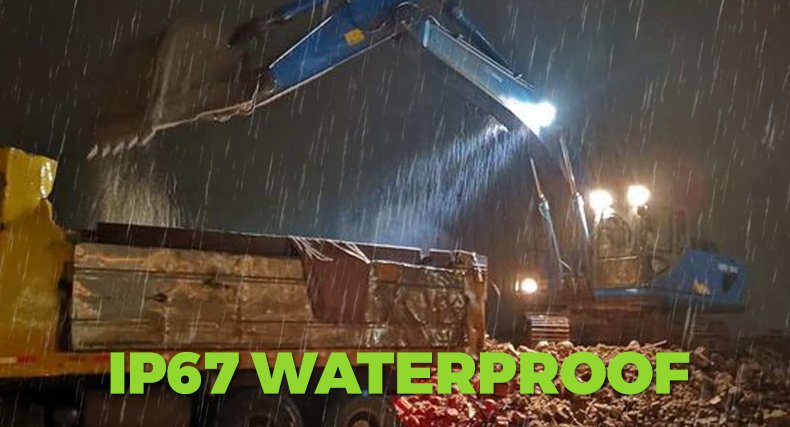
- Sealing: IP66 is the sensible floor for exterior tractor lamps; IP67/IP68 matters for machines that get jet-washed, and a documented high-pressure wash rating (IP69K is the claim to ask about) separates sealed-for-real from sealed-for-the-datasheet. The lens seam, cable gland and any vent are where the story actually ends.
- Vibration: cab-off mounting sees the raw chassis spectrum; potted drivers and strain-relieved cable exits, not damping foam.
- Chemical exposure: silage effluent, slurry and fertilizer dust corrode ordinary hardware quickly — stainless fixings, coated boards and UV-stable lenses are the spec lines for spreading and spraying seasons.
- Thermal margin: a lamp boxed against a cab pillar runs hotter than the same lamp on an open bracket; ask what case temperature the driver is derated at.
Tractor Work Light Positions Side by Side
| Position | Best For | Optic | Compatibility Checks |
|---|---|---|---|
| ROPS top / cab roof | Headlands, yard movement, general area | Wide flood, shielded downward | Clamp-only mounting (no drilling); cab roof load and wash reach |
| Fender / front mount (AEV-style) | Loader coupling, hitching, ground ahead | Flood or combo | Full bucket curl clearance; standard pin-set compatibility per make |
| Rear / three-point tower | Implement hookup, spreading, baling at dusk | Wide flood | Keep clear of linkage travel and PTO; do not feed from trailer socket circuits |
| Boom / sprayer task lights | Nozzle checks, reel and hose work | Diffused flood | Chemical-rated housing; wash-down sealing as a minimum, not a feature |
| Quick-release shared lamp | Fleets lighting multiple machines with few lamps | Task flood | One bracket standard across the fleet; anti-theft retention |
Compliance Notes for Agricultural Lighting
Most tractor work lighting is off-road task lighting and sits outside road-lamp approval regimes — but the line moves the moment a lamp is visible forward on a public road or is wired to function while driving between fields. For European machines that spend road time, E-marked lamps (the UN ECE regime) keep that argument from ever starting, alongside the CE and RoHS documentation buyers already expect. A photobiological safety assessment to EN 62471 (the standard for lamp and lamp-system hazard to eyes) is increasingly requested by large contractors and insurers; XRLL’s documented test set includes EN 62471 reports alongside CE, RoHS and ISO 9001 manufacturing certification. As always with any market: report numbers per SKU beat a logo on a carton.
The Dealer and Farm-Fleet Compatibility Checklist
- Confirm the machine’s real system first: 12 V negative ground, 6 V legacy, generator vs alternator, any AC magneto circuits — before quoting any lamp.
- One lamp family with wide DC input tolerance, stated transient immunity and low quiescent draw across the fleet.
- Relay-switched, fused-from-battery circuits; dedicated socket or cable for implement lighting; no trailer-socket borrowing.
- ROPS/FOPS clamp-only mounting; standardized front mount sets where the tractor has provisions; clearance walked through full loader and steering travel.
- Sealing matched to the wash-down regime, chemical-rated hardware for spreading and spraying duty.
- Photometric lux tables on file per model, and the certification pack (CE, RoHS, EN 62471, E-mark where road-visible) matched to the market.
See how tractor and field duty are covered across the range — chip grade, sealing tests and per-model documentation — on the XRLL agriculture & forestry solution line.
Confirm Compatibility Before You Quote
Send the machine’s year, electrical system and mounting positions to the XRLL sales desk — a Foshan factory producing 10,000+ units a day across four lines for customers in 80+ countries — and get a voltage-and-bracket compatibility answer with certification documentation inside 24 시간. OEM branding, custom brackets and beam variants run on in-house tooling, with pre-production samples before series orders.
이메일: service02@xrlledlight.com · Phone/WhatsApp: +86-15818025687
FAQ
Are LED work lights compatible with old generator-charged tractors?
예, with two checks: the lamp driver must cover the wider voltage swing an aging generator and regulator produce, and total added load must stay inside what the machine’s charging system supplies at idle. LEDs help here — a typical work lamp draws a few amps as halogen and a fraction of that as LED — but the driver’s stated input range and transient protection, not the bulb technology, decide whether it survives.
Can I drill my tractor’s ROPS to mount a work light?
아니요. The roll-over protection structure is a certified load path, and drilling it compromises the very protection it exists to provide — with liability consequences in an accident. Use the manufacturer’s provided mounting holes, or a clamp-on saddle/strap bracket that grips two faces of the tube. This is why standardized agricultural clamp mounts exist at all.
What IP rating does a tractor work light actually need?
IP66 is the practical floor for any exterior position on a farm machine. Move to IP67/IP68 — or a documented high-pressure wash rating — if the tractor is jet-washed weekly, because the water ingress that kills lamps arrives during cleaning, not rain. Then check where the rating’s weak points are: cable gland, lens seam and any vent are the entry paths, and a sealed connector on a matched harness ends the argument.
Can I power rear work lights from the tractor’s trailer socket?
Not reliably. The standardized rear socket circuits (12 N/12 R seven-pin in most markets) are engineered to carry a trailer’s own signal and tail lighting, not an added bank of task lamps on the tractor; loading them causes dim output, overheated contacts and blown protection that shows up as trailer-lighting faults instead. For permanent implement-side lighting, wire a fused, relayed circuit from the battery and add a dedicated switched socket if the job moves between machines.


