LED Warning Lights: Types, Specifications and Procurement Checklist
A distributor builds an industrial safety catalog the way a contractor builds a toolkit — one drawer at a time — and somewhere in the second year the gap shows up. Customers who bought helmets and hi-vis vests start asking for machine-mounted visual signals, and the first inquiry that mentions an LED warning light sends the purchasing team scrolling through unfamiliar supplier listings. The category looks simple from the outside: a lamp, a bracket, a wire. In practice it is a family of genuinely different products — projection lights, zone markers, laser line projectors, strobes and beacons — each answering a different safety question, each carrying its own specification and certification burden. This guide maps the whole family, lists the specifications that separate reliable products from decorative ones, and closes with the procurement checklist a distributor can run against any candidate supplier.
Key Takeaways
- Five product families, five jobs. Blue spot and arrow projectors warn ahead of the machine, red zone lights mark the standoff footprint, laser line projectors draw walking corridors, strobes and beacons command attention at crossings, and crane warning lights extend the logic overhead. Stock the family mix your customer base actually works in.
- Specifications predict survival. Input voltage range, LED source brand, IP68 sealing, operating temperature and housing material decide whether the unit still works in year three — more than any brightness figure on the front page of the datasheet.
- Certifications travel with the sale. CE and ROHS are the baseline; E-mark (E9) and DOT-referenced compliance unlock road-going customers; EN 62471 and laser-safety documentation cover photobiological and projector products. A supplier who files documents per model keeps your tenders clean.
- Converge SKUs where the hardware allows. Wide-voltage inputs (12/24 V) and selectable flash patterns let one beacon model serve indoor and outdoor fleets, cutting inventory depth without cutting coverage.
- Audit the factory, not the brochure. Incoming chip verification, PCB and driver checks, seal testing, photometric measurement, thermal aging, vibration, electrical safety and final inspection — a nine-gate sequence like this is the difference between batch consistency and batch roulette.
The Five Jobs a Warning Light Does
Before comparing products, get the jobs straight, because customers rarely ask for a product family — they describe an accident they want to prevent. Five questions cover almost every industrial inquiry.
1. Warning ahead of the machine: spot and arrow projectors
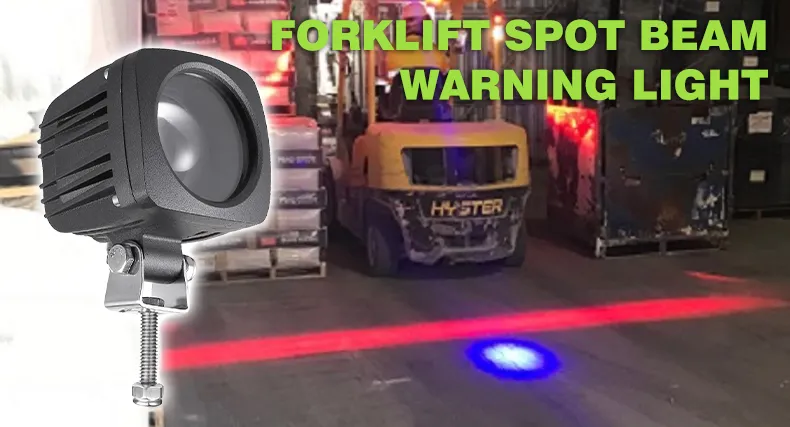
A forklift emerging from a racking aisle is invisible until it is moving, and pedestrians walk exactly where aisles meet. A blue spot projector solves the geometry: mounted on the vehicle and angled at the floor, it throws a bright blue spot several meters ahead of the machine — moving before the machine moves, visible before the machine is visible. Arrow versions project a directional symbol that reads as motion itself. The specification that matters most here is photometric: a projector running on quality LED chips produces a spot that stays legible under 200-lux warehouse lighting, while a weak unit washes out exactly when the aisle is brightest. Units in the 1334Q class — a 24 W LED line warning light in this family — show how far output has climbed in compact housings.
2. Marking the standoff distance: red zone lights
Where the spot projector warns ahead, the red zone light marks beside: a beam angled downward at the sides paints a boundary line on the floor at the distance pedestrians must keep from the moving machine. It converts an invisible rule — the safety distance from a passing forklift — into a physical line on the ground. Fleets deploy them on machines that share narrow corridors with foot traffic, and the pairing of one blue spot forward plus two red zone units on the sides has become the default safety kit on new counterbalance trucks in demanding warehouses.
3. Drawing corridors: laser line projectors
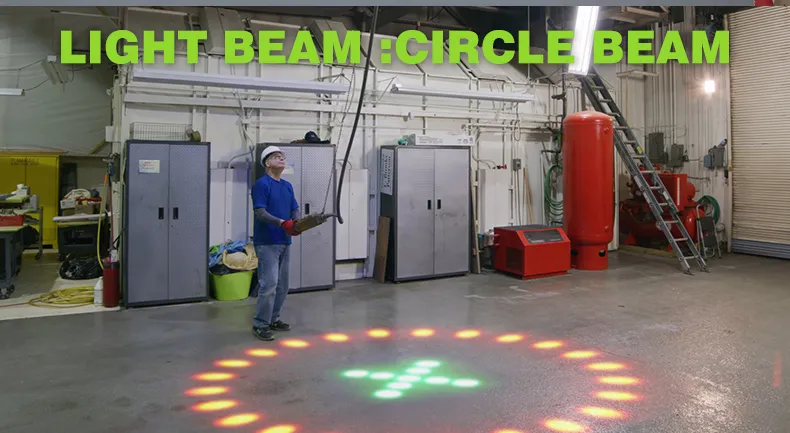
Laser line projectors take floor marking off the paint schedule. Instead of repainting walking corridors every year, a projector mounted at height casts a continuous red or green line across the floor — a boundary that never wears, repositions in minutes, and stays visible in the low light where paint disappears. In pedestrian-heavy logistics floors they delineate walkways; around machines they mark exclusion arcs; in staging areas they separate forklift lanes from picking zones. Products in this class carry their own compliance conversation — laser safety grading under IEC 60825 and photobiological testing under EN 62471 — which is covered in the certification section below.
4. Commanding attention: strobes and flashing beacons
Crossings, reversing routes, dock edges: locations where the pedestrian must stop and look, not just be aware. An LED strobe or flashing beacon fires high-contrast pulses that trigger peripheral vision and read as an instruction rather than a background condition. Amber domes in the 5 W class — the 2010A flashing beacon family — cover service vehicles and indoor plant; higher-output units serve outdoor yards where daylight competition is real. The LED generation of this category replaced motor-driven rotating domes with solid-state arrays, which removed the single most failure-prone component and made selectable flash patterns a firmware feature rather than a hardware variant.
5. Extending the logic overhead: crane and AGV warning lights
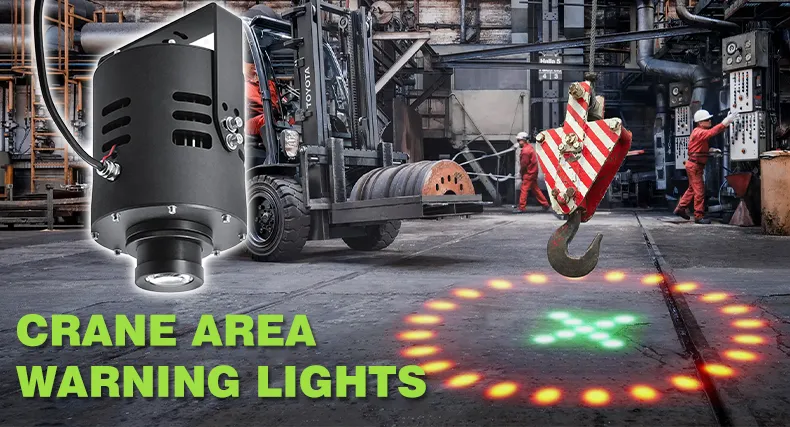
Overhead cranes move loads above heads, and AGVs move silently at ankle height — two opposite geometries that both need ground-projected warning. Crane warning lights project the load position or an exclusion zone onto the floor beneath the hook path; high-output units in the 1335i class deliver 75 W of projection for spans where ambient light is uncontrolled. AGV fleets use compact projectors and beacons to announce approach at blind corners where the vehicle itself is silent and low. Both applications reward the same supplier qualities as the rest of the family: sealed housings, wide voltage tolerance, and test reports on file.
| Product family | What it answers | Typical mounting | Who buys it |
|---|---|---|---|
| Blue spot / arrow projector | “Pedestrians can’t see my machines coming” | Forklift front/rear, angled at floor | Warehouses, cold stores, plants |
| Red zone light | “Nobody keeps distance from moving trucks” | Machine sides, downward beams | Mixed foot-traffic logistics floors |
| Laser line projector | “Painted walkways wear out and rework costs money” | Ceiling or machine, downward projection | Distribution centers, factories, staging areas |
| LED strobe / flashing beacon | “Nobody stops at our crossings” | Vehicle roof or body, fixed posts | Yard fleets, service vehicles, gates |
| Crane / AGV warning light | “Loads and robots move where people stand” | Crane bridge, AGV chassis | Steel, ports, automated warehouses |
Specifications That Separate Products
Once the family is mapped, the specification sheet decides what you are actually buying. Six lines do most of the separating.
Input voltage and electrical compatibility
Industrial vehicles span 12 V cars and vans, 24 V trucks and forklifts, and 48 V and 80 V heavy trucks and material handling fleets. A product line built on wide-voltage inputs (typically 10–30 V or 20–80 V ranges) covers more of your customer base per SKU, survives voltage transients during charging and cranking, and simplifies your spares kit. Confirm the range on the datasheet, not the catalog summary — the fine print is where compatibility lives.
Light source quality
The LED chips and driver electronics determine output stability over years, not weeks. Products standardized on OSRAM or Cree chips bring published binning and predictable lumen maintenance; anonymous chips bring the reverse. The same logic applies to laser diodes in projector products. A supplier who names the component brands is a supplier who selected components deliberately — component naming is a small signal that travels a long way.
Sealing: the IP rating that matches the duty
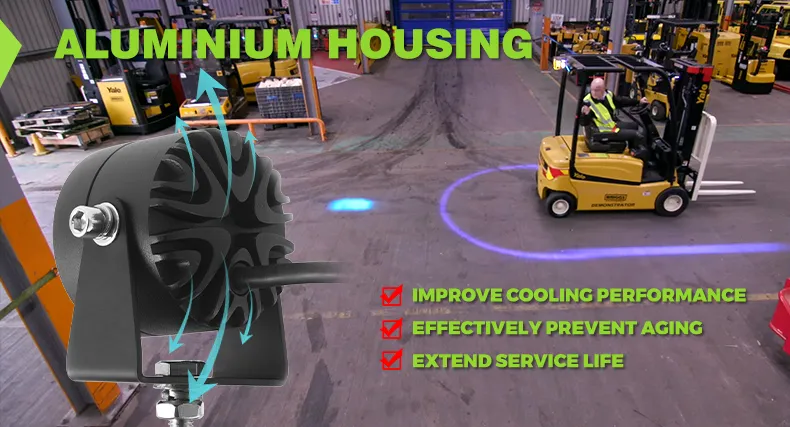
IP68 — dust-tight and protected against continuous immersion — is the grade that survives pressure washing, outdoor rain duty and cold-store condensation cycles. Lower ratings do fine on clean indoor walls and fail everywhere else. Housing material matters in parallel: die-cast aluminum dissipates heat from high-output LEDs and shrugs off the impacts that crack plastic domes. Since a cracked housing admits water, and water kills drivers, the housing is part of the sealing system, not separate from it.
Thermal and mechanical endurance
Ask for the operating temperature range and what stands behind it. Products aged through high-low temperature cycling and vibration testing before shipment carry real numbers (-30 °C to +60 °C territory for outdoor duty); products without that testing carry guesses. The same section of the datasheet usually reveals mounting provisions — bracket strength, vibration damping, connector strain relief — which decide whether the unit stays aimed after six months of forklift vibration re-centers everything the installer tightened.
Optics and beam control
Beam pattern separates professional units from assembled ones: a spot projector needs a clean-edged symbol that reads at distance, a red zone light needs a crisp boundary line, a beacon needs intensity distributed across the viewing angles that matter. This is engineering, not luck, and it shows in the product photographs — if the promotional images show fuzzy edges and washed-out symbols, the field performance is worse, because marketing photography flatters.
Serviceable details
Stainless hardware, sealed connectors, interchangeable brackets, and consistent polarity marking across a product family reduce your after-sales load to near zero. None of these lines sells a catalog, and all of them decide whether the second order arrives.
Certification Files Your Customers Will Ask For
Distribution lives one document away from losing a tender, so treat the certification package as part of the product. The working set for this category:
- CE — the European baseline, covering EMC and electrical safety directives; serious suppliers ship the EMC test reports behind it (EN 55015 / EN 61547 territory for lighting equipment), not just the logo.
- ROHS — restricted-substance compliance for European customers and an increasingly common procurement gate worldwide.
- E-mark (E9) — European vehicle-component approval, mandatory for lamps mounted on road-going vehicles; the E9 designation identifies the approving authority.
- DOT-referenced compliance — the North American market’s documentation route for vehicle lighting.
- EN 62471 — photobiological safety of lamps, the assessment buyers ask about for high-output LEDs and projector products.
- Laser safety (IEC 60825) — laser classification for line projectors; your customers’ safety engineers will ask for the class and the report, per model.
- ISO 9001 — the factory quality system underneath all of the above; it predicts whether batch 40 matches batch 1.
Two habits turn this list from overhead into advantage. First, request files per model at quotation stage — a supplier who produces them promptly has them, and one who stalls does not. Second, check the report dates and laboratory names; documents age, and tenders notice.
Building the Line as a Distributor
The profitable shape of a warning-light line follows customer operations rather than the supplier catalog. A practical starting structure:
Indoor kit. Blue spot projectors plus red zone lights as paired SKUs, one wide-voltage strobe with selectable patterns for crossings, and a compact line projector for walkway demarcation. This kit serves warehouses, cold stores and plants — the volume heart of the market.
Outdoor kit. Amber flashing beacons in 5 W class for service vehicles, higher-output strobes for yard duty, and projector units with the output to stay legible in daylight — the 75 W crane-warning class anchors the heavy end.
Road-legal kit. Beacon and strobe models with E-mark (E9) and DOT-referenced documentation for customers whose vehicles share public roads — the gate approach, the municipal contractor, the breakdown fleet.
Automation kit. Compact projectors and beacons specified for AGV and mobile robot fleets, where low draw, sealed housings and pattern control matter more than raw output.
Across all four kits, converge on suppliers whose families already span the voltage ranges and mounting standards your market uses. Every additional supplier fragments your certification file, your spares stock and your quality variance; every converged SKU strengthens all three. This is where manufacturer scale earns its keep — a factory running four assembly lines at 10,000-plus units a day, supplying distributors in 80-plus countries from an ISO 9001 system, absorbs your volume growth without re-quoting, and a nine-gate inspection sequence (from incoming chip verification through sealing, photometric, thermal, vibration and electrical tests to final inspection) keeps the thousandth unit inside the same tolerance band as the first.
The Procurement Checklist
Run every candidate supplier through the same sequence before the first container:
- Family coverage. Do they manufacture across the five families, or assemble two of them and badge the rest? One-line depth beats five-line shallowness at equal quality.
- Specification verification. Ask for measured performance — output figures, beam photographs, IP test evidence — per model, and compare against the claims in their own catalog.
- Certification file per model. CE with EMC reports, ROHS, E-mark (E9) and DOT documents where road duty applies, EN 62471 and laser-safety files for projector products, ISO 9001 for the factory.
- Component policy. Named LED sources (OSRAM, Cree) and consistent driver electronics; ask what arrives at their incoming inspection and what gets rejected.
- Production transparency. Factory floor area, assembly line count, daily capacity, and the full test sequence between incoming components and shipment.
- OEM/ODM capability. Logo marking, custom beam and projection patterns, housing molds for private-label lines, and engineering response inside 24 hours — this is the margin layer of distribution.
- Sample discipline. Bench-test evaluation units on your own vehicles and walls before committing; a supplier confident in the line ships samples without ceremony.
- Commercial reliability. Export history, reference customers in your region, and a sales team that answers specification questions with documents rather than adjectives.
Sourcing a Warning-Light Line for Your Catalog?
Send your target customer profile and SKU plan to the XRLL team — a warning-light manufacturer since 2011, producing on four assembly lines in a 17,000 square-meter Foshan plant, serving 5,000-plus B2B customers across 80-plus countries. Within 24 hours you will receive a family-by-family recommendation with model specifications, the certification file per model, and evaluation samples for your bench test. OEM/ODM programs cover logo branding, custom projection patterns and purpose-built housings for private-label lines.
Review the complete LED warning light range — spot and zone projectors, laser line projectors, strobes, beacons and crane warning systems — then talk to the factory directly.
Email: service02@xrlledlight.com · Phone / WhatsApp: +86-15818025687
Frequently Asked Questions
Which LED warning light types should a new distributor stock first?
Start with the indoor kit — blue spot projectors and red zone lights as paired SKUs, plus one wide-voltage strobe with selectable patterns — because mixed foot-traffic warehouses generate the highest inquiry volume. Add amber beacons for service-vehicle customers next, then high-output projectors for crane and yard duty as the industrial side matures. Converge on one manufacturer per kit to keep certification files and spares manageable.
What specification matters most for wash-down and outdoor environments?
Sealing and housing, taken together. IP68-rated enclosures survive pressure washing and continuous rain, and die-cast aluminum housings handle the heat of high-output LEDs plus the impacts that crack plastic domes — a cracked housing admits water, and water failure is the most common early death in this category. Check the operating temperature range on the datasheet as well, since outdoor fleets cycle between freezing yards and heated docks.
Why does LED chip brand matter in a warning light?
The chips and driver electronics decide whether output holds for years or fades in months. Established sources such as OSRAM and Cree publish performance bins and lumen-maintenance data, so a manufacturer standardizing on them can guarantee what the thousandth unit delivers; anonymous chips cannot be held to any figure. Since a warning light that dims quietly is a safety product failing silently, chip provenance is a safety specification, not a marketing one.
Do laser line projectors need different documentation than LED beacons?
Yes. Projectors that use laser sources carry laser-safety classification under IEC 60825, and your customers’ safety engineers will ask for the class per model — commonly the low classes designed for floor-projection duty. High-output LED products add photobiological assessment under EN 62471. Both sit on top of the CE/ROHS baseline, and both should arrive as test reports rather than logo claims when you request the certification file.
How can a distributor verify supplier quality before the first bulk order?
Three steps: request the per-model certification file and measured specifications at quotation stage; audit the production basics — floor area, assembly lines, daily capacity, and the inspection sequence between incoming components and shipment; and bench-test samples on your own vehicles before committing. A manufacturer running a nine-gate test sequence from chip verification to final inspection, under ISO 9001, will pass all three without preparation; a trader re-badging assembled goods will not.


