Forklift Safety Lights: Selection Guide for Warehouses 2026
Most warehouses add a forklift safety light after a near miss. A truck reverses out of an aisle half a second before a picker steps into its path, and the team concludes that the floor needs a clearer warning than paint, mirrors and horns can provide. A safety light closes that gap at low cost: it projects a visible cue onto the floor around the truck, so pedestrians respond to the light instead of relying on eye contact or a horn they may never hear over fans, radios and reversing alarms. This guide covers the five light types in common use, the specifications that matter when you buy for a fleet rather than a single truck, and the checks that separate a reliable manufacturer from a reseller.
Principais conclusões
- Type follows hazard. Blue spots warn people that a truck is approaching, red zones and laser lines mark the keep-out area, and AI detection intervenes before contact.
- Rate ingress protection against your harshest room, not your average one. Cold storage and washdown destroy under-specified electronics within months.
- Ask for test reports, not adjectives. CE, Marca eletrônica, DOT, CEI 60825 and ISO 9001 paperwork should arrive with the quotation.
- Chip provenance predicts lifespan. OSRAM and Cree chips hold output and colour far longer than unbranded alternatives.
- Buy from a factory that can customize. Housing molds, beam patterns and logos matter once the lights carry your brand.
What a Forklift Safety Light Changes on the Floor
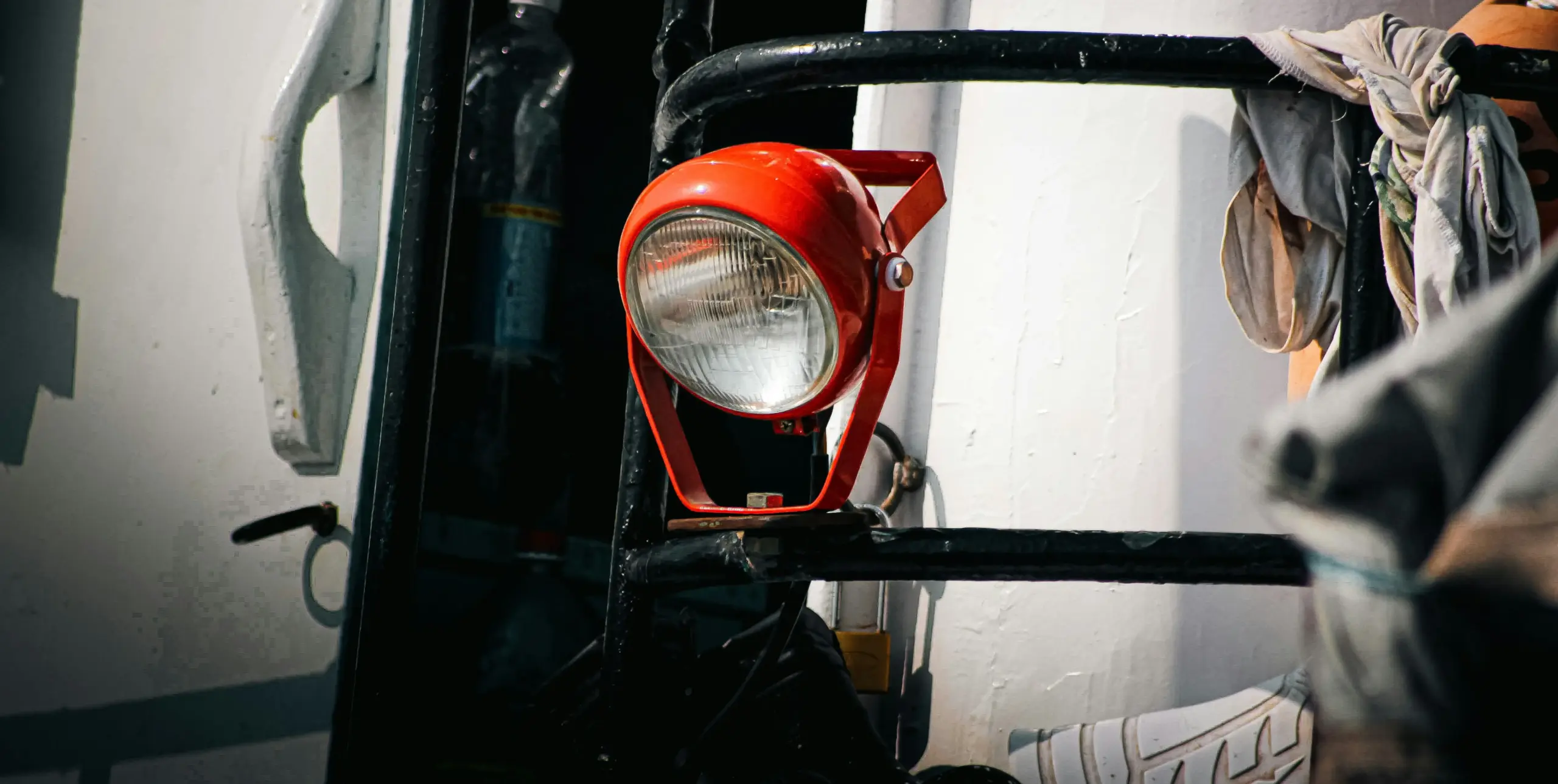
Forklifts and people share the same aisles in almost every operation, and the physics rarely favours the pedestrian. A loaded truck outweighs a person several times over, stops slowly, and gives its operator a partly blocked view at exactly the points where people cross. Training and speed rules address the same risk, but both depend on somebody remembering them at the right moment.
A projected light removes part of that dependence. The cue sits on the floor, in the pedestrian’s natural line of sight, and travels with the truck. A blue dot rounding a blind corner announces the vehicle before either party can see the other. A red boundary shows how much space the mast and the counterweight will sweep, so people step back without being asked.
Where compliance fits
In the United States, OSHA 1910.178 places the duty of care on the employer: trucks, attachments and operating conditions must be kept safe, and visibility is part of that obligation. ANSI/ITSDF B56.1 sets the corresponding design expectations for the trucks themselves. Neither document names a product category, which is why auditors look for evidence instead: a written lighting standard, installation records, and hardware that carries its own conformity marks. For European and export fleets those marks are CE and E-mark; for laser-based projection units, add IEC 60825 laser classification and, where photobiological safety is assessed, EM 62471.
Five Types of Forklift Safety Lights, Matched to the Hazard
Blue spot lights
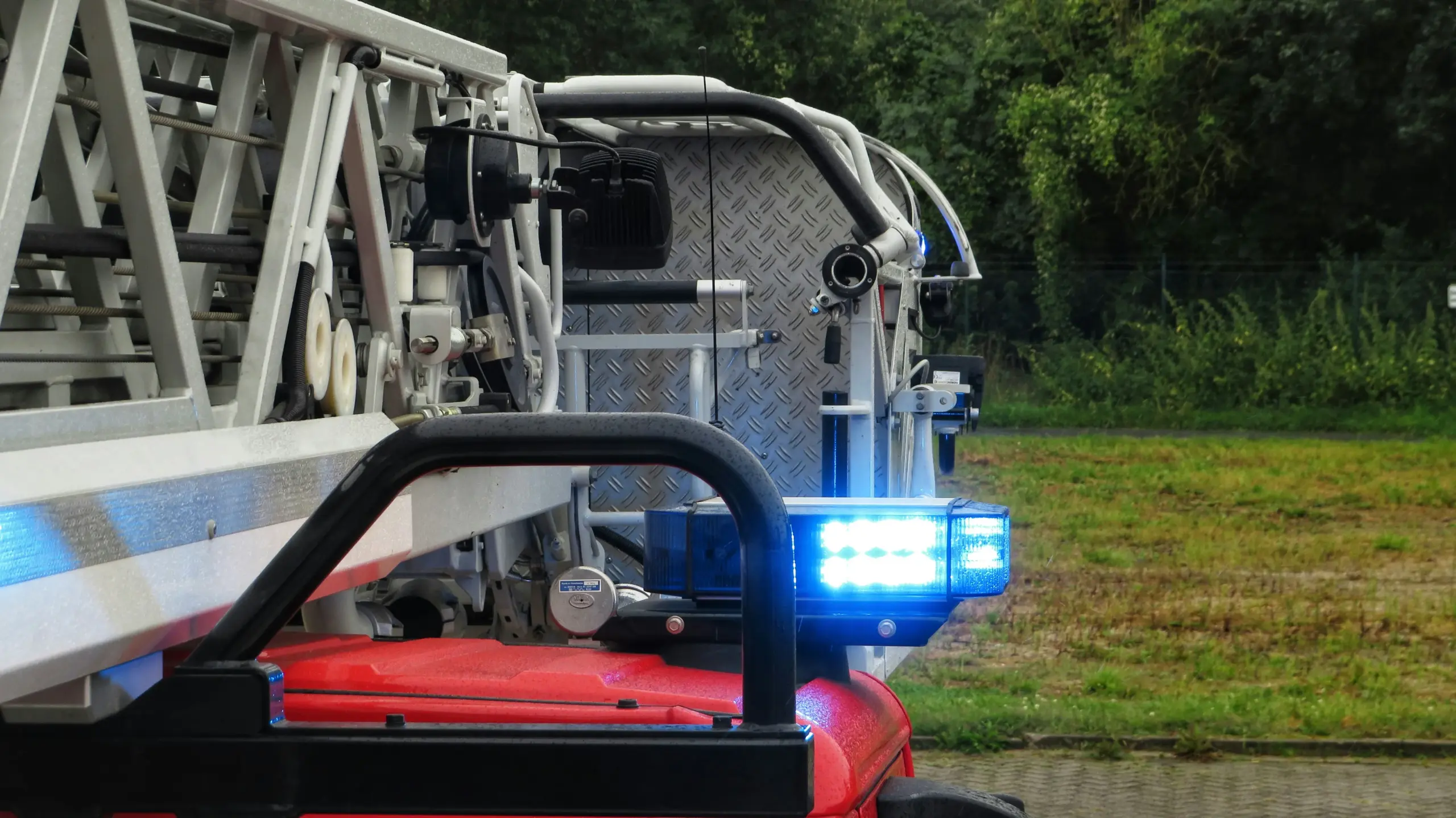
A blue spot light throws a single saturated dot onto the floor a few metres ahead of, or behind, the truck. Its job is advance warning where sightlines fail: aisle ends, racking corners, doorways. Blue works because it contrasts with the warm high-bay lighting typical of older warehouses and reads instantly as a warning rather than as illumination. The 1335D in the XRLL range is a typical example of this class.
Red zone lights
Red zone lights paint a boundary around the moving truck, marking the area a pedestrian should not enter while the mast swings or the vehicle reverses. They earn their keep in narrow aisles, at dock doors, and anywhere people habitually walk behind a working truck. The projected zone stays with the vehicle, which a painted floor line cannot do.
Laser line projection
Laser line units project a sharp line or zone outline that stays crisp at distance and under bright ambient light, which makes them the better choice in large, well-lit halls where LED spots wash out. Because they are laser products they must carry an IEC 60825 classification, and a serious supplier will hand over the test report without being asked twice. Laser projection is one of the areas XRLL develops in house, with its own patent portfolio behind the optics.
Beacons and strobes
An amber strobe answers a different question: is anything moving out there? It carries that signal across yards, up ramps and through doorways, long before floor projections become visible. Beacons pair well with spot and zone lights rather than replacing them.
AI pedestrian detection
Detection systems move from warning to intervention. The XRLL XRL1341 mounts three AI cameras for 360-degree coverage, identifies a pedestrian at 6 to 7 metres, and fires an audio-visual alarm that reaches both the operator and the person approaching. The housing is sealed to IP67, and the system is aligned with OSHA 1910.178 and the newer forklift safety expectations emerging around it. In high-traffic yards where behaviour is hard to coach, this is the layer that catches what lights alone cannot.
Comparison at a Glance
| Light Type | Primary Job | Best Suited To | Key Spec to Verify |
|---|---|---|---|
| Mancha azul | Advance warning of an approaching truck | Blind aisles, racking corners, doorways | Projection distance, beam focus, IP rating |
| Red zone | Marks the keep-out perimeter | Narrow aisles, dock doors, swing radius | Zone width and adjustability, mounting side |
| Laser line | Sharp floor boundary over distance | Large, brightly lit facilities | CEI 60825 laser class, line brightness |
| Beacon / strobe | Long-range moving-vehicle cue | Yards, ramps, entry points | Flash pattern, visibility angle |
| AI pedestrian detection | Active detection and alarm before contact | High-traffic mixed sites | Detection range (6–7 m), camera coverage, IP67 |
Seven Checks Before You Place a Bulk Order
Specification sheets tend to agree with each other until something fails in month two. These are the checks that predict behaviour in service.
1. Visibility under your lighting, not the showroom’s
Judge the beam under your own high-bay LEDs at the busiest shift. Ask for the beam pattern and the rated projection distance, and confirm the colour still separates from the floor at ten metres. A sample on one truck for a week tells you more than any datasheet.
2. Ingress protection matched to the harshest room
Rate the light for the worst environment any truck enters. Condensation in cold stores, high-pressure washdown in food plants and abrasive dust in aggregate yards each destroy under-specified housings quickly. IP67 covers temporary immersion and suits most indoor duty; IP68 is the safer specification for washdown and outdoor work. XRLL tests IP68 sealing as a standard step in its nine-stage inspection sequence, and the XRL1341 carries IP67.
3. Voltage range across a mixed fleet
Electric trucks run at several different system voltages, and a light specified for one of them will not necessarily tolerate the rest. Confirm the input window covers every truck in the fleet, and check current draw so the retrofit does not tax older batteries.
4. Conformity paperwork with the quotation
Require certificates up front: CE and ROHS for the EU, E-mark and DOT for vehicle-related use in Europe and the United States, CEI 60825 for laser units, EM 62471 for photobiological safety, and ISO 9001 for the quality system behind them. XRLL holds these with third-party test reports on file.
5. Evidence of vibration and thermal testing
Mast and chassis vibration loosens poor solder joints and seals long before normal wear does. Look for aging, vibration and shock testing inside the supplier’s QC process. XRLL runs nine inspection stages, from incoming chip verification through high- and low-temperature aging, vibration and impact testing, electrical safety checks and a final pre-shipment inspection.
6. Chip provenance
The LED chip sets lumen maintenance and colour stability over the life of the unit. German OSRAM and US Cree chips, verified at incoming inspection as XRLL does, hold their output for years. Unbranded chips dim and shift colour within months, and the warning you paid for quietly weakens.
7. Customization and sampling discipline
Fleet buyers eventually want a logo, a specific beam or projection pattern, or a housing that fits an unusual mount. Confirm the supplier cuts its own molds, quotes within a day, and sends samples for approval before mass production begins. XRLL offers OEM and ODM work on logo, beam pattern, housing mold and projection pattern, with sample confirmation before production.
Matching Lights to the Environment
Distribution and logistics. Blue spots at aisle ends plus red zones on the truck cover the two classic collision points, the blind corner and the swing radius, with beacons at dock doors.
Cold chain and food processing. Specify IP68 and thermal-cycling tolerance first; condensation kills under-rated electronics faster than any mechanical fault. Laser lines define walkways that floor tape cannot hold on wet surfaces.
Manufacturing and heavy industry. Bright halls and mixed traffic favour laser line projection for its long-throw clarity, with AI detection reserved for the busiest pedestrian corridors.
Yards and outdoor sites. Beacons carry the long-range signal while spots and zones handle the close work. Confirm dust, rain and temperature ratings in writing.
Vetting the Supplier Behind the Spec Sheet
Product specs travel easily between traders, so the durable questions are about the company standing behind them.
- Does it own the factory? XRLL has manufactured in Foshan since 2011, in a 17,000 m² plant with 17 machines, four assembly lines and daily output above 10,000 units. Vertical integration keeps quality and lead time under one roof.
- Can it show the test trail? Nine inspection stages per unit, with third-party certification available for review.
- Does it hold patents in the categories you are buying? More than 30 utility-model and design patents, concentrated in laser projection, AI detection and matrix display technology.
- Who already buys from it? Over 5,000 B2B customers in more than 80 countries, with the United States, United Kingdom, Germany, Spain, Italy, Australia and Japan as core markets.
Planning a Retrofit?
Send fleet size, operating environments and system voltages to XRLL and the sales team will respond within 24 hours with a quotation, specification sheets and evaluation samples. Every unit ships from the company’s own Foshan plant with CE, Marca eletrônica, DOT, ROHS and ISO 9001 documentation, and OEM or ODM customization is available on logo, beam pattern, housing and projection pattern.
E-mail: service02@xrlledlight.com · Telefone / WhatsApp: +86-15818025687
Perguntas frequentes
What does a forklift safety light do that mirrors and horns cannot?
It puts the warning on the floor, in the pedestrian’s line of sight, whether or not anyone is watching the truck. Mirrors need an observer and horns need audible attention; a projected spot or zone works even when the pedestrian is wearing hearing protection or looking at a pick list.
Blue spot or red zone: which comes first?
They solve different problems, so most fleets install both. Start with blue spots if your near misses happen at blind corners and aisle ends, where people need advance warning. Start with red zones if the risk is people standing too close to a working truck, near the mast swing or behind a reversing vehicle.
Does OSHA require forklift safety lights?
OSHA 1910.178 does not name them, but it requires employers to keep trucks and operating conditions safe, and visibility falls inside that duty of care. Safety lights are a recognized way to meet it, and installation records plus conformity paperwork give an auditor something concrete to review.
Which IP rating suits cold storage and washdown areas?
Specify IP67 as the floor and prefer IP68 where condensation, thermal cycling or high-pressure cleaning are routine. The XRL1341 AI detection unit is sealed to IP67, and IP68 sealing is tested as a standard stage of XRLL’s nine-step QC sequence.
How is AI pedestrian detection different from a warning light?
A warning light is passive; it only helps if someone sees it. The XRL1341 actively detects people with three AI cameras covering 360 degrees, alarms at 6 to 7 metres before contact, and alerts the operator and the pedestrian at the same time.
Can lights be customized for our fleet and brand?
Sim, when you buy from a factory rather than a trader. XRLL customizes logo, beam pattern, housing mold and projection pattern, quotes within 24 horas, and provides sample confirmation and testing before mass production, so fit and function are validated on your own trucks first.


