
Semi Truck LED Lights: Marker, Running, Auxiliary Guide 2026
Ordering lighting for a tractor-trailer is not one purchase, it is a parts list. A single semi is fitted with headlamps, front and rear turn signals, running lamps, tail and brake lamps, reverse lamps, clearance and marker lamps across the cab roof and trailer corners, side markers along both flanks, plus the auxiliary work and dock lights that never appear on the DOT paperwork but decide whether a driver can couple a trailer at 2 a.m. When procurement treats semi truck led lights as one line item, fleets end up with mismatched connectors, mixed colour temperatures across the same trailer face, and lamps that pass a visual inspection but fail the electrical one. Treating it as a system — position by position, spec by spec — is how body builders and fleet managers buy lighting once per truck instead of once per year.
Principais conclusões
- Semi lighting splits into two procurement worlds: the FMVSS 108 regulated positions (visibility to others) and the task positions (driver’s ability to see) — different rules, different failure modes, one wiring plan.
- LED upgrades pay back fastest on the always-on positions: running, marker and clearance lamps that burn hundreds of hours nightly and sit at the worst corrosion points on the vehicle.
- The trailer face is an electrical load budget: 12 V trailer circuits designed around incandescent filaments tolerate LED swaps, but flasher rates, ground paths and corroded sockets decide whether the swap works.
- Colour temperature consistency across one vehicle face is a brand and inspection issue, not vanity — mix lamp suppliers and the trailer front glows two shades of white.
- Body builders should specify connectors, cable colours and mounting centers as a standard across the build, so any shop in the network can service the truck without an adapter kit.
- For 24 V tractors and mixed fleets, lamps with true wide-input drivers avoid the flicker-and-fail pattern that dual-nominal labels hide.
The Two Lighting Systems on Every Semi
The regulated system exists so other road users can read the vehicle: its width, its length, which way it is turning, when it is slowing. The task system exists so the crew can see the truck and the work: dock manoeuvring, trailer coupling, load inspection, roadside repair. They share battery, grounds and suffering — road salt, pressure washers, stone chips — but they are bought and evaluated differently. Regulated positions are defined by FMVSS 108 in the US market (and ECE regulations in export markets); task positions are defined by nothing but how well they do the job.
| Position | Job | Regulated Colour | LED Upgrade Notes |
|---|---|---|---|
| Headlamps | Forward road illumination | White | Beam pattern is regulated — retrofit bulbs must not scatter; most fleets keep factory heads and add auxiliary bars instead |
| Front turn / running combo | Direction, presence from front | Amber or white turn; white running | Amber turn requirements tighten in export markets — specify by destination, not habit |
| Clearance / marker (cab roof, trailer corners) | Show width and outline | Front white, rear red, intermediate amber on wide vehicles | Highest-hour always-on lamps on the truck — best LED payback; sealed LED units end the cracked-lens water problem |
| Side markers | Show length and trailer edges | Amber forward, red rearward | Flush-mount LED markers survive car-wash brushes and dock impacts better than lensed incandescent cups |
| Tail / brake / turn (rear) | Presence, slowing, turning from behind | Red, higher intensity on brake | Combination units cut trailer connector load; check flasher compatibility when converting a whole trailer |
| Reverse | Backing illumination, warning | White | Frequently the first lamp to fail from corrosion — a cheap reason to buy sealed LED on the whole rear face at once |
| Auxiliary driving / work lights | Unlit roads, dock and roadside work | Not a regulated function | Size and aim to the job — see the fleet light bar selection guide linked below |
Markers and Clearance: the Always-On Workhorses
Clearance and marker lamps run whenever the truck is on the road — thousands of hours a year, on the highest, wettest, most salt-exposed points of the cab and trailer. They are also the most inspection-visible failure on any commercial vehicle: one dark roof corner is enough for an out-of-service note. Sealed LED markers fix both problems at once: solid-state emitters shrug off the vibration that breaks filament welds, and a potted, gasketed body stops the slow water ingress that corrodes incandescent sockets from the inside.
Placement, colour and count are prescribed rather than discretionary in regulated markets, and the rules get more detailed the longer the vehicle. Our companion piece on truck light bar selection covers the roof-mounted task lighting; for the marker positions themselves, the compliance detail — who must fit them, where, and in what colour — is worth reading once properly before a trailer build.
The Rear Face: Tail, Brake and the Trailer Circuit
The trailer rear is where LED conversion meets electrical reality. A factory trailer wiring circuit was designed around filament loads; LED lamps draw a fraction of the current, which is excellent for the truck’s switches and wiring and occasionally bewildering for thermal flasher relays that expect a load to blink against. When converting a whole trailer, change the lamps and check the flasher arrangement in the same job.
Corrosion, not LED failure, is the dominant rear-face defect. The ground path through old steel sockets oxidises, brake lights dim instead of dying, and the diagnosis lands on the new lamps. Sealed LED combination units with their own gaskets and clean ring terminals remove the socket from the failure chain. Buy the rear face as one kit — tail/brake/turn, reverse, markers — in matched colour temperature and connector type, because a mixed rear face is both a service nuisance and an inspection conversation starter.
Auxiliary and Task Lighting: Where the Hours Actually Hurt
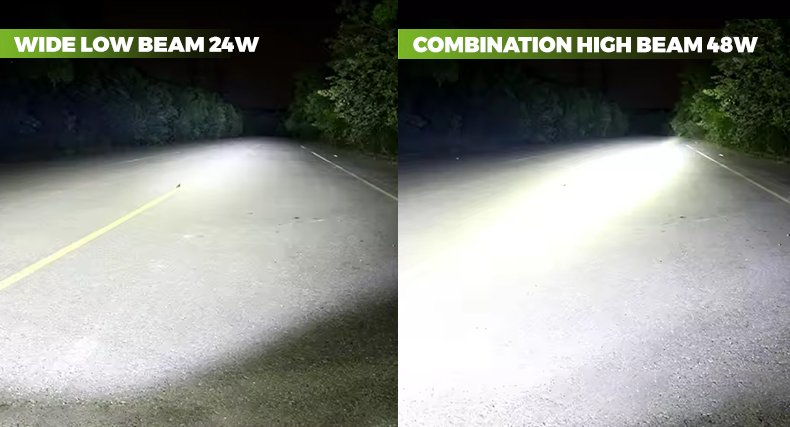
Regulated lamps are about being seen; task lamps are about the two hours a day the driver actually needs to see. Cab-roof bars and cab lights extend the road ahead in unlit territory and wash the yard in flood; bumper and apron lights point at the coupling point; trailer work lights light the dock side of the box. Fleet experience says the same fixture families used across tractor and trailer positions — same brackets, same harness parts, same spares — beat a collection of one-off solutions.
For the tractor’s cab-mounted bars, the selection logic is length, beam and driver quality rather than the regulated positions; the guide linked above walks through it. For dock and coupling task lights, our truck work-light pairing guide covers mounting positions and aiming that fleets actually get value from.
Electrical Architecture: 12 V, 24 V and Mixed Fleets
North American tractors run 12 V electrical systems; much of the rest of the world runs 24 V, and border-crossing and mixed-yard fleets live with both. A lamp family that genuinely spans 9-36 V continuous input lets a fleet standardise on one part number across platforms instead of stocking two. What does not work is a “12/24 V” label on a driver with no regulation headroom: cold-crank sag on an aging battery and load-dump spikes off a heavy charging system are exactly where under-built drivers flicker or die, and the failure gets blamed on the LED.
The same driver stage decides whether the lamp stays quiet electrically. Switch-mode drivers couple noise into the harness; on a truck packed with radios, toll readers, telematics and lane systems, an EMC-controlled design is part of compatibility, not a bonus. The engineering behind both points is covered in our wide-voltage compatibility explainer and the CISPR 25 EMC guide.

Compliance: FMVSS 108, ECE, and What a Supplier Owes You
In the US market, vehicle lighting positions are governed by FMVSS 108, and equipment is self-certified by the manufacturer against the standard’s photometric and placement requirements. In export markets, the equivalent framework is ECE regulation with type approval — the E-mark on a lamp housing is the visible evidence of that paperwork. The practical procurement consequence: the same physical lamp may be road-legal in one position in one market and not in another, and the difference lives in documents, not hardware.
What a serious supplier should hand a fleet or body builder on request: which standard each fixture is approved or tested to, the report or approval numbers, and the permitted mounting positions from that paperwork. XRLL’s certification base includes ISO9001 quality management, Marca eletrônica (E9) approval for European vehicle components, DOT-relevant documentation, CE and ROHS, with test references maintained per product family. Importers verifying a new source should treat “available on request” as the beginning of the conversation, not the end of it.
Buying the System: a Body-Builder and Fleet Spec Checklist
| Spec Item | Standardise On | Why |
|---|---|---|
| Connector family | One sealed connector system per vehicle zone | Any roadside shop can service the truck; no adapter kits, no cut-and-splice repairs |
| Colour temperature | One bin across all white positions on a vehicle face | Mixed whites look like a repair accident; consistent bins also mean matched aging |
| Mounting centers | Published hole spacing per fixture family | Body builders pre-drill once; replacements drop into existing holes |
| Input voltage band | True 9-36 V regulated drivers | One SKU across 12 V e 24 V platforms; survives crank sag and load dump |
| Selagem | IP68 on exterior positions, potted drivers | Pressure washers and salt are the real test; the socket stays the weak point only if the lamp lets water in |
| Documentation | Per-family approval references, mounting rules | Inspection and registration questions get answered with paper, not opinions |
For fleets, the ordering logic falls out of the table: convert the always-on and failure-prone positions first (markers, clearance, rear face), standardise the task positions on one fixture family, and write the connector, colour-temperature and mounting specs into the build sheet so every truck in the yard converges on the same parts list. For distributors and OEM programs, the same standardisation is what turns semi lighting from a catalogue of one-offs into a serviceable line — customisable at source across logo, beam and housing, with sample confirmation before volume.
Build one lighting spec across the whole truck
Send your vehicle mix (12 V / 24 V), trailer count and build sheet. XRLL engineers map one connector, colour-temperature and driver standard across every regulated and task position, with OEM options and a quote within 24 horas.
Perguntas frequentes
Which semi truck LED lights are worth converting first?
The always-on and failure-prone positions: clearance and marker lamps, which run every operating hour at the vehicle’s highest corrosion points, and the trailer rear face, where socket corrosion causes dim or intermittent brake and reverse lamps. Those conversions cut the two most common lighting defects an inspection writes up, and pay back in reduced roadside stops before any aesthetic argument about white light.
Can I replace incandescent trailer lamps with LED one at a time?
Physically yes, but convert each circuit as a set and check the flasher arrangement when the turn circuit goes LED, because thermal flashers designed for filament loads can blink too fast or not at all with low-draw lamps. Cleaning or replacing the ground path in the same job prevents the classic misdiagnosis where corroded sockets make new LED lamps look defective.
What colours do semi truck marker and clearance lights have to be?
In US service the pattern is white forward-facing, red rearward-facing, with amber permitted at intermediate positions on wide vehicles, and side markers amber toward the front of the vehicle and red toward the rear. Export markets under ECE regulation tighten some positions toward amber specifically. Because placement and count are prescribed by vehicle width and length, confirm each build against the destination market’s rules rather than the previous customer’s habit.
Do LED lamps work on both 12 V tractors and 24 V trucks?
Only lamps with a genuinely regulated wide-input driver — a real 9-36 V continuous band with transient protection — can be stocked as one SKU across mixed fleets. Dual-nominal labels without regulation headroom flicker on cold-crank sag and fail on load-dump spikes, which is why mixed 12/24 V operations should test candidate lamps against their worst electrical environment, not their newest truck.
What paperwork should a fleet demand from a truck lamp supplier?
Per fixture family: the standard each lamp is approved or tested to (FMVSS 108 self-certification basis for US service, ECE type approval with E-mark numbers for European markets), the permitted mounting positions from that paperwork, and production test evidence for sealing and environmental stages. Importers should treat report numbers as verifiable references — a supplier that maintains documentation per family, as XRLL does across its ISO9001, Marca eletrônica, DOT, CE and ROHS certification base, answers that request with paper rather than assurances.


