How to Choose a Forklift Safety Light Manufacturer
A regional forklift dealer just won a retrofit contract: 220 trucks across six customer sites, all needing safety lights within a quarter. The purchase order is ready. What is not ready is the supplier decision — because the last supplier shipped a container where half the units failed within a season, the certification file turned out to be a screenshot, and the replacement lead time quietly stretched from three weeks to nine. Choosing a forklift safety light manufacturer is the decision that decides whether the next 220-truck program ends in margin or in claims.
This article lays out how dealers, rental companies and fleet buyers separate real manufacturers from trading companies dressed up as factories: what evidence to demand, which manufacturing and quality signals actually predict year-two survival, how OEM and ODM capability changes fleet economics, and a vetting checklist that can be run against any shortlist — including ours.
Principais conclusões
- Verify “manufacturer” with evidence, not letterhead. Factory address on certifications, production photos tied to a real facility, and a willingness to host a visit separate manufacturers from traders. Ask what the factory cannot do — traders struggle to answer.
- Certification files are audit documents, not badges. Request the full reports behind CE, Marca eletrônica, DOT, ROHS and ISO 9001 claims, plus EN 62471 photobiological reports for laser products. Check that model numbers on the certificates match the models on the quote.
- Quality is a process you can inspect. Nine in-house gates — from incoming OSRAM/Cree chip verification to final pre-shipment inspection — predict failure rates better than any warranty sentence. Ask which gates run on every unit and which run per batch.
- OEM/ODM depth decides fleet economics. Custom beam patterns, projection patterns, housing molds and logos let a retrofit program standardize one specification across mixed fleets, instead of managing five suppliers’ SKUs.
- Run a paid-size pilot before the bulk order. Evaluation samples in real duty cycles, plus written confirmation of rated input for your voltage groups, flush out compatibility problems while they are still cheap.
What “Manufacturer” Actually Means in This Category
The word appears on every B2B lighting website, and it costs nothing to type. The verification starts with scope. A genuine manufacturer designs and assembles in its own facility and controls the steps that determine product character: housing molds, optics, driver selection, sealing and final testing. A trading company buys finished goods, applies a logo and resells. Both exist legitimately in the market, but a fleet retrofit program has different risk profiles with each — the trader cannot fix a sealing defect, because the sealing is done three companies away.
Three checks settle the question quickly. Primeiro, certificates: ISO 9001 and product test reports carry the audited factory’s name and address. If the entity on the certificate differs from the entity sending the quote, ask why. Segundo, production evidence: photos and videos of specific, identifiable spaces — an assembly line, a spray-coating workshop, an integrating sphere for photometric testing — rather than stock renders. Third, a direct question: ask what the factory does not produce. A real manufacturer answers with a list of outsourced steps; a reseller answers with marketing.
The distinction pays in the moments that matter. When a sealing process needs adjustment for cold-store duty, a manufacturer engineering team modifies and re-tests in-house. When a mold wears out, they own the tool. XRLL’s own setup — a 17,000-square-metre factory in Foshan running 17 production machines and four assembly lines with daily capacity above 10,000 units — exists precisely so those conversations happen inside one company instead of across an ocean of intermediaries.
The Evidence Chain: Certifications, Test Reports, Traceability
Certifications cluster into two groups, and buyers who mix them up underserve themselves. Management-system certification — ISO 9001 — says the factory runs a documented quality process that an external auditor has checked. Product certifications — CE for EU compliance, E-mark for vehicle components in Europe, DOT for the US market, ROHS for hazardous substances — say specific models passed specific tests. Both matter, but they answer different questions: ISO 9001 predicts consistency; product marks predict legal marketability.
The vetting move is to demand the report, not the logo. A genuine CE file includes EMC and LVD test reports with the laboratory’s name, the tested model number and the test date. An E-mark certificate shows the E9 approval number tied to a component type. For laser projectors, CEI 60825 governs laser product safety, and a serious supplier adds an EN 62471 photobiological report — the document European buyers increasingly request to address blue-light exposure questions. Requesting these files before the bulk order, and checking that model numbers align with the quotation, screens out the copied-logo suppliers in one email round.
Traceability is the quieter half of the evidence chain. Ask how a returned unit can be traced back to its production batch, its chip lot and its test record. Manufacturers with in-house inspection keep those records; buyers of finished goods cannot produce them. When a dealer’s customer asks, two years into a fleet program, why one unit failed — the answer to that question is worth more than a cent-per-unit price difference.
Manufacturing Depth: Capacity, Lines and Quality Gates
Capacity questions sound commercial, but they are quality questions in disguise. A supplier who assembles 300 units a day on one line inspects differently from one who builds 10,000 across four lines: the second has enough volume to justify automated optical checks, aging racks and dedicated sealing-test stations, and enough throughput that your urgent reorder does not jump the queue ahead of someone’s quality gate.
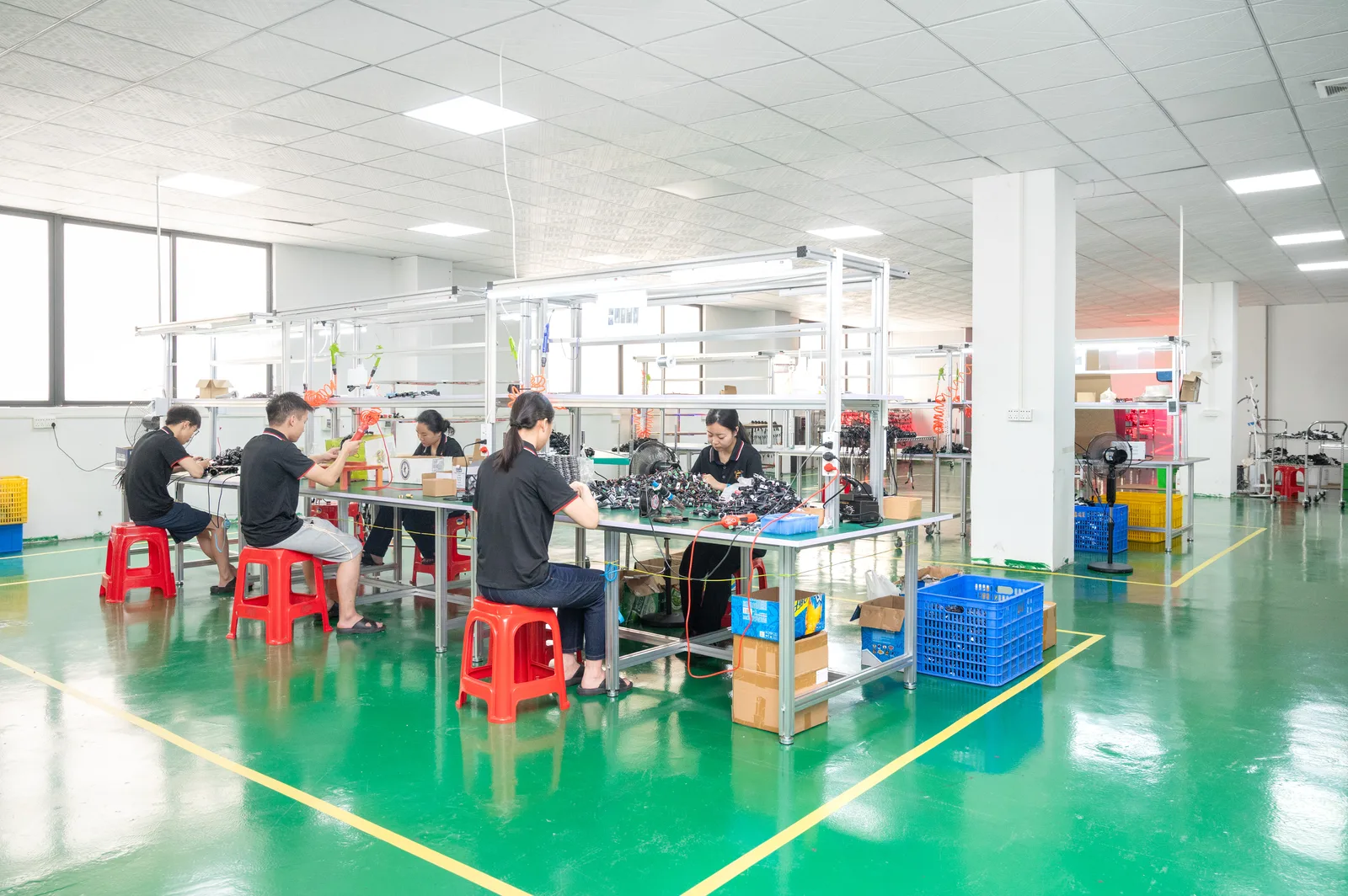
The quality-gate conversation is where manufacturer and reseller answers diverge sharpest. Ask the supplier to walk through their inspection sequence. XRLL’s runs in nine gates: incoming LED chip inspection verifying OSRAM and Cree components, PCB and driver component checks, weld and assembly inspection, IP68 sealing tests, photometric and beam-pattern output tests, high-and-low temperature aging, vibration and shock testing, voltage and electrical safety checks, and a final pre-shipment inspection. Two details deserve follow-up in any such walkthrough: which gates run on every unit versus per batch, and what happens when a unit fails — rework, scrap, or quietly repackaged. A supplier who volunteers failure-handling detail is usually a supplier who has nothing to hide.
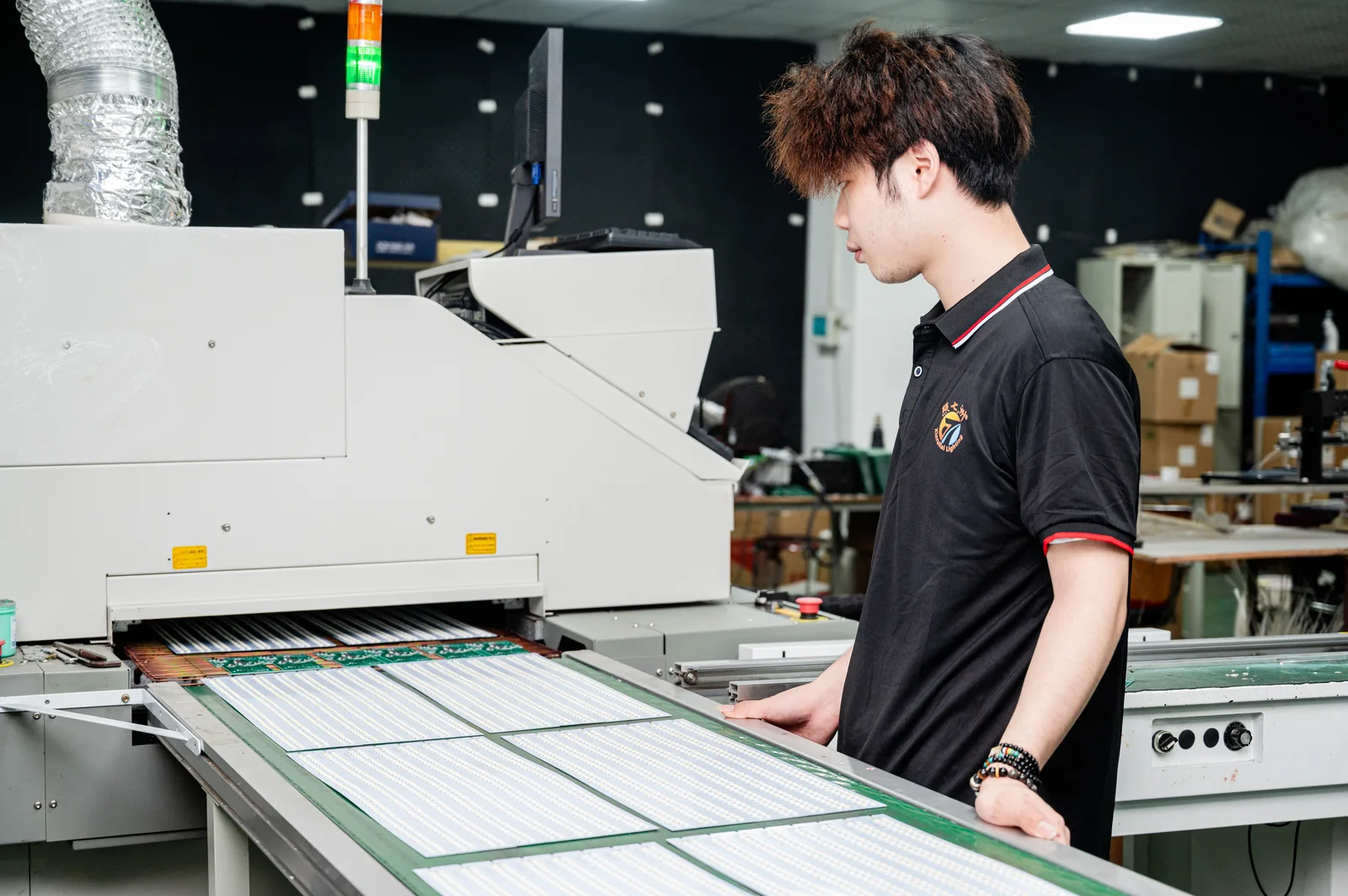
Component provenance belongs in the same conversation. LED chips determine lumen maintenance and colour stability over years, which is why XRLL standardized on German OSRAM and American Cree chips in 2013 and verifies them at incoming inspection. Dealers reselling into demanding customers — cold-storage operators, mining contractors, port handlers — find that chip pedigree answers the warranty-life question before it is asked.
Engineering Capability: What Exists Beyond the Catalog
A catalog proves the supplier can copy. Engineering depth proves the supplier can solve. The practical test: bring a real application problem to the technical conversation and watch what happens. A beam that must reach further down a nine-metre aisle, a projection pattern that has to mark a crane’s swing arc rather than a forklift’s, a housing that survives pressure washing twice a week — each of these pushes a genuine engineering team into optics, thermal and sealing specifics, while a reseller’s team promises to ask their supplier.
XRLL’s engineering position rests on 30-plus utility and design patents and product categories most competitors do not offer at all: laser line projection safety lights for forklifts, cranes and AGVs, and the XRL1341 AI pedestrian detection system, which uses three AI cameras for 360-degree coverage, flags pedestrians six to seven metres out, and triggers sound and light alarms from an IP67-sealed unit aligned with OSHA 1910.178 powered-truck safety goals. A dealer whose supplier offers these categories can quote the whole safety package on one truck — spot light, zone light, projection and detection — with one certification file and one warranty conversation, instead of stitching four vendors into every quote.
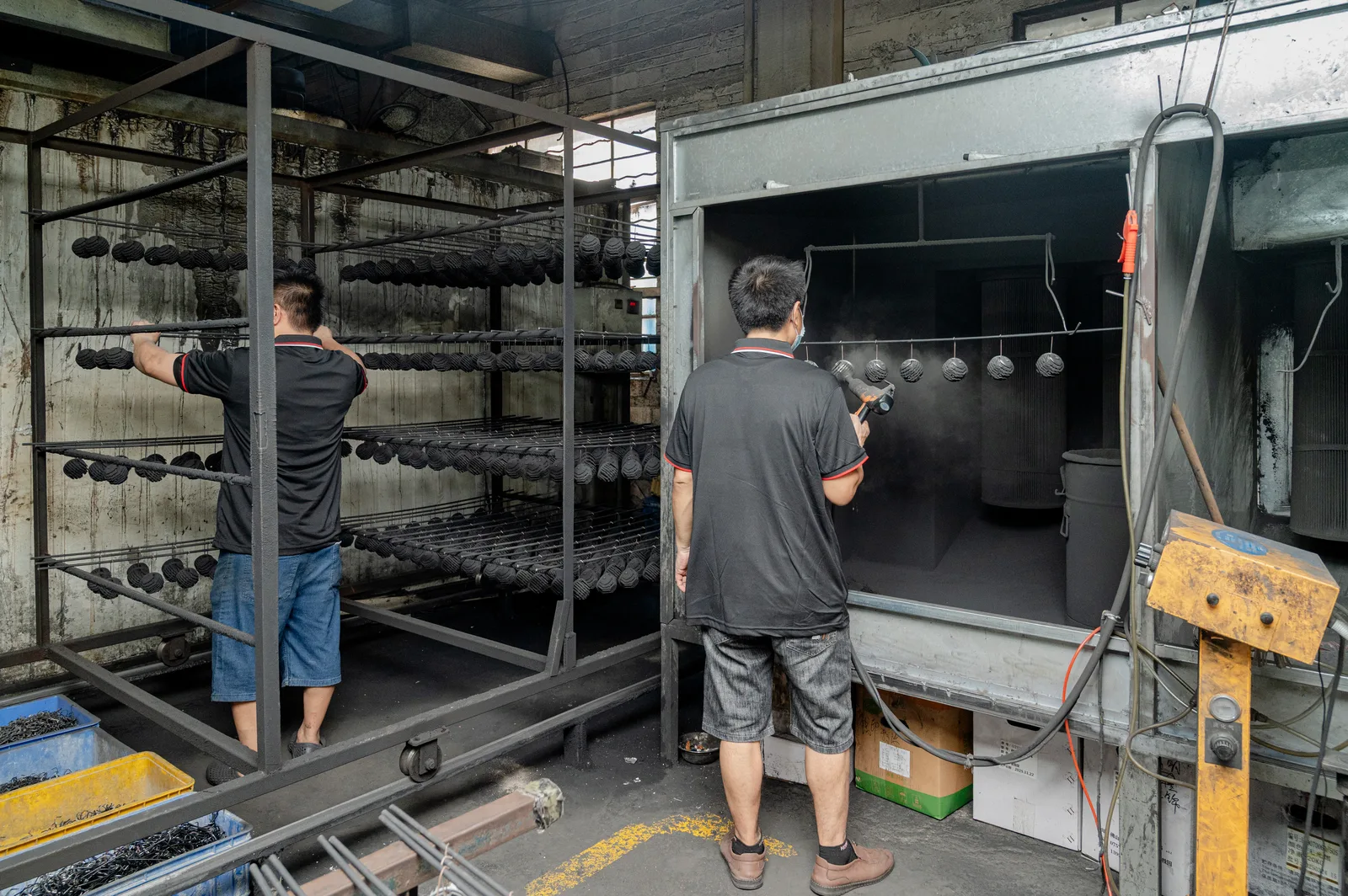
Tooling ownership is the final engineering marker. Housing molds owned in-house mean a custom housing is a project measured in weeks and a modified one is a conversation, not a negotiation with a third party. XRLL makes its own tooling for custom housings — a capability visible in the spray-coating and finishing stages of its workshop, where housings are prepared before assembly rather than received finished from elsewhere.
OEM and ODM Fit: The Fleet-Program Multiplier
For dealers and rental fleets, OEM and ODM capability converts a supplier relationship into a product line. OEM — the supplier builds to their existing design under the buyer’s brand. ODM — the supplier’s engineering develops or adapts the design itself. For a retrofit program spanning mixed truck brands and sites, the differences show up in three places: specification control, brand equity and service simplicity.
Specification control means one beam pattern, one connector standard and one mounting kit across every unit in the fleet, whatever badge the customer drives. Brand equity means the dealer’s logo — XRLL supports custom logos, beam patterns, projection patterns and housing molds — turns the safety program into the dealer’s product rather than a passthrough. Service simplicity means one part number, one spares pool and one warranty contact per site. A rental company running 800 units across 40 customers feels that difference every month in admin hours alone.
The engagement process signals maturity. XRLL’s stated flow: the customer provides specifications or a sample, receives a quotation within 24 horas, and confirms pre-production samples and testing before mass production. Buyers should expect the same shape from any serious OEM partner — sample-first, test-before-bulk, written confirmation of rated input for the fleet’s voltage groups. Volumes, tooling investment and lead times for custom projects are quoted per program, and buyers should treat any supplier who quotes those numbers instantly, before understanding the application, with suspicion.
XRLL’s OEM/ODM program page details the customization scope, and the LED forklift light range shows the platform those programs build on.
Commercial Reliability: The Signals That Predict Year Three
Every supplier looks dependable in month one; the program lives or dies in year three. Predictive signals concentrate in responsiveness and honesty about limits. Response time within 24 hours — XRLL commits to it with a six-person sales team — matters less for politeness than for what it predicts: a supplier who answers a technical question in hours will also answer a field-failure question in hours, when it counts.
Honesty about open items is the second signal. Reputable manufacturers publish what is confirmed and hold back what is not. MOQ, lead times, payment terms, warranty duration and sampling policy for a specific program are quoted against that program’s volumes and customization level — a supplier who states terms in writing after understanding requirements is behaving correctly; one who promises universal terms in a first email is selling. Buyers should likewise treat any figure not yet contractually confirmed as open, and get it into the proforma invoice rather than the sales chat.
Reference diligence completes the picture. Ask for two customers in a comparable duty cycle — not the flagship logo, but a fleet of similar size and environment — and ask those references one question: what broke, and how did the supplier handle it? The handling story predicts the partnership better than any brochure claim.
A Ten-Point Vetting Checklist You Can Run This Week
| Check | Green Signal | Red Flag |
|---|---|---|
| 1. Certificate entity vs quoting entity | Same name and factory address on ISO 9001 and product reports | Different entity, or screenshots instead of report PDFs |
| 2. Model-number match | Quoted model appears on the test report | “Similar family” certification for the quoted model |
| 3. Production evidence | Named, specific workshop spaces on request; visit offered | Stock renders, or deflects when asked for a walkthrough |
| 4. Quality gates | Numbered gates, failure handling explained unprompted | “Full inspection” with no process detail |
| 5. Chip provenance | Named chip brands verified at incoming inspection | Unbranded chips, or brand claims without verification step |
| 6. Sealing verification | IP68/IP67 tested as a production gate, not just on datasheet | Rating quoted from supplier’s supplier |
| 7. Engineering conversation | Optics, thermal and mounting specifics offered for your application | Catalog page forwarded as the answer |
| 8. OEM/ODM scope | Logo, beam pattern, projection pattern, housing mold all in scope; sample-first flow | Logo printing only, or custom promises without a sample stage |
| 9. Pilot support | Evaluation samples offered; voltage-group input confirmed in writing | Pushes straight to full-container pricing |
| 10. Reference duty cycle | References in comparable environments; failure-handling stories volunteered | Only logo references, or none contactable |
Run the checklist on two or three shortlisted suppliers and the ranking usually makes itself. The exercise costs a week of email; skipping it costs a container.
Evaluating Suppliers for a Fleet Retrofit Program?
Put XRLL through the same checklist. Send your truck list, duty cycle and target models — the sales team responds within 24 hours with model recommendations, the full certification file, evaluation samples for pilot trucks and an OEM/ODM scope sheet for fleet branding.
E-mail: service02@xrlledlight.com · Telefone / WhatsApp: +86-15818025687
Perguntas frequentes
How can I verify a supplier is a real manufacturer without visiting China?
Three remote checks cover most of the risk: request the full certification files and confirm the audited factory name and address match the quoting entity; ask for specific, nameable production spaces — assembly line, sealing-test station, photometric lab — on a video walkthrough; and ask what the factory outsources, which real manufacturers answer readily. A live video tour of the workshop, arranged in a normal sales conversation, is now standard practice among serious factories.
Which certifications should a forklift safety light supplier hold?
ISO 9001 at the factory level; CE and ROHS for EU markets; E-mark for vehicle-component compliance in Europe; DOT for the US market. For laser projection products, CEI 60825 laser-safety compliance plus an EN 62471 photobiological report. Match each certificate to the exact model quoted — a mark held by “a similar family” is not a mark held by your product.
Is OEM quality lower than the factory brand?
Not inherently — OEM units run on the same lines and through the same inspection gates as the factory brand; the difference is commercial, not procedural. Quality diverges only when customization cuts corners, which is why the sample-first flow matters: pre-production samples tested in real duty cycles before mass production. Confirm which quality gates apply to your OEM run, in writing, and the brand on the housing becomes irrelevant to reliability.
What minimum order should we plan for a custom OEM program?
Treat MOQ as a function of customization level — logo-only programs carry smaller minimums than custom housings or optics, which involve tooling. Ask shortlisted suppliers to quote MOQ, tooling investment and lead time together for your specific specification, in writing, after they have seen the requirements. A supplier who cannot explain how customization level drives the minimum order is guessing, and you would be the one funding the guess.


