Marine LED Search Lights: Corrosion Resistance Specs for Boat Fleets
A workboat’s lighting budget is decided by water — not the seawater it splashes through, but the salt film that dries on every surface between voyages, quietly eating housings, fasteners and connector pins. A marine search light led unit that measured beautifully on its first sea trial can be a rusted sculpture within eighteen months if its corrosion spec was never written down. Fleet operators, marine equipment distributors and harbor-tough procurement officers rarely get sold on corrosion engineering, because it makes a worse first impression than lumens do; it makes a far better second one when the replacement quotes come in. This guide lays out the material grades, sealing ratings, wiring practices and test evidence that separate searchlights built for salt air from land lighting dipped in a marine price tag — and how to specify the difference into a purchase order before the first failure, not after.
Key Takeaways
- Corrosion spec beats brand: the same fixture design in painted aluminum, anodized aluminum with 316 hardware, or plain steel costs nearly the same to buy and wildly different money to own on salt water.
- Ask for the test story with numbers: salt-fog duration under ASTM B117 or ISO 9227, IP verification under IEC 60529, and what was inspected after the test — finish, hardware and function.
- Most marine lighting failures start at connectors and cable runs, not the lamp: specify plated contacts, sealed connectors or potting, drip loops and strain relief before comparing beam patterns.
- Galvanic isolation is a line item: stainless on aluminum without washers or sleeves is a battery, and salt air supplies the electrolyte free of charge.
- Distributors should stock one corrosion class per duty — workboat, harbor/perimeter, recreational — with published finish specs, instead of one cheap SKU that returns under warranty from every port.
Why Salt Air Kills Lighting Hardware in a Predictable Order
Marine corrosion of exterior lighting follows a script. Chloride holds moisture against surfaces far longer than rain does, so ordinary anodizing or thin paint chips and blooms. Then the galvanic series takes over: wherever two dissimilar metals touch — a stainless screw through an aluminum housing, a brass terminal against an alloy bracket — salt film completes the circuit and the less noble metal sacrifices itself at an accelerated rate. Finally the micro-environments win: water that enters but cannot drain, crevices under gaskets, and connector housings that wick damp air into pins. Lamps rarely die of “bad LED”; the OSRAM and Cree chip classes used across serious industrial lines outlive every other component in the assembly. They die of seized yokes, fogged lenses, green corroded contacts and housings that cracked when frozen swelling rust pushed from inside.
Every spec decision in the rest of this guide targets one of those three mechanisms: barrier quality (finish and sealing), galvanic discipline (metal pairings and isolation), and drainage design (nothing that catches water without a way out).
Housing, Finish and Hardware: the Material Decision Table
| Build Option | Corrosion Behavior in Salt Air | Fair Use on a Fleet | Watch For |
|---|---|---|---|
| Die-cast aluminum, powder-coated | Good until the coat chips; then pitting starts under the paint edge | Sheltered decks, harbor equipment, inland vessels | Coat thickness spec, pre-treatment, and whether fastener holes are sealed |
| Hard-anodized aluminum + 316 stainless hardware | Strong baseline; anode layer is integral, not a coat to chip | Workboats, fishing and patrol duty, exposed masts | Isolation washers/sleeves at every stainless-to-aluminum joint |
| Marine-grade polymers (ASA/PC housings) | Immune to galvanic corrosion; UV and impact rating become the question | Small craft, cockpit and dock lighting, budget fleet refresh | UV-stabilized resin (ASA, not plain ABS), gasket compression set |
| 316L stainless full-body fixtures | Best long-term surface; can still pit in stagnant crevices | Heavy duty, tow-behind, port infrastructure, washdown areas | Confirm 316 vs 304 — the molybdenum content is the difference chloride attacks |
Land-lighting repackaged for boats usually fails the fourth column, not the first: the housing survives because it is decent aluminum, and the lamp dies because the mounting yoke is plated zinc pressed steel, the lens bezel screws are the only carbon-steel parts in the design, or the “stainless” bracket is a 304 grade sold as if grades did not matter. Ask for the hardware metallurgy by line item. It is a five-minute conversation that predicts your two-year failure rate better than any brochure adjective.
Sealing, Drainage and What the IP Numbers Cover
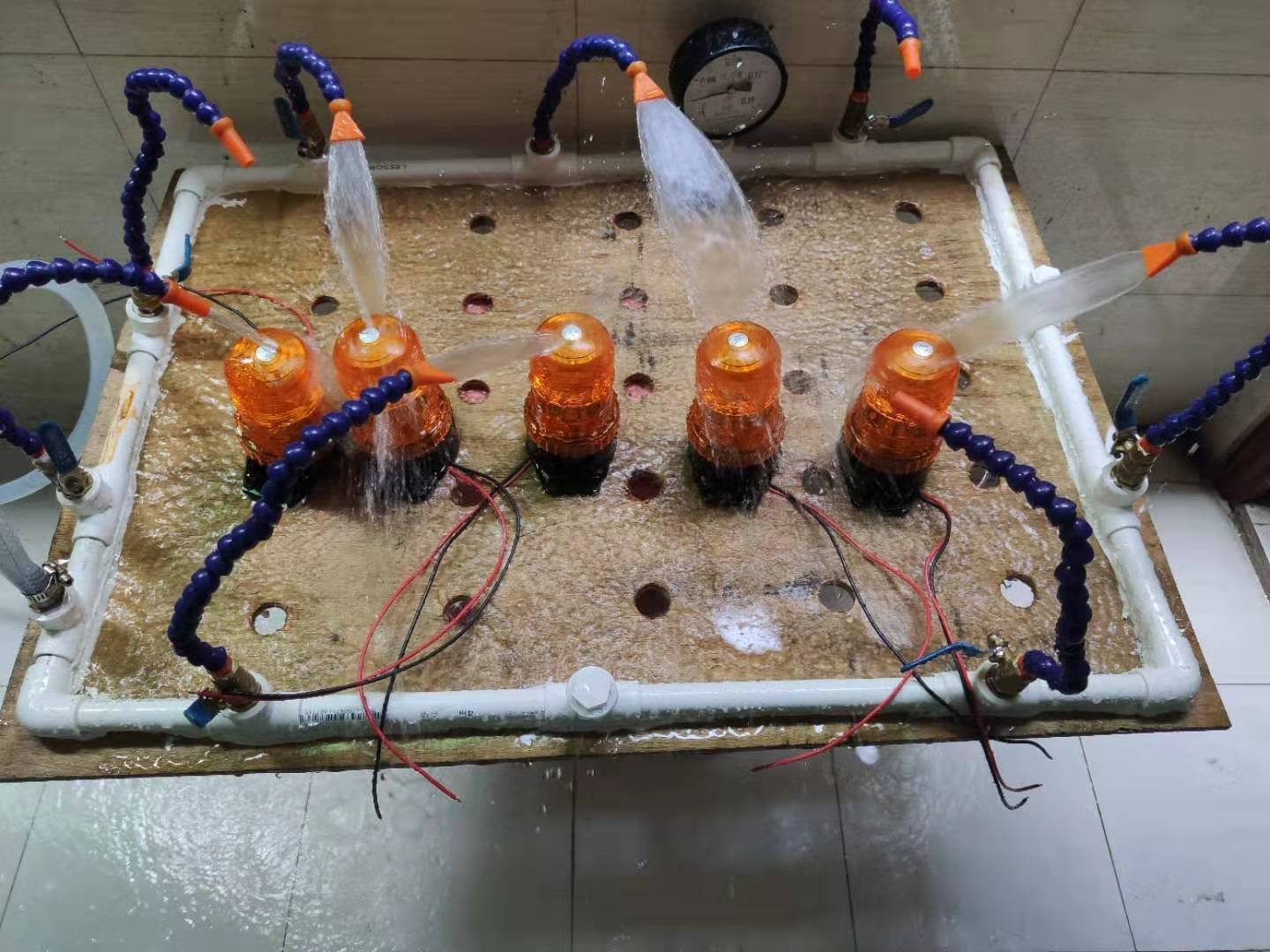
An IP rating describes how well a sealed box keeps water out during a test — it says nothing about what happens to water that gets in through an open cable gland, a missing drain, or a breathing lens that sweats through every thermal cycle. Marine fixtures need both halves of the story. For the first half, the practical floor is IP66 for exposed deck equipment — protected against heavy seas and jets — with IP67 or IP68 specified where washdown, immersion risk or stowed-awash duty exists; the IP67 versus IP68 comparison covers what each test actually imposes. For the second half, look at the design: does the housing have a defined drain path, are gasket faces accessible for replacement, is the driver electronics potted or merely board-mounted inside a sealed shell, and does the lens use a captured gasket that survives re-opening?
Thermal cycling is the underrated sealer-killer. A fixture that passes its IP test cold will pump humid salt air in and out of its breathing gaps as the housing heats in sun and cools at night, condensing inside. Potting — encasing driver electronics in resin — is the design answer, which is why potting is a specification line worth demanding on anything that mounts unsupervised on a boat, and why factories that run sealing tests as a standing QC step are the ones able to show you per-lot evidence rather than a one-time lab certificate.
Connectors and Cable Runs: the Failure Rate Nobody Graphs
If you log actual marine lighting returns, connector and wiring faults outrank lamp failures in most fleets. Three practices separate professional installs from the ones that fail: first, connectors either sealed to at least IP66 or located inside a protected enclosure — a bare automotive blade connector at the mast base is a scheduled failure. Second, drip loops below every entry point, so water traveling down the cable falls off a low point instead of following the conductor into the housing. Third, strain relief: marine cable chafes, snaps at terminations, and pulls connectors out of their sockets; a secured bulkhead pass-through with a clamp costs pennies and saves the whole fixture.
Tin- or gold-plated contacts matter more than housing metal, because a few micro-ohms of corrosion resistance at the contact interface is the difference between full output and a flickering lamp on a long 12/24 V run. Where crews service equipment with gloves and no soldering iron, specify connectors that survive being mated and demated a few dozen times without their seals taking a set.
Salt-Fog Testing: What the Numbers Prove, and What They Do Not
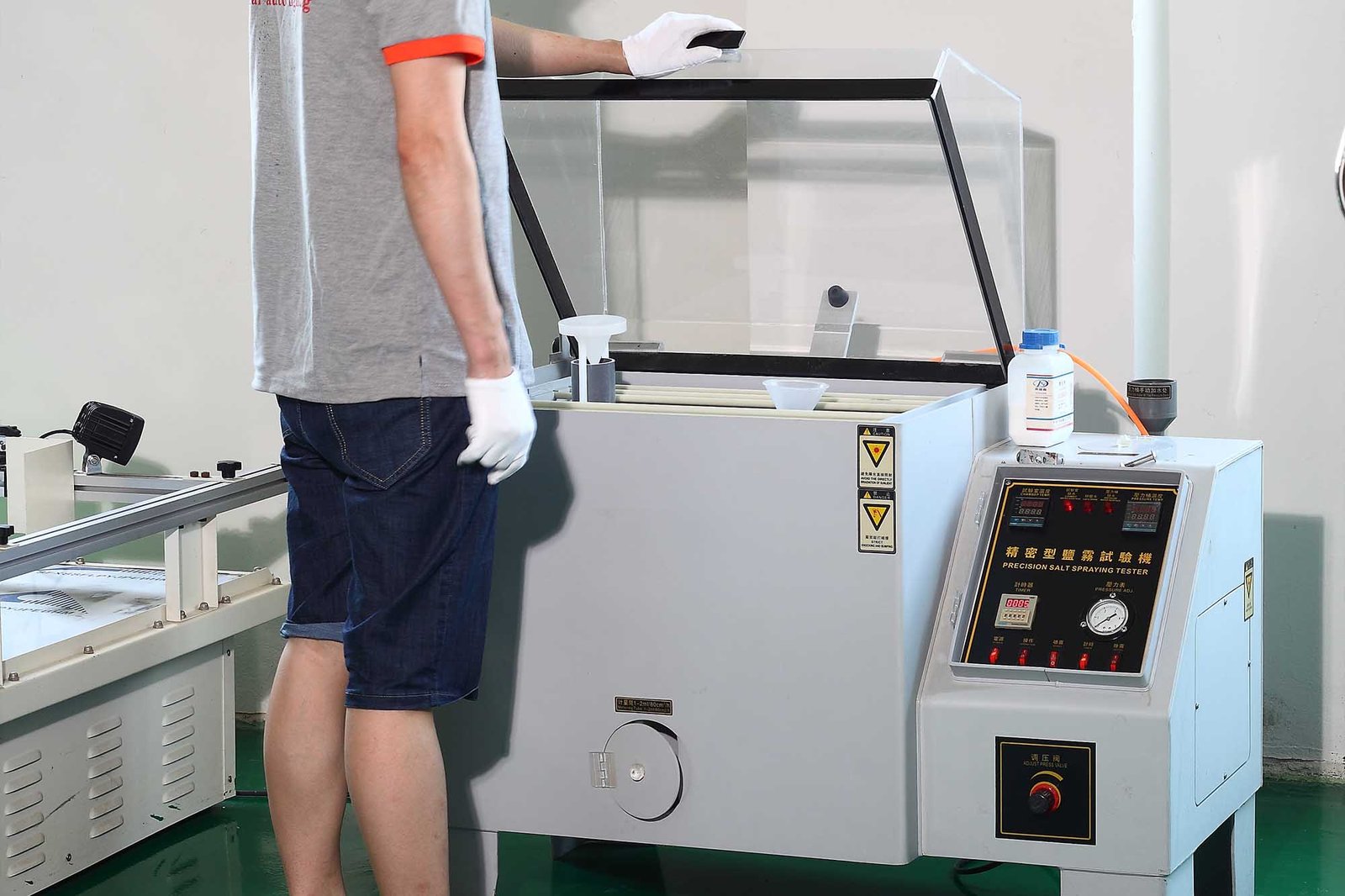
The workhorse evidence for marine corrosion claims is the accelerated salt-fog test — ASTM B117 or its international twin IEC/ISO 9227 — where the part sits in a chamber breathing a 5% sodium chloride fog at warm temperature for a stated duration. Common published figures run from a cosmetic 24–96 hours up through 240, 720 and 1,000-plus hours for hardware intended for real exposure. Treat the hours as a comparison tool, not a calendar: 720 hours in a fog chamber does not equal 720 days at a dock, because the test compresses chemistry, not UV, thermal cycling or mechanical wear. What makes a salt-fog claim trustworthy is the post-test criteria — what counted as failure: first red rust? coating blistering? function loss? corrosion of the threads — and whether the tested sample was a finished assembly with hardware installed, or a conveniently bare panel.
Manufacturers that operate their own corrosion chambers — as XRLL does among its in-house reliability stations, alongside sealing, vibration and temperature cycling — can usually show per-batch verification rather than a single type-test report from a launch year. For fleet buyers specifying more than a handful of units, ask which tests are routine production checks and which were one-off; the answer tells you how consistently the delivered lamps match the certified one.
Specifying the Searchlight Itself Beyond Corrosion
With the survival spec set, the duty spec is familiar lighting arithmetic. Throw distance needs beam angle and luminous intensity in candela, not lumens alone — a 9,000-lumen flood washes the near water while a 3,000-lumen spot reaches the buoy line; look for the beam angle and candela figure or a photometric file. Fixed-mount units want a yoke with defined tilt/rotation range and tool-adjustable locking; handhelds want a separate mounting cradle that shares the same corrosion class. Power on vessels is 12 or 24 V DC with a stated inrush and a fuse rating you can coordinate with the boat’s panel; ignition protection (ИСО 8846 in European practice) belongs on anything installed in engine-room or fuel-vapor zones. Duty cycle matters on patrol and watch boats — a searchlight rated for continuous output at ambient 40 °C is a different product from one whose stated hours assume 30-minute runs.
The Distributor’s Evaluation Checklist
- Hardware metallurgy line by line: housing alloy and finish, fastener grade (316 stated, not “stainless”), yoke and bezel materials, isolation washers at dissimilar joints.
- Salt-fog evidence: standard cited, duration, post-test pass criteria, finished assembly vs bare sample.
- IP verification: rating per IEC 60529, which variants are tested, drain and breathing design, whether driver electronics are potted.
- Connector class: sealed part numbers, plating, mating-cycle durability, available spare connectors.
- Photometrics: candela and beam angle at the mounted position, not chip-level claims.
- DC behavior: voltage range, inrush, reverse-connection and under-voltage protection.
- Spare-parts reality: gaskets, lenses, hardware kits and yokes orderable as wear parts with stock.
- Warranty terms written for salt exposure — some land-lighting warranties explicitly exclude marine use.
For buyers comparing a supplier’s manufacturing depth behind these answers — QC stations, sealing verification, chip sourcing and OEM program structure — the work light sourcing guide covers the questions that transfer to any harsh-environment lighting category, and the same evidence framework applies whether the fixture is spec’d for a quarry haul road or a harbor patrol boat; see how XRLL frames duty-tested equipment for dust, vibration and weather load on its mining and quarry solutions page, where the hardware works as hard as it does in salt air.
Send the Exposure Profile, Get the Corrosion Spec
Tell the XRLL sales desk the duty — workboat mast, harbor perimeter, handheld deck pack, 12 V or 24 V, expected washdown — and receive a matched recommendation with hardware metallurgy, sealing and salt-fog evidence, and connector options, from a Foshan factory running its own corrosion, sealing, vibration and temperature stations across four lines, answering in 24 часы. Bracket patterns, finishes, branding and voltage configurations run on in-house tooling with samples before series production.
Электронная почта: service02@xrlledlight.com · Phone/WhatsApp: +86-15818025687
FAQ
What IP rating do deck-mounted search lights actually need?
IP66 is the practical floor for anything exposed to spray or washdown — it is rated against powerful water jets, which is what a deck actually delivers. IP67 suits fixtures that may sit awash or be stowed wet, and IP68 only makes sense with a stated immersion depth and time. Insist on the rating per IEC 60529 with the test condition printed, and pair it with design questions — drains, gasket accessibility, potted drivers — because an IP66 box with no drain path still grows an indoor pond.
Is anodized aluminum or stainless steel better for marine lighting?
Both work when the system is designed, not just the metal. Hard-anodized aluminum gives an integral corrosion layer that cannot chip like paint and stays light for mast duty; 316L stainless shrugs off impact and abrading better and suits deck hardware and tow units. The failure mode is the boundary between them: stainless fasteners clamping aluminum without isolation washers set up a galvanic cell that salt air happily powers. Specify the pairing and the isolation hardware in the same sentence.
How many salt-spray hours should a workboat fixture pass?
Treat 240 hours as a commercial baseline, 720 hours as credible heavy-duty evidence, and demand the rest of the sentence: which standard (ASTM B117 or ISO 9227), what sample (finished assembly with hardware, not a bare coupon), and what counted as failure (first rust bloom, coating blistering, or full function check). A supplier who answers all four is reporting tests; one who quotes a lone big number is reporting marketing. Accelerated fog compresses corrosion chemistry only, so pair it with UV and thermal-cycle evidence for anything that lives outdoors.
Can a Chinese lighting manufacturer supply marine-duty fixtures with documentation?
The factory label is less predictive than the QC architecture behind it. Ask what the plant tests routinely — sealing, corrosion chamber duration, vibration, temperature cycling — versus what it tested once for a certificate, and whether reports carry model and lot numbers. A manufacturer running nine documented inspection stages including IP sealing verification, ИСО 9001 systems and per-market certifications (CE, RoHS, E-mark, DOT where applicable) can hand you evidence per shipment; the same questions will separate that plant from a reseller in one email exchange regardless of country.


