Truck Light Bars: Selection Guide for Fleet Buyers 2026
A regional carrier that runs tractors day and night does not buy a truck light bar the way an enthusiast does. The purchase order starts with an incident report — a driver squinting through an unlit yard gate, a trailer backed into a dark loading bay, a night breakdown on the shoulder with no work light worth the name — and ends with a part number that has to survive vibration, road spray, diesel exhaust and a different truck every week. For fleet buyers and the distributors who supply them, the selection problem is not “which bar is brightest” but which bar holds its output, its seal and its wiring through three years of 3 a.m. duty, and at what unit price that answer stays true across fifty trucks instead of one.
Key Takeaways
- For commercial trucks, a light bar is a task and auxiliary driving aid — size it to the mounting position and job, not to the wattage number on the box.
- Double-row combo-beam bars in 22-32 inch lengths cover most fleet needs; single-row and spot-heavy bars are specialists that suit specific roles.
- The specs that predict field life are the sealing rating (IP68), the housing (die-cast aluminium acting as heatsink), the chip tier (OSRAM / Cree class) and the driver’s voltage band — in that order of diagnosability.
- 24 V electrical architecture and load-dump transients are a commercial-truck problem that passenger-grade bars are not designed around; specify a regulated wide-input driver.
- Road legality differs by market: white front-facing auxiliary lamps are restricted on public roads in many jurisdictions — buy amber or switchable wiring where required, and ask the supplier for its compliance documentation.
- Distributors and OEM buyers should evaluate a manufacturer on fixture consistency across batches, customisation of beam and branding, and per-lot test evidence — not on the sample that arrives for evaluation.
What a Light Bar Is Actually For on a Commercial Truck
Factory lighting on a Class 8 tractor is engineered for road driving: headlamps aimed to legal beam patterns, markers for conspicuity, lamps for the immediate cab surroundings. A truck light bar fills the gaps that design leaves. Three jobs come up repeatedly in fleet debriefs:
- Long-range supplement on unlit roads. Rural routes, mining haul roads and border crossings where the highway ends and the road surface keeps going. A spot-dominant bar extends the driver’s reaction distance at 55-65 mph.
- Yard and dock work. Reversing a trailer into a dark bay, chocking wheels, coupling lines. This is a flood job — wide, even light at ground level, not a distant hot spot.
- Roadside service and recovery. A night breakdown on the shoulder needs the working area around the truck and trailer washed with light so the driver and the response crew stay visible and can actually see the job.
Most trucks need two of the three, and the mistake that wastes budget is buying one bar configured for all three and excelling at none. The fleet answer is usually a combination-beam bar on the cab — mid-distance throw with usable side spill — plus purpose-mounted work lights where the task actually happens. Our guide to truck work lights covers the second half of that pairing.
Bar Configurations: Single Row, Double Row, and the Shapes In Between
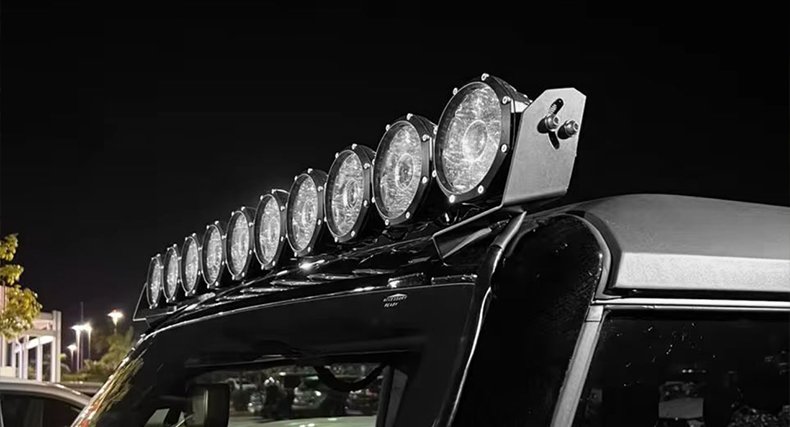
Rows and length determine output ceiling and beam control more than any marketing claim. A single-row bar is low-profile and survives low-clearance positions under bull bars and inside brush guards; its reflector or TIR (total internal reflection) optics can be excellent for its size. A double-row bar doubles the die count behind a deeper housing — more raw lumens, more heat to move, and enough depth that wind drag and mounting hardware matter on an aerodynamic cab.
Between those poles sit the configurations fleets actually order:
- Curved vs. straight bars. Curved geometry wraps the beam slightly around the front corners — useful for yard work, less precise for long throw.
- Combo / dual-row with split optics. Spot modules on the outside, flood modules in the middle (or the reverse pattern). The default fleet choice because one fixture covers two jobs reasonably.
- Pit lights and light-module bars. Rows of round drop-in pods on a rock bar. Serviceable pod by pod, a genuine uptime advantage in a fleet that repairs its own equipment.
- Interchangeable-lens bars. A family of bars that swaps spot, flood and diffuser lenses with the same wiring. Good for distributors who want one SKU covering several applications.
Sizing and Output: Matching the Bar to the Truck
Lengths from 12 to 50 inches all exist; the fleet-relevant band is narrower. Wattage and lumen figures only mean something when read together with beam pattern — a 180 W spot throws further than a 240 W flood at distance while lighting less of the ground around the bumper. The table below maps the common sizes to commercial-truck roles.
| Bar Size / Type | Typical Power Band | Best Fleet Application | Mounting Notes |
|---|---|---|---|
| Single row, 12-22 in | 40-90 W | Service trucks, under-rail and brush-guard positions, tow and recovery | Low profile survives clearance-critical positions; light enough for sheet-metal brackets with reinforcement |
| Double row combo, 22-32 in | 120-240 W | The fleet default: long-haul cab roofs, over-the-road tractors that also do yard work | Needs a proper roof rack or wind-deflector mount; check height compliance for drive-through washes and low docks |
| Double/triple row spot, 32-50 in | 240-420 W | Mining and quarry haul, border and desert routes, genuinely unlit long stretches | Wind load and current draw demand engineered brackets and a relayed harness fused at the battery |
| Rock-bar pod modules | 30-60 W per pod | Mixed duty where individual modules get damaged; self-repairing fleets | Pod-by-pod serviceability is the point; wiring count goes up, so waterproof connectors matter |
| Curved flood bars | 90-180 W | Loading docks, material-handling areas, perimeters — area wash, not distance | Mount lower and aim down; wraps light around the front corners of the truck |
One more number deserves attention: current draw. A 300 W bar on a 12 V system pulls around 25 A; on the same fixture wired to a 24 V tractor circuit it draws roughly half. That is why the driver design — not just the LEDs — decides whether a bar belongs on a commercial vehicle at all, covered below.
Beam Patterns: Spot, Flood, Combination, and Which One the Route Needs
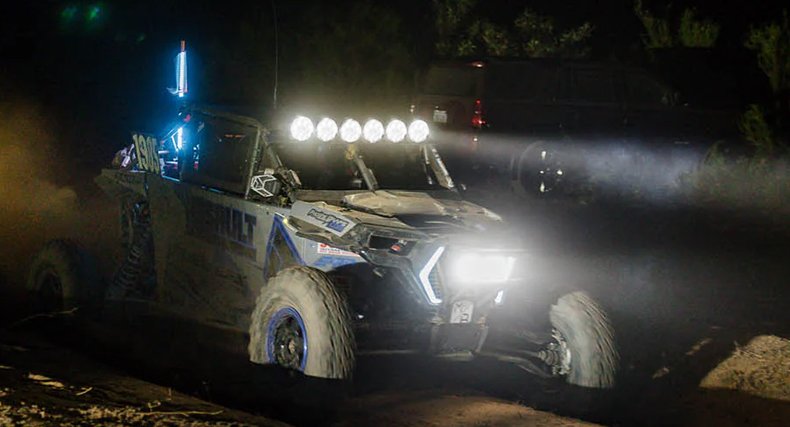
Spot beams concentrate output into a narrow throw — hundreds of metres of usable light on an open road, and a blinding glare wall for anyone in the opposite lane if aimed carelessly. Flood beams do the opposite: wide, short, even coverage for close work. Combination (or “hi/lo”) bars split the housing into both, usually wired so the driver selects flood-only for yard duty and full output for the road.
For fleet buyers the practical guidance is short. If the truck spends its life on lit highways, the bar is a backup and a work lamp — flood-leaning combo, aimed low. If it runs unlit corridors, spot-leaning combo with a flood fill for the shoulder. If it never leaves a yard, skip the bar and buy properly aimed work lights instead; the beam that helps at 300 metres is a nuisance at 20.
Durability Specs That Predict Field Life
Fleet buyers should read a spec sheet the way a maintenance manager reads a failure log. Four items correlate with staying lit:
- Ingress sealing. IP68 means the fixture is rated to survive immersion, not just rain — the realistic standard for a bar that faces pressure washers, road spray and standing water on a flat mounting face. Ask whether sealing is potted, gasketed or both, and whether the supplier tests every unit or samples the batch. At XRLL, IP68 sealing is one of nine in-line checks each unit passes before shipping, not a launch-sample claim.
- Housing and heat path. A die-cast aluminium housing that functions as the heatsink outlives a plastic-bodied bar of identical wattage. LEDs do not fail from peak output; they fail from sustained junction temperature. The high-low temperature aging stage of production testing exists precisely to shake out drivers and solder joints that drift under heat.
- Chip tier and bin consistency. Name-brand chips (German OSRAM, US Cree and equivalent tiers) matter less for the badge than for binning — matched output and forward voltage across every emitter in the bar. Mixed bins mean one row dims before the other and the thermal design runs unevenly.
- Vibration and impact evidence. Cab roofs are a high-vibration position, and a bar on a haul truck sees stone impact no passenger vehicle sees. Vibration and shock testing on the production line, not just a datasheet icon, is what you want documented.
Electrical Integration on 12 V and 24 V Truck Systems
Commercial truck electrics are hostile territory for a lamp designed for a weekend 4×4. Charging systems run above nominal, cold cranks pull the bus voltage down hard, and load-dump events — an alternator dumping its pulse onto the harness when a big load releases — can send tens of volts through the circuit. A bar whose driver is a simple buck stage rated “12/24 V” may light up on the bench and fail on the worst truck in the yard.
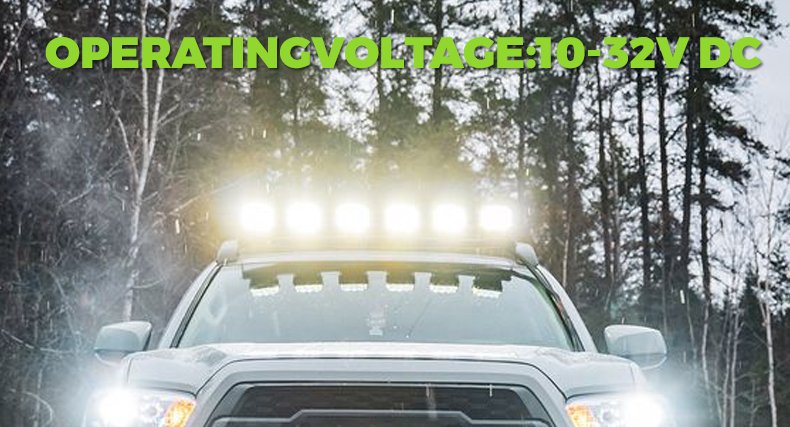
Specify a regulated wide-input driver — a genuine 9-36 V continuous band with clamped protection — so one SKU covers 12 V straight trucks and 24 V tractors without a transformer. The same driver stage should be EMC-quiet; a switch-mode bar that noise-couples into the harness will interfere with radios, ETC readers and the truck’s own electronics. The deep dive on both points is in our wide-voltage compatibility guide and the CISPR 25 EMC explainer.
On the install side: relayed harness fused at the battery, sized for the bar’s measured inrush, not its running current; switch positions the driver can reach with a seatbelt on; and dielectric grease or sealed connectors everywhere water can pool. Fifty-truck rollouts fail on install kits as often as on fixtures, so price the harness in the same order.
Road Legality and Compliance by Market
Supplementary forward-facing white lamps are regulated, and the rules differ enough to cost a distributor a container if ignored. In the US market, auxiliary driving lamps are restricted by FMVSS 108 placement and aiming rules and, in several states, by “covered when not in use” requirements aimed at the aftermarket. In Europe, forward fog and driving lamps carry E-mark type approval with defined mounting heights and minimum separation from the headlamps, and many of the same positions require amber rather than white for certain vehicle categories. Australia runs its own vehicle lighting standards with strict enforcement on aftermarket fitment.
The buyer’s checklist is boring and effective: ask the supplier which specific fixtures hold E-mark or DOT-relevant test documentation, get the report numbers, and confirm the intended mounting position against the local rule before the first unit goes on a customer’s truck. XRLL’s certification base — ISO9001 quality management, E-mark (E9) for European vehicle components, DOT documentation, CE, ROHS and IEC 60825 on laser products — is documented per product family, and test-report references are available on request for importers who need to verify rather than trust a badge on a box.
Supplier Evaluation for Distributors and OEM Buyers
A fleet that standardises on one bar across its shops, or a distributor carrying the line under its own brand, is buying the manufacturer’s consistency, not its sample. The evaluation questions that separate a real factory from a trading shop:
| Evaluation Area | What to Ask For | Why It Predicts Trouble |
|---|---|---|
| Production control | Per-lot evidence for sealing, aging and vibration checks; the QC stage list, not just an ISO certificate | Batch drift is what turns a good first order into a warranty problem on the tenth |
| Optical consistency | Chip supplier, bin-matching practice, beam photos from random production units | Mismatched bins age unevenly and make look-alike replacements impossible across years |
| Electrical design | Driver input band, protection stages, inrush figures, EMC test evidence | The failure mode fleets report as “flickering” or “radio noise” is a driver design defect |
| Customisation | Logo, beam pattern, housing mold and connector options; sample confirmation before volume | Private-label programs live or die on whether the second container matches the first |
| Capacity and continuity | Line count, daily output, tooling ownership — in-house molds or outsourced | A discontinued housing mold ends a product line mid-lifecycle; owned tooling does not |
On the manufacturer side of that table, the relevant facts about XRLL: founded in Foshan in 2011, 17,000 m² of plant with 17 production devices and four assembly lines turning out more than 10,000 fixtures a day, more than 30 utility and design patents, custom housing tooling done in-house, and an export base of 5,000+ B2B customers across 80+ countries. OEM and ODM programs — logo, beam, housing and projection pattern — run through sample confirmation before volume, with quotations answered within 24 hours. Commercial terms such as MOQ, lead time and payment structure are set per program and available on request.
Common Selection Mistakes Worth Five Trucks of Budget
- Buying lumens instead of a beam. A 30,000-lumen spot in a dock yard blinds the spotter and lights nothing within working range.
- Ignoring the harness. The bar survives; the cheap relay block corrodes in a winter-road-salt environment and the fault gets blamed on the lamp.
- One spec for every platform. 12 V light trucks and 24 V tractors can share one wide-voltage fixture — but only if the driver actually is wide-voltage. Dual-nominal labels are not the same thing.
- No aiming procedure. Fifty installs with fifty different angles produces a glare complaint list and a return rate that has nothing to do with product quality. Write the aim spec into the install guide.
- Skipping the compliance question until after the order. Retrofit removal costs more than the type-approval paperwork was ever worth.
Spec the bar, the beam and the harness in one order
Send your mounting position, electrical architecture (12 V, 24 V or mixed) and route profile. XRLL engineers recommend one bar family across your platform list, with OEM logo, beam and housing options and samples confirmed before volume — reply within 24 hours.
Frequently Asked Questions
What size LED light bar does a commercial truck need?
For most fleet tractors a 22-32 inch double-row combination-beam bar on a roof or wind-deflector mount covers highway supplement and yard work in one fixture. Go smaller and single-row for clearance-critical positions, larger and spot-dominant only for genuinely unlit long corridors such as mining haul roads. Match the beam to where the truck actually works before matching wattage to a number.
Are LED light bars street legal for trucks?
Forward-facing white auxiliary lamps are regulated in every major market: US state rules on covering and use, European E-mark type approval with mounting-height and separation requirements, and strict Australian aftermarket standards. The fixtures themselves can be compliant when approved patterns, positions and colours are respected — verify the specific product’s documentation against the registration market before fitment rather than relying on a general claim.
Will one light bar work on both 12 V and 24 V trucks?
Yes, if the driver is a true regulated wide-input design rated for continuous 9-36 V operation with transient protection. A “12/24 V” dual-nominal label is not the same thing — those fixtures often drop out on cold-crank sag or fail on load-dump spikes from 24 V charging systems. Standardising on one wide-voltage SKU cuts part numbers, mis-orders and dead stock across a mixed fleet.
What makes a light bar durable enough for truck duty?
Four things you can verify: IP68 sealing tested in production (a bar sees pressure washers and standing water, not drizzle), a die-cast aluminium housing engineered as the heatsink, name-brand LED chips bin-matched across the fixture, and documented vibration, shock and high-low temperature aging checks. Ask for the production test list, not just the IP rating printed on the label.
Can distributors order light bars under their own brand?
Yes. XRLL runs OEM and ODM programs covering logo, beam pattern, housing tooling and connector configuration, with custom housing molds made in-house. Programs start from your specification or a sample, move through pre-production sample confirmation, and quote within 24 hours. Batch-to-batch consistency — matched bins, same optics, same sealing — is the term to negotiate into the agreement.


