Forklift Headlights and Work Lamps: Voltage Compatibility Guide 2027
The maintenance bay at a third-party logistics depot tells the story in one shelf: a bin of dead forklift headlight units, most of them returned by drivers within a week of installation, none of them showing a broken lens or a burnt filament. The depot runs diesel trucks with 12-volt systems, electric pallet movers at 48 volts, and a handful of 80-volt order pickers. Every lamp on that shelf was installed on the wrong side of that spread. Voltage mismatch is the quietest way to waste a lighting budget, because the failure shows up as a dead unit weeks later, never as an obvious installation error.
This guide explains how forklift system voltages work, what happens to a forklift headlight or work lamp when the voltage is wrong, how to read a supplier datasheet before ordering, and how to specify lamps across a mixed fleet without gambling on returns.
Key Takeaways
- One fleet rarely means one voltage. Combustion-engine trucks typically run 12V or 24V electrical systems, while electric forklifts commonly run traction packs at 36V, 48V, 72V or 80V. Specifying one lamp for all of them is where returns start.
- Overvoltage kills LED drivers silently. Feed a 12V-rated lamp from a higher-voltage source and the driver stage absorbs the excess until it fails — days or weeks later, with no visible cause.
- Undervoltage degrades before it disables. A lamp run below its rated input dims, flickers and may drop out entirely, and drivers report it as a “quality problem” when it is actually a compatibility problem.
- The truck’s data plate settles the question. System voltage is printed on the machine. Match the lamp’s rated input to the plate, and confirm the exact rated input range with the lamp manufacturer before any bulk order.
- Buy for the environment, not just the electrics. IP68 sealing, vibration-tested housings and named LED chips — XRLL builds with OSRAM and Cree chips and runs nine in-house inspection gates — decide whether a correctly-wired lamp survives its first year.
The Voltage Landscape Behind a Mixed Fleet
Forklift fleets mix two electrical worlds. Internal combustion trucks — diesel, LPG and petrol — carry starting and lighting systems that follow automotive practice, typically 12 volts, مع 24 volts common on larger machines. Electric forklifts are a different animal altogether: the traction battery that drives the motors also feeds the accessories, and those packs commonly sit at 36, 48, 72 or 80 volts depending on the truck’s size and duty. A single warehouse can therefore run four or five distinct voltage levels in the same aisle.
Lamp manufacturers respond to this spread in two ways. Some lamps are built for a specific nominal input — a 12V work lamp belongs on small combustion equipment. Others use a wide-input driver, sometimes quoted by manufacturers as covering ranges in the tens of volts, so one unit can follow the fleet across truck types. Both approaches are legitimate; the failure mode is buying the first kind while assuming it behaves like the second. Ranges and ratings vary between models and manufacturers, which is why the only reliable source for what a given lamp accepts is that lamp’s own datasheet — confirmed directly with the maker, not inferred from a listing title.
Overvoltage: the silent killer
An LED lamp is not a bulb. Between the chip and the input wires sits a driver — a small switching circuit that turns a raw DC input into the tightly controlled current an LED needs. Feed that driver more voltage than it is rated for and nothing dramatic happens at first: the lamp lights, perhaps brighter, and everyone moves on. Inside, the driver’s components are operating beyond their limits, heating beyond design margins on every shift. The failure arrives days or weeks later as a lamp that no longer lights, and the warranty claim lands on the supplier’s desk with no visible cause. In practice, a surprising share of “defective” returns in mixed fleets are overvoltage installations, not bad lamps.
Undervoltage: dim, flickering, and blamed on quality
The mirror case does the opposite damage. A 12V lamp fed from a sagging or low battery, or a wide-input lamp wired through long, thin cable runs, receives less than its rated input. The output drops, the beam dulls, and in marginal cases the driver’s protection circuit cuts the lamp out entirely under load. Operators read this as poor brightness or unreliability, and the lamp gets blamed for a mismatch it did not cause. Undervoltage rarely destroys hardware, but it destroys confidence — and it doubles the maintenance workload as technicians swap perfectly good units chasing a phantom fault.
Reading a Work Light Datasheet Before You Order
A forklift headlight or work lamp datasheet contains four fields that decide whether the unit survives your fleet. Read them in this order:
- Rated input voltage. A single nominal value such as 12V or 24V, or a range spanning several tens of volts for wide-input units. This single line decides which trucks the lamp may touch. Treat any rating not printed on the datasheet as unknown, and confirm it with the manufacturer in writing before ordering.
- Power and current draw. Wattage tells you the load; current draw at the truck’s voltage tells you whether the auxiliary circuit and wire gauge can carry it. A lamp that suits the voltage can still overload an undersized loom when multiplied across six trucks running night shifts.
- Ingress protection. IP67 means dust-tight and protected against temporary immersion; IP68 goes further for continuous or deeper exposure. Warehouse trucks cope with washdown and pressure cleaning, so sealing is not optional on any voltage system.
- Connector and mounting hardware. Mismatched connectors invite improvised splices, and improvised splices are where corrosion and intermittent faults begin. Confirm what the lamp ships with and whether the manufacturer can supply it pre-fitted for your loom — for OEM and ODM buyers this is a standard customization item.
Matching Lamp Type to the Task
Voltage is the first filter, but a correct order also puts the right kind of lamp in the right place. The three categories below cover most forklift lighting specifications.
| Lamp Type | Primary Job | Beam Character | Typical Mounting | Specify By |
|---|---|---|---|---|
| Forklift headlight | Illuminate the travel path; make the truck visible to others | Forward, controlled cut-off, often high and low beam | Overhead guard front, mast area | System voltage, نمط الشعاع, sealing |
| Work lamp | Light a task area — picking faces, dock edges, yard work | Flood or combination, wide spread | Rear of overhead guard, sides, mast | System voltage, lumens, mounting axis |
| Safety / warning light | Project a visible warning — blue spot, red zone line, arrow | Downward or side projection onto the floor | Low on chassis, fore and aft | System voltage, projection colour and distance |
Note the pattern: every row ends with system voltage as a specification item. The lamp’s job decides the optics; the truck decides the electrics; the two decisions are independent, and both belong in the purchase order.
Wiring Practices That Prevent Returns
Correct voltage at the connector is necessary but not sufficient. Field failures trace back to a handful of installation habits, and none of them cost money to fix:
- Ground to the battery, not the nearest bolt. Painted mast sections and powder-coated brackets introduce resistance that accumulates as voltage drop and intermittent dimming. A dedicated return conductor to the battery keeps the driver fed as designed.
- Size the conductor for the run, not the bench. A lamp that measures correctly on a one-metre test lead can drop a full volt across a five-metre loom at higher current. Undervoltage symptoms that appear only after installation are usually cable sizing, not lamp quality.
- Switch and protect the circuit. A relay-controlled feed with correct fuse protection keeps the lamp off the ignition circuit and isolates faults before they propagate. Tapping the lamp into an existing accessory line is the most common shortcut and the most common cause of clustering faults.
- Seal every joint. Heat-shrink with adhesive, proper connector housings and strain relief at both ends keep washdown water out of the circuit. Corrosion at a splice mimics lamp failure as reliably as overvoltage does.
What Separates Durable Lamps Once the Voltage Is Right
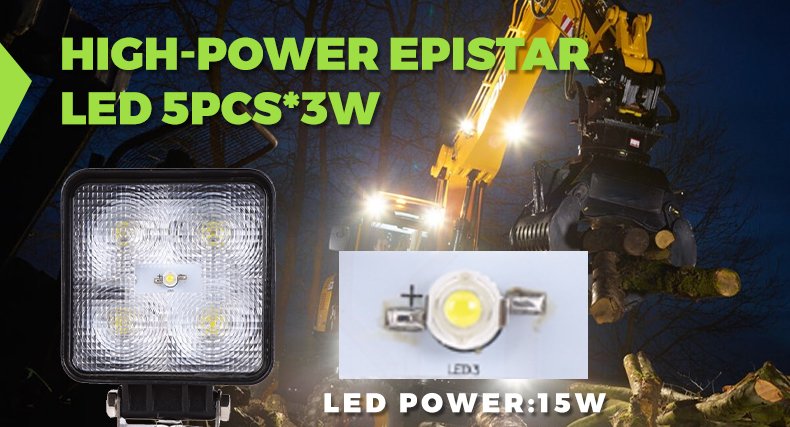
With electrics matched, the remaining failure causes are environmental: water, vibration and heat. This is where manufacturing depth shows. XRLL, a lighting manufacturer founded in Foshan in 2011, builds its forklift and work lamp range on the same disciplines that heavy-duty buyers specify in tenders:
- Named LED chips. Standard production uses German OSRAM and American Cree chips, verified at incoming inspection rather than assumed.
- IP68 sealing. Dust-tight and rated for continuous immersion, tested on every production run alongside the visual and assembly checks.
- Nine in-house inspection gates. Incoming chip inspection, PCB and driver checks, welding and assembly inspection, IP-sealing tests, photometric and beam-pattern output testing, high and low temperature aging, vibration and shock testing, electrical safety testing and a final pre-shipment inspection.
- Certification on file. ايزو 9001 quality management, م, بنفايات, E-mark and DOT documentation for the relevant product families, plus EN 62471 photobiological reports — the evidence pack a procurement department can audit.
Scale matters for buyers beyond quality. Four assembly lines across a 17,000-square-metre plant producing more than 10,000 units a day is what allows a supplier to support both a one-off retrofit order and an OEM program with custom connectors, beam patterns or housing molds — with quotations returned inside 24 ساعات.

A Five-Step Voltage Specification Routine for Mixed Fleets
- Inventory the fleet by system voltage. Walk the yard with the data plates: combustion trucks at 12V or 24V, electric trucks at their pack voltage. Group trucks by voltage, not by model year.
- Match lamp families to each group. Single-voltage lamps where the group is uniform; wide-input lamps where a lamp must serve several groups. Note both decisions in the specification sheet.
- Confirm ratings with the manufacturer in writing. Datasheet voltage, current draw and connector options, confirmed before the purchase order — a two-line email that prevents the returns bin.
- Pilot on the harshest truck. Install first on the truck with the worst duty: washdown schedule, coldest store, longest shift. Evaluate after two weeks, not two days.
- Standardise and document. Fix the lamp-to-voltage mapping in the maintenance system so the next technician installs the right unit without tribal knowledge.
For buyers consolidating suppliers, the XRLL LED forklift light range covers headlights, work lamps and floor-projection warning lights on one industrial product line, which simplifies exactly this mapping exercise — one vendor, one evidence pack, several voltage groups.
Specifying Lights Across a Mixed-Voltage Fleet?
Send XRLL your truck voltage groups, mounting points and duty conditions. The sales team responds within 24 hours with per-truck lamp recommendations, rated input confirmation in writing, certification files and evaluation samples. OEM and ODM customization covers connectors, beam patterns and housing molds for fleet-wide standardization.
بريد إلكتروني: service02@xrlledlight.com · Phone / واتساب: +86-15818025687
Frequently Asked Questions
Can I fit a 12V forklift headlight to a 48V electric forklift?
Not directly. A lamp rated for 12V input must not be connected to a 48V traction system — the driver circuit will be overpowered and will fail after a short period of operation. Either specify a lamp whose datasheet covers the truck’s system voltage, or install a voltage converter sized for the lamp’s current draw. When converting, wire the converter to the battery through a fused, relay-controlled feed and confirm the whole chain with the lamp manufacturer.
What voltage system does an electric forklift use for lights?
Electric forklifts commonly run traction packs at 36V, 48V, 72V or 80V, and the lighting circuit is fed from that pack or from an onboard converter, depending on the truck. The authoritative source is always the truck’s data plate and wiring diagram. Once you know the number, match it against the lamp’s rated input on its datasheet — and confirm that rating with the manufacturer in writing before any bulk order.
Why did my replacement work lamp fail within days of installation?
In mixed fleets the most common cause is a voltage mismatch: a lamp installed on a system outside its rated input usually lights normally at first, then the overstressed driver fails days or weeks later with no visible damage. The second most common cause is water ingress at an improvised splice rather than in the lamp itself. Check the rated input against the truck’s system voltage and inspect the joints before replacing the unit a second time.
Are wide-input work lights better for mixed fleets?
They reduce the number of lamp variants a store must hold, because one unit can serve several voltage groups, and they cut the risk of a technician fitting the wrong box. The trade-off is that wide-input drivers cost more than single-voltage designs. For a fleet spanning 12V to 80V, many operators standardise on wide-input lamps for work lighting and keep dedicated lamps for trucks with uniform systems. Either way, the rated input range must be confirmed on the datasheet, not assumed from the product name.
What should I ask a supplier before ordering forklift lighting in bulk?
Ask for three things in writing: the rated input voltage range and current draw for each lamp, the sealing test evidence behind the IP rating, and the certification file — ISO 9001, م, بنفايات, E-mark or DOT as applicable to your market. A manufacturer with its own production line, like XRLL’s Foshan facility with its nine in-house inspection gates, can supply all three directly and return a quotation within 24 ساعات, including OEM and ODM connector or mounting customization.


