Forklift Warning Lights: Amber Beacons and Zone Markers Compared
A fleet manager walks into a supplier’s showroom with a straightforward brief: fit twenty-five forklifts with a warning light that keeps pedestrians out of the aisle. The catalogue opens on page one and offers five different products that all claim to do the job. Amber beacon. Strobe. Blue spot. Red zone marker. Laser line projector. Each has a data sheet, each has a certification logo, and each solves a slightly different problem than the one the fleet manager actually has.
This is the specification trap most buyers fall into. A forklift warning light is not one product; it is a family of five sub-types, each with a different visibility profile, a different pedestrian cue and a different regulatory footprint. Choosing the wrong sub-type means the retrofit gets installed, gets signed off, and still fails to prevent the incident it was bought to prevent. This guide compares the two sub-types that get confused most often — amber beacons and zone markers — and shows how the other three fit into the specification.
Key Takeaways
- Amber beacons signal presence; zone markers signal geometry. A beacon tells a pedestrian a truck is coming. A zone marker tells a pedestrian how much floor the truck is about to occupy. They are not interchangeable.
- Sub-type selection depends on aisle width, ambient light and traffic pattern. Wide aisles with mixed vehicle traffic suit amber beacons; narrow aisles with dense pedestrian flow suit zone markers.
- Certification requirements differ per sub-type. Amber beacons mounted for road use fall under ECE R65 or SAE J845; laser line projectors fall under IEC 60825; every forklift warning light in the EU carries CE and ROHS.
- Layering beats single-product thinking. Most modern retrofits pair a beacon with a zone marker or a blue spot, because each addresses a different failure mode in the same accident chain.
- Buy from a manufacturer who can customize beam pattern and housing mold. Fleet heterogeneity across voltage, mast configuration and duty cycle is the norm, not the exception.
The Five Sub-Families of Forklift Warning Lights
Before comparing amber beacons and zone markers head-to-head, it helps to see the whole family. Every product on the market sits in one of these five buckets, and each bucket has a distinct job.
1. Amber beacons
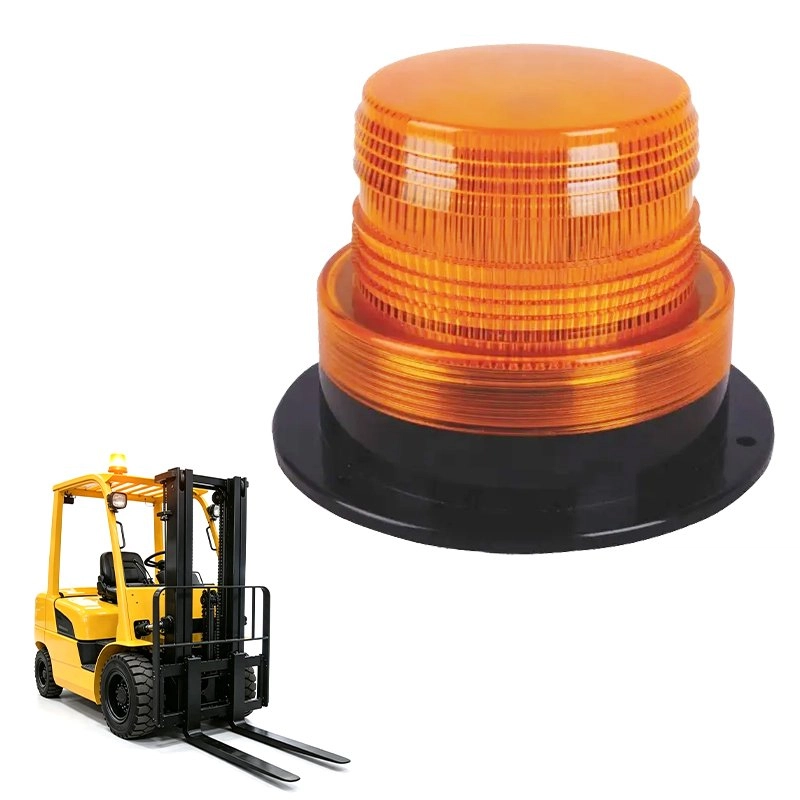
The classic rotating or flashing dome light mounted on the overhead guard. Amber is the colour because it is the international signal for caution and because it stays visible in dust, fog and bright ambient light. Beacons announce that a vehicle is operating. They are the oldest sub-type, the cheapest to install and the most widely recognized by pedestrians — but they carry no information about where the vehicle is going or how much space it will sweep.
2. Strobe lights
A high-intensity short-pulse flash, usually xenon or LED. Strobes are brighter than beacons at distance and cut through sunlight, but the pulse pattern can be visually fatiguing over a full shift and, in the wrong environment, can trigger photosensitive reactions. Strobes belong on yard trucks, outdoor aprons and high-speed traffic zones, not on indoor aisle work.
3. Blue spot lights
A focused LED that projects a saturated blue dot on the floor several metres ahead of or behind the truck. Blue is the colour because it stands out against the yellow-and-orange palette of a typical warehouse, and because the dot gives a pedestrian a distance reference rather than just a warning. Blue spots address the aisle-end and doorway crossing scenario.
4. Red zone markers
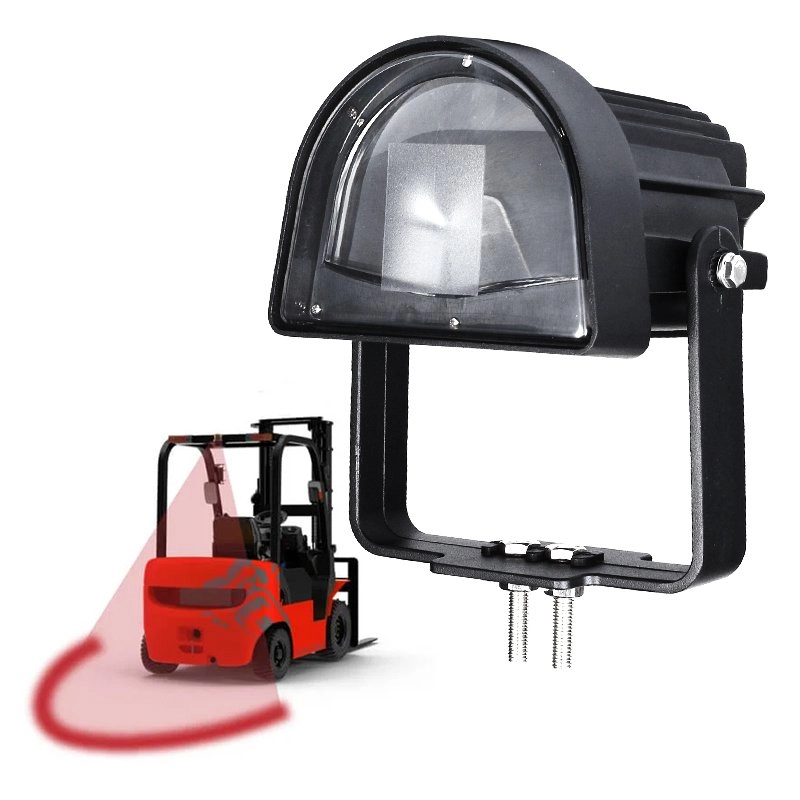
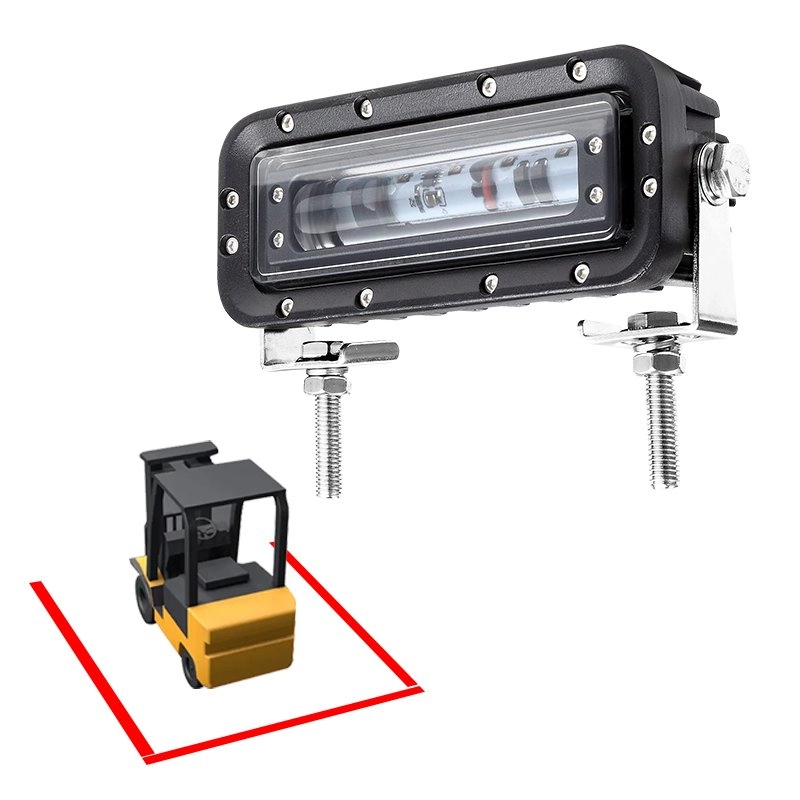
An LED projector that paints a red boundary on the floor around the moving truck, showing the sweep radius of the mast and the counterweight. Zone markers answer the question a beacon cannot: how much floor is about to be dangerous. They are the standard retrofit for narrow-aisle racking and high-mast trucks.
5. Laser line projectors
A class 1 or class 2 laser that draws a crisp, high-contrast line on the floor. Laser lines stay visible at distance and under bright ambient light where LED spots wash out, which makes them the choice for brightly lit halls, outdoor yards and any environment with strong overhead lighting. They fall under IEC 60825 for laser safety and require the classification label on the housing.
Amber Beacons vs Zone Markers: Head-to-Head
These two sub-types get confused more than any other pair, and the confusion is understandable — both are floor-visible, both are amber-or-red, both mount on the truck. But they solve different problems. The table below separates them on the eight dimensions that actually decide which one belongs in your specification.
| Dimension | Amber Beacon | Zone Marker (Red Zone) |
|---|---|---|
| Primary job | Announce vehicle presence | Show sweep envelope geometry |
| Visibility range | 50 to 150 metres (line of sight) | 2 to 5 metres (floor projection) |
| Ambient light tolerance | Excellent in daylight; good indoors | Good indoors; washes out in direct sun |
| Directional information | None — omni-directional flash | Full — shows the exact floor area at risk |
| Pedestrian cue | Look up, locate the truck, judge distance | Look down, see the boundary, step back |
| Mounting location | Overhead guard, top of mast | Low on the chassis or mast base, aimed at the floor |
| Typical unit cost (USD) | 50 to 200 | 150 to 500 |
| Governing standard | ECE R65 / SAE J845 (road use); م, بنفايات | EN 62471 photobiological; م, بنفايات, IP67 or IP68 |
When amber beacons are the right call
Choose an amber beacon when the hazard is presence rather than geometry. Outdoor yards, mixed vehicle traffic (trucks, cars, forklifts sharing the same apron), site entrances, and any environment where a pedestrian needs to spot the vehicle from 50 metres or more. Beacons are also the right default when the fleet is heterogeneous — they work on any voltage, any mast height, any duty cycle, and they satisfy the visual-warning requirement in most general-industry safety audits.
When zone markers are the right call
Choose a zone marker when the hazard is the sweep envelope. Narrow-aisle racking, high-mast reach trucks, order pickers working alongside pedestrian pickers, and any site where the accident pattern is “pedestrian too close to the truck” rather than “pedestrian did not see the truck.” Zone markers are also what a customer’s ESG auditor will look for on a modern fulfilment operation, because they demonstrate a specific engineering control rather than a generic warning.
When to layer both
Most three-shift distribution centres end up with both. A beacon on the overhead guard for long-range presence, a zone marker on the chassis for short-range geometry, and — where the accident history justifies it — a blue spot at the front for aisle-end warning and an AI detection system for the blind-spot cases. Layering is not redundancy; each sub-type closes a different gap in the accident chain.
Technical Specifications That Actually Matter
Every supplier quotes lumens. Very few hand over the full specification set that predicts how the fixture will behave in year two on a truck that runs three shifts. Ask for all seven columns below in writing before you shortlist.
| Specification | Amber Beacon | Zone Marker | Blue Spot | Laser Line |
|---|---|---|---|---|
| Ingress protection | IP65 minimum | IP67 indoor, IP68 washdown | IP67 | IP65 to IP67 |
| Voltage compatibility | 12/24/48/80 V | 12/24/48/80 V | 12/24/48/80 V | 12/24/48 V |
| Vibration resistance | Mast-transmitted shock tested | Chassis-mounted, higher shock load | Chassis or mast base | Optical alignment critical |
| LED chip provenance | Named supplier (OSRAM, Cree, Lumileds) | Named supplier | Named supplier | Laser diode class documented |
| Operating temperature | -30 to +50 درجة مئوية | -30 to +50 درجة مئوية | -30 to +50 درجة مئوية | -20 to +40 درجة مئوية (laser diode limits) |
| Lifetime (L80) | 30,000 to 50,000 ساعات | 30,000 to 50,000 ساعات | 30,000 to 50,000 ساعات | 20,000 to 30,000 ساعات |
| Certification pack | م, بنفايات, ECE R65 or SAE J845, E-mark for road use | م, بنفايات, EN 62471, IP test report | م, بنفايات, EN 62471, IP test report | م, بنفايات, اللجنة الانتخابية المستقلة 60825 class label |
Certification and the paper trail
A certification mark printed on a housing proves nothing on its own. What matters is the test report behind it, and whether the report covers the exact model you are buying rather than a similar-looking sibling. Every serious specification asks for the following at quotation stage.
- CE and ROHS declarations for the EU and UK markets, including UKCA where applicable.
- ECE R65 or SAE J845 for amber beacons used on vehicles that touch public roads; E-mark (E9) for the European marking.
- DOT compliance for any fixture mounted on a vehicle operating in the United States.
- EN 62471 photobiological safety assessment for LED modules within arm’s reach of operators.
- اللجنة الانتخابية المستقلة 60825 classification for any laser-based projector, with the class label physically on the housing.
- IP test report from an accredited lab, not a self-declaration.
- ايزو 9001 covering the manufacturing site, not the trading intermediary.
XRLL holds the full stack — CE, بنفايات, E-mark (E9), نقطة, EN 62471, اللجنة الانتخابية المستقلة 60825, ايزو 9001 — and can supply the underlying test reports with any quotation. Specific per-model certification files are available on request; ask the sales team for the exact SKU you are specifying.
Common Specification Mistakes
Four errors show up in almost every retrofit project that underperforms.
Mistake 1 — buying beacons for a narrow-aisle problem. A beacon tells the pedestrian a truck is coming; it does not tell them where the truck will be. In a narrow aisle, the pedestrian needs the geometry, not the announcement. Zone markers solve that; beacons do not.
Mistake 2 — mixing voltage families on one fleet. A 48 V reach truck and an 80 V counterbalance truck need different drivers. Standardize on a supplier that offers the full voltage range on the same product family, or accept that you will carry two spare-parts inventories.
Mistake 3 — skipping the IP rating because the warehouse is indoors. Indoor does not mean dry. Cold storage condenses. Fresh food zones get washed down. Dust from cardboard and shrink wrap accumulates inside any housing that is not sealed. IP67 is the practical floor for a forklift warning light; IP68 for cold or washdown.
Mistake 4 — treating the laser line as a premium beacon. A laser line is a different product with a different regulatory footprint. It needs the IEC 60825 class label, it needs operator training on never staring into the beam, and it needs a documented risk assessment before installation. Buying a laser line because “it is brighter” without the accompanying compliance work creates a new hazard instead of solving the old one.
Supplier Evaluation: Manufacturer or Trader
Most suppliers on a sourcing platform will tell they are a factory. Very few can prove it in a way that survives an audit. Three checks settle the question quickly.
Ask for the manufacturing site, not the sales office. A genuine manufacturer will name the city, the plant size, the number of production lines and the daily output. XRLL has manufactured in Foshan, Guangdong since 2011, in a 17,000 m² plant with 17 آلات, four assembly lines and daily output above 10,000 units. That kind of specific answer is harder to invent than a stock photo of a workshop.
Ask for the quality control sequence. Nine inspection stages is what XRLL runs per unit: incoming LED chip verification against OSRAM and Cree references, PCB and driver inspection, soldering and assembly checks, IP68 sealing tests, photometric and beam-pattern verification on an integrating sphere, high and low temperature ageing, vibration and shock tests, voltage and electrical safety tests, and a pre-shipment final check. A trader who cannot describe the QC sequence is buying from someone who can.
Ask for the patent portfolio and customization capability. More than 30 utility-model and design patents concentrated in laser projection, AI detection and matrix display technology is what an engineering-driven factory looks like on paper. OEM and ODM customization covering logo, نمط الشعاع, housing mold and projection pattern is what lets you standardize a heterogeneous fleet on one part number instead of three.
Putting the Comparison into a Specification
Follow this five-step sequence and the sub-type decision writes itself.
- Map the accident pattern. Pull the near-miss and recordable log for the last 24 months. Classify each event: pedestrian did not see truck (beacon gap), pedestrian misjudged sweep envelope (zone marker gap), pedestrian stepped into aisle at crossing point (blue spot gap), pedestrian in blind spot or not looking (AI detection gap).
- Match sub-type to gap. The dominant gap in your log decides the primary sub-type. Most warehouses find a mix — beacon for outdoor and yard, zone marker for narrow-aisle indoor, blue spot for aisle-end crossings.
- Specify the technical envelope. Voltage family, IP rating, vibration testing, operating temperature, LED chip provenance, certification pack. Write it down; do not accept a supplier’s generic data sheet.
- Pilot on three to five trucks. Run for 60 to 90 days in the highest-risk aisle. Log detection events, operator feedback, hardware issues. Tune the specification before scaling.
- Scale and document. Roll out across the fleet during planned maintenance windows. Record per-truck installation details. Feed the near-miss log into the quarterly safety review.
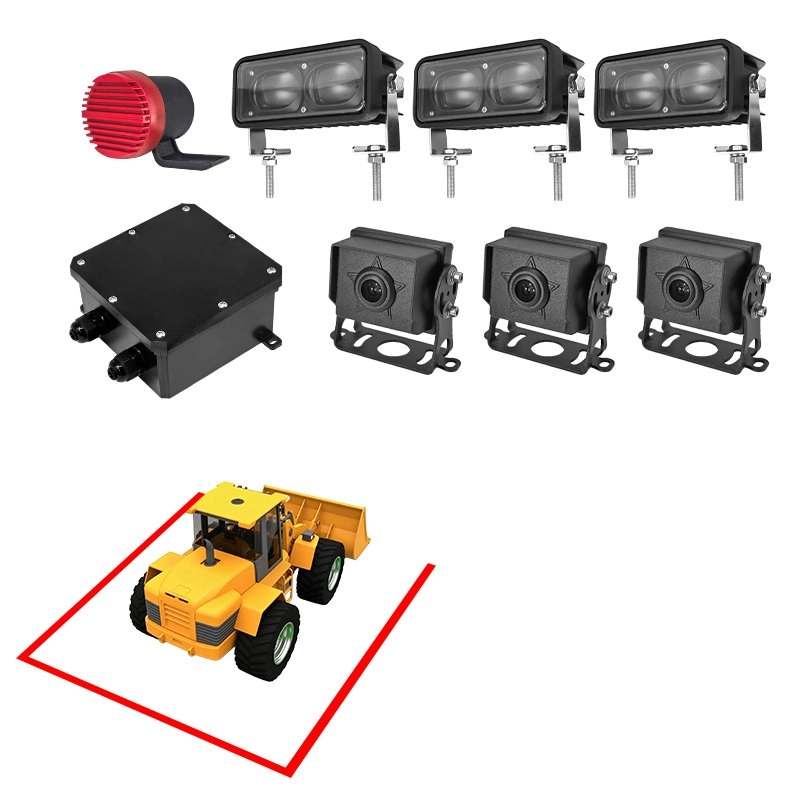
The XRLL LED forklift light range covers all five sub-families — amber beacons, strobe lights, blue spots, red zone markers and laser line projectors — plus the XRL1341 AI pedestrian detection system, on a single certification stack and a single voltage-agnostic product platform.
Specifying a Forklift Warning Light Retrofit?
Send your fleet composition, aisle widths, ambient conditions and accident log to XRLL. The sales team will respond within 24 hours with a sub-type recommendation, per-truck specification, certification files and evaluation samples. Every unit ships from the company’s own Foshan plant — 17,000 منشأة م², 17 آلات, four assembly lines, daily output above 10,000 units — with CE, بنفايات, E-mark, نقطة, EN 62471, اللجنة الانتخابية المستقلة 60825 and ISO 9001 documentation. OEM or ODM customization covers logo, نمط الشعاع, housing mold and projection pattern.
بريد إلكتروني: service02@xrlledlight.com · Phone / واتساب: +86-15818025687
Frequently Asked Questions
What is the difference between an amber beacon and a zone marker on a forklift?
An amber beacon signals vehicle presence from 50 to 150 metres and is mounted on the overhead guard. A zone marker projects a red boundary on the floor showing the sweep envelope of the mast and counterweight, and is mounted low on the chassis. Beacons tell a pedestrian a truck is coming; zone markers tell a pedestrian how much floor is about to be dangerous. Most modern retrofits pair both because they close different gaps in the accident chain.
Which forklift warning light sub-type is best for narrow-aisle racking?
Zone markers. In a narrow aisle the hazard is the sweep envelope, not the vehicle’s presence — the pedestrian already knows the truck is there. A red zone projection shows exactly how much floor the mast and counterweight will occupy, which is the information a picker needs before stepping into the aisle. Layer a blue spot at the aisle ends for crossing-point warning.
Do amber beacons need ECE R65 certification?
Only if the vehicle operates on public roads. Pure indoor warehouse forklifts do not fall under ECE R65, but they do fall under CE, ROHS and the general machinery directive. Any forklift that crosses a public road, a shared yard with road traffic, or a customer site with road-vehicle interaction needs an E-mark (E9) beacon that meets ECE R65 class 1 or class 2. Ask the supplier for the E-mark certificate covering the exact model, not a family certificate.
Can I mix blue spots and zone markers on the same truck?
نعم, and most high-density operations do. A blue spot at the front projects a dot several metres ahead for aisle-end warning; a zone marker on each side paints the sweep envelope. They address different failure modes and share the same voltage and mounting infrastructure. Confirm the supplier offers both on the same product family so you can standardize wiring harnesses and spare parts.
What IP rating should a forklift warning light have?
IP67 is the practical floor for indoor warehouse use. Move to IP68 for cold storage where condensation forms on every surface, for fresh-food zones with high-pressure washdown, or for outdoor yard trucks. IP65 is only acceptable for an amber beacon mounted under the overhead guard where it is fully protected from water ingress — anything lower will fail at the solder joints long before the LEDs dim.
How do I verify a supplier is a real manufacturer and not a trader?
Ask three specific questions. Where is the plant, how large is it, and how many units does it produce per day? What is the quality control sequence — how many inspection stages, and can you show the test reports? What is your patent portfolio and who supplies your LED chips? A real manufacturer answers with a plant address, machine count, daily output figure, named chip suppliers such as OSRAM or Cree, and a list of utility-model or design patents. A trader deflects or answers in generalities.


